
Division word problems
Read the story, decide what is being shared or grouped, draw it, divide, then check what the remainder means.
The main kinds of division word problem
- Sharing: “24 stickers are shared among 4 friends. How many each?” 24 ÷ 4 = 6.
- Grouping: “24 stickers go on sheets of 4. How many sheets?” 24 ÷ 4 = 6.
- Rates: “A car goes 240 km in 4 hours. How far each hour?” 240 ÷ 4 = 60 km.
- Comparing: “A tree is 36 m tall, 4 times as tall as a house. How tall is the house?” 36 ÷ 4 = 9 m.
- Remainders: “26 children, 4 per table. How many tables?” 26 ÷ 4 = 6 r 2, so 7 tables.
See it: pictures to draw with your child
Copy these onto paper or a whiteboard. A quick sketch makes the idea concrete before any written method.
A routine for every problem
- Read it twice. Retell the story in your own words.
- Find the total and the groups. Which number is being split up? Is the other number the number of groups, or the size of each?
- Draw it. A bar model or a few circles is enough.
- Write the division and work it out.
- Check by multiplying, and decide what any remainder means.
- Answer in a sentence with units.
Using a bar model
A bar model shows the total as one long bar, split into equal parts. For “72 cupcakes are packed equally into 6 boxes”, draw a bar labelled 72 and split it into 6 equal parts. Each part is 72 ÷ 6 = 12.
The same picture solves the grouping version: “72 cupcakes in boxes of 12. How many boxes?” Now each part is labelled 12, and you count the parts. Bar models also help with remainder problems.
Multi-step problems
From grade 3, some problems need two steps, often a multiplication or subtraction with the division.
“A class of 28 has 4 boxes of 50 crayons. They share all the crayons equally. How many does each child get, and how many are left?” Step 1: 4 × 50 = 200 crayons. Step 2: 200 ÷ 28 = 7 r 4. Each child gets 7, and 4 are left over.
Ask “what do I need to find first?” and write each step on its own line.
Clue words, and why to be careful
Words like each, per, share, equally, split, groups of and every often mean divide. But clue words can mislead: “each box has 6 eggs; there are 5 boxes” needs multiplication.
A better question is: do I know the total? If you know the total and need the parts, divide. If you know the parts and need the total, multiply. See multiplication word problems for the other side.
Quiz: division stories
Read carefully. Some stories have remainders to think about.
Where this fits: division step by step
- What is division
- Division as repeated subtraction
- Division on a number line
- Dividend, divisor and quotient
- Dividing by 2, 5 and 10
- Division facts
- Checking division with multiplication
- Division with remainders
- Interpreting remainders
- 2-digit by 1-digit division
- 3-digit by 1-digit division
- Partial quotients
- Short division
- Long division
- Zeros in the quotient
- Estimating quotients
- Long division with 2-digit divisors
- Division word problems (this page)
What to say to your child
A short script for teaching it the first time. Pause after each line and let your child do the next step.
- “Listen: 35 marbles are shared by 5 children. What is being shared?” (Marbles.)
- “How many groups?” (5 children.) “So it’s 35 ÷ 5.” (7!)
- “Now: 35 marbles go in bags of 5. How many bags?” (Also 35 ÷ 5: 7 bags.)
- “And if there were 37 marbles?” (7 bags and 2 left over.)
- “Say the answer as a sentence.” (Each child gets 7 marbles.)
More worked examples
Example 1: sharing
48 pencils are shared among 8 tables. 48 ÷ 8 = 6. Each table gets 6 pencils.
Example 2: grouping
A baker has 90 rolls and packs 6 in a bag. 90 ÷ 6 = 15. She fills 15 bags.
Example 3: a rate
A printer prints 960 pages in 8 minutes. 960 ÷ 8 = 120 pages a minute.
Example 4: two steps
3 friends earn $45, $30 and $21 and share the total equally. 45 + 30 + 21 = 96, and 96 ÷ 3 = $32 each.
Practice questions (answers below)
Ask these out loud or write them down. Check each answer, and ask “how did you get that?” for one or two.
- 40 apples shared by 5 children. How many each?
- 63 chairs in rows of 9. How many rows?
- A book has 84 pages. Read 7 a day. How many days?
- 150 km in 3 hours. How far each hour?
- 38 children, 6 per team. How many full teams?
- 38 children, 6 per car. How many cars?
- A shop sells 256 eggs in boxes of 12. How many full boxes, and how many left?
- 5 friends share 3 bags of 40 sweets. How many each?
- Stretch: a ribbon is 4 m long. How many 30 cm pieces can be cut?
Show the answers
- 8
- 7
- 12
- 50 km
- 6
- 7
- 21 boxes, 4 left
- 24
- 13 pieces (10 cm left)
Common mistakes
How to teach it at home
Real shares
Use real situations: splitting snacks, bills, pages or minutes.
Story swap
Your child writes a division story for you to solve.
Draw it
Sketch a quick bar or circles for every story problem.
By grade
- Grade 3 (3.OA.A.3): division word problems within 100 with equal groups and arrays.
- Grade 4 (4.OA.A.3): multi-step problems, interpreting remainders.
- Grade 5 (5.NBT.B.6): word problems with 2-digit divisors and bigger numbers.
- See also: interpreting remainders and estimating quotients.
More for each grade: Grade 3 math and the CBSE class 3 maths guide; Grade 4 math and the CBSE class 4 maths guide; Grade 5 math and the CBSE class 5 maths guide.
Worksheets and practice
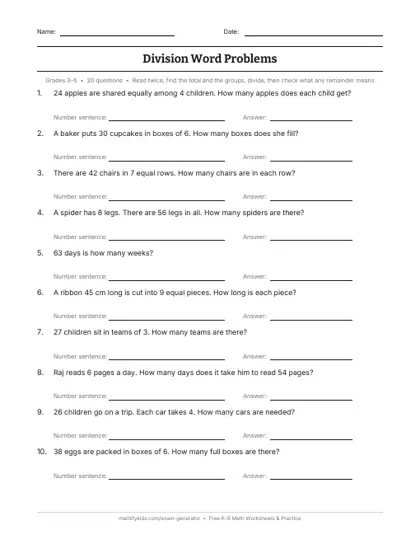
Division word problems worksheet: printable PDF with an answer key. · Make a fresh test
Division practice · division speed test · division chart · division for kids
Last reviewed
Questions parents ask
How do you solve division word problems?
Read twice, find the total and the groups, draw a bar model, divide, check by multiplying, and answer in a sentence.
What words mean division in word problems?
Share, each, per, equally, split, groups of and every often mean divide. Always check by asking whether you know the total.
How do you know whether to multiply or divide?
If you know the total and want the parts, divide. If you know the parts and want the total, multiply.
What do you do with a remainder in a word problem?
Decide from the story: round up, drop it, give it as the answer, or turn it into a fraction.
What grade learns division word problems?
Grade 3 starts with problems within 100 (3.OA.A.3), grade 4 adds remainders and multi-step problems.