
Division on a number line
Start at the number you are dividing and jump back to 0 in equal jumps. The number of jumps is the answer.
How division on a number line works
For 24 ÷ 6, start at 24. Jump back 6 to 18, then 12, then 6, then 0. That is 4 jumps, so 24 ÷ 6 = 4.
Each jump is one group of 6. The number line is a picture of repeated subtraction, and it shows the equal groups as equal-sized hops.
You can also jump forwards from 0 to 24 in 6s and count the jumps. Forwards is the same as counting in 6s, which links straight to the 6 times table.
See it: pictures to draw with your child
Copy these onto paper or a whiteboard. A quick sketch makes the idea concrete before any written method.
Step by step
- Draw a line and mark 0 and the dividend. Add marks in steps of the divisor.
- Start at the dividend and draw jumps back, each the size of the divisor.
- Number the jumps as you go: 1, 2, 3 …
- When you land on 0, the last jump number is the quotient.
- If you can’t make another full jump, the gap to 0 is the remainder.
Remainders on a number line
Try 14 ÷ 4. Jump back from 14 in 4s: 10, 6, 2. One more jump of 4 would go below 0. So there are 3 full jumps and a gap of 2: 14 ÷ 4 = 3 r 2.
The picture makes the rule clear: the remainder is the gap left at the end, and it is always shorter than one jump. If the gap is as long as a jump, you missed a jump.
Jumping forwards: the times table link
Many children prefer to start at 0. For 35 ÷ 5, jump forwards in 5s: 5, 10, 15, 20, 25, 30, 35. Seven jumps reach 35, so 35 ÷ 5 = 7.
This is the same as saying the 5 times table until you reach 35. Each landing spot is a multiple of 5. Children who know the table can jump straight to the answer: 7 × 5 = 35.
Use whichever direction your child finds easier. Both show that division asks how many equal jumps fit.
When a number line helps most
A number line is best for small dividends and small divisors in grade 3, and for children who like to see division as movement. It is also a good way to explain remainders.
It gets crowded for big numbers. For 96 ÷ 4, use bigger jumps of 40 (10 fours), then 16 (4 fours), which leads to partial quotients. For facts, move on to fact families so answers become quick to recall.
Quiz: jumps on a number line
Count the jumps back to 0.
Where this fits: division step by step
- What is division
- Division as repeated subtraction
- Division on a number line (this page)
- Dividend, divisor and quotient
- Dividing by 2, 5 and 10
- Division facts
- Checking division with multiplication
- Division with remainders
- Interpreting remainders
- 2-digit by 1-digit division
- 3-digit by 1-digit division
- Partial quotients
- Short division
- Long division
- Zeros in the quotient
- Estimating quotients
- Long division with 2-digit divisors
- Division word problems
What to say to your child
A short script for teaching it the first time. Pause after each line and let your child do the next step.
- “Stand at 12 on our number line. We’ll take jumps of 3 back to 0.”
- “Jump! Where are you?” (9.) “Keep jumping and count.”
- “9, 6, 3, 0. How many jumps?” (4.) “So 12 ÷ 3 = 4.”
- “What if we start at 13?” (4 jumps and 1 step left over.)
- “That leftover step is the remainder.”
More worked examples
Example 1: 16 ÷ 4
From 16: 12, 8, 4, 0. Four jumps, so 16 ÷ 4 = 4.
Example 2: 27 ÷ 9
From 27: 18, 9, 0. Three jumps, so 27 ÷ 9 = 3.
Example 3: with a remainder: 11 ÷ 3
From 11: 8, 5, 2. Three jumps, then 2 is too short for another jump. 11 ÷ 3 = 3 r 2.
Example 4: forwards: 42 ÷ 7
From 0 in 7s: 7, 14, 21, 28, 35, 42. Six jumps, so 42 ÷ 7 = 6.
Practice questions (answers below)
Ask these out loud or write them down. Check each answer, and ask “how did you get that?” for one or two.
- 10 ÷ 2
- 18 ÷ 3
- 20 ÷ 5
- 32 ÷ 8
- 21 ÷ 7
- 40 ÷ 10
- 13 ÷ 4
- 17 ÷ 3
- How many jumps of 6 from 36 to 0?
- Stretch: 100 ÷ 20 on a number line
Show the answers
- 5
- 6
- 4
- 4
- 3
- 4
- 3 r 1
- 5 r 2
- 6
- 5 jumps
Common mistakes
How to teach it at home
Hopscotch jumps
Chalk a number line outside and jump back in equal steps.
Ruler jumps
Use a ruler as a number line and hop a finger in 2s, 5s or 10s.
Stairs
Count stairs in 2s or 3s: how many big steps to the top?
By grade
- Grade 3 (3.OA.A.2): division as how many equal groups, shown as equal jumps.
- Grade 3 (3.OA.C.7): fluency with division within 100.
- Grade 4: number lines support remainders and bigger dividends.
- Next: dividend, divisor and quotient.
More for each grade: Grade 3 math and the CBSE class 3 maths guide.
Worksheets and practice
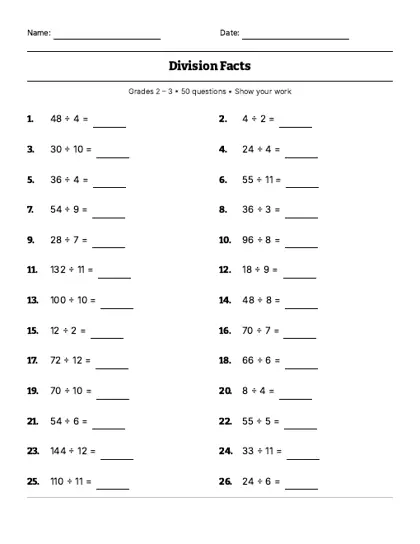
Division facts worksheet: printable PDF with an answer key. · Make a fresh test
Division practice · division speed test · division chart · division for kids
Last reviewed
Questions parents ask
How do you divide on a number line?
Start at the dividend and jump back to 0 in jumps the size of the divisor. The number of jumps is the quotient.
How do you show a remainder on a number line?
When the next jump would go past 0, stop. The gap between where you are and 0 is the remainder.
Can you divide on a number line going forwards?
Yes. Jump from 0 to the dividend in steps of the divisor and count the jumps. It is the same as counting in multiples.
Why use a number line for division?
It shows division as equal groups you can see, and it makes remainders easy to understand.
What grade uses number lines for division?
Grade 3 (class 3), when division is first taught.