
2-digit by 1-digit division
Share the tens first, then the ones. 84 ÷ 4: 80 ÷ 4 = 20 and 4 ÷ 4 = 1, so 21.
Share the tens, then the ones
A 2-digit number is made of tens and ones. To divide, share the tens first, then the ones, and add the answers.
69 ÷ 3: 6 tens shared by 3 is 2 tens (20). 9 ones shared by 3 is 3. So 69 ÷ 3 = 23. Check: 23 × 3 = 69.
This works neatly when each digit divides exactly. When it doesn’t, a ten has to be broken into ones, just like regrouping in subtraction.
See it: pictures to draw with your child
Copy these onto paper or a whiteboard. A quick sketch makes the idea concrete before any written method.
When the tens don’t share equally
Try 52 ÷ 4. Share 5 tens among 4: each gets 1 ten, with 1 ten left over. Break that ten into 10 ones, and add the 2 ones: 12 ones. Share 12 ones among 4: 3 each.
So each group has 1 ten and 3 ones: 52 ÷ 4 = 13. Check: 13 × 4 = 52.
Base-ten blocks make this real. Your child can actually swap a ten rod for 10 unit cubes, then keep sharing.
The splitting method
A quicker mental way is to split the dividend into two parts that both divide easily. Look for a multiple of 10 times the divisor.
- 72 ÷ 3: split 72 into 60 + 12. 60 ÷ 3 = 20 and 12 ÷ 3 = 4. Answer: 24.
- 91 ÷ 7: split into 70 + 21. 70 ÷ 7 = 10 and 21 ÷ 7 = 3. Answer: 13.
- 96 ÷ 8: split into 80 + 16. 80 ÷ 8 = 10 and 16 ÷ 8 = 2. Answer: 12.
This is the start of partial quotients, and it is how many adults divide in their heads.
Try any division step by step
Type a 2-digit number and a divisor, then press Next step.
2-digit division with remainders
Many 2-digit divisions don’t come out exactly. 47 ÷ 3: 4 tens shared by 3 is 1 ten each, with 1 ten left. 1 ten and 7 ones make 17. 17 ÷ 3 = 5 r 2. So 47 ÷ 3 = 15 r 2.
Check: 15 × 3 = 45, and 45 + 2 = 47. The remainder 2 is smaller than 3, so it is right. More in division with remainders.
Writing it down
In grade 4, children write the same steps with the long division bracket: divide the tens, multiply, subtract, bring down the ones, divide again. The tool above shows each step.
The bracket method and the splitting method give the same answer. Splitting is better for mental maths; the bracket is better for bigger numbers, as in 3-digit by 1-digit division.
Quiz: 2-digit by 1-digit
Share the tens, then the ones. Some have remainders.
Where this fits: division step by step
- What is division
- Division as repeated subtraction
- Division on a number line
- Dividend, divisor and quotient
- Dividing by 2, 5 and 10
- Division facts
- Checking division with multiplication
- Division with remainders
- Interpreting remainders
- 2-digit by 1-digit division (this page)
- 3-digit by 1-digit division
- Partial quotients
- Short division
- Long division
- Zeros in the quotient
- Estimating quotients
- Long division with 2-digit divisors
- Division word problems
What to say to your child
A short script for teaching it the first time. Pause after each line and let your child do the next step.
- “Here are 48 as 4 ten rods and 8 cubes. Share them between 2 plates.”
- “Tens first: how many rods each?” (2.) “Now the cubes.” (4 each.)
- “So each plate has 2 tens and 4 ones: 24. 48 ÷ 2 = 24.”
- “Now 52 ÷ 4. Share the 5 rods.” (1 each, 1 left.) “Swap the spare rod for 10 cubes.”
- “12 cubes into 4 plates?” (3 each.) “So 13 on each plate!”
More worked examples
Example 1: no regrouping: 86 ÷ 2
8 tens ÷ 2 = 4 tens, 6 ones ÷ 2 = 3. 86 ÷ 2 = 43.
Example 2: breaking a ten: 75 ÷ 5
7 tens ÷ 5 = 1 ten, 2 tens left = 20. 20 + 5 = 25 ones, 25 ÷ 5 = 5. Answer: 15.
Example 3: splitting: 84 ÷ 6
84 = 60 + 24. 60 ÷ 6 = 10, 24 ÷ 6 = 4. Answer: 14.
Example 4: a remainder: 58 ÷ 4
40 ÷ 4 = 10, 18 ÷ 4 = 4 r 2. Answer: 14 r 2. Check: 14 × 4 + 2 = 58.
Practice questions (answers below)
Ask these out loud or write them down. Check each answer, and ask “how did you get that?” for one or two.
- 46 ÷ 2
- 63 ÷ 3
- 84 ÷ 4
- 54 ÷ 3
- 72 ÷ 6
- 95 ÷ 5
- 68 ÷ 4
- 57 ÷ 4
- A teacher shares 96 pencils among 8 tables. How many on each table?
- Stretch: 99 ÷ 7
Show the answers
- 23
- 21
- 21
- 18
- 12
- 19
- 17
- 14 r 1
- 12
- 14 r 1
Common mistakes
How to teach it at home
Money sharing
Share 10-rupee notes or dimes and coins among the family, changing a note for coins when needed.
Bundles
Bundle sticks in tens and share them, undoing a bundle when needed.
Split it
Ask “what easy part can you take first?” for problems like 84 ÷ 7.
By grade
- Grade 3 (3.OA.C.7, 3.NBT.A.3): divide within 100 and multiply multiples of 10.
- Grade 4 (4.NBT.B.6): divide up to 4-digit numbers by 1-digit numbers, with remainders, using place value.
- Before: division facts within 100.
- Next: 3-digit by 1-digit division.
More for each grade: Grade 3 math and the CBSE class 3 maths guide; Grade 4 math and the CBSE class 4 maths guide.
Worksheets and practice
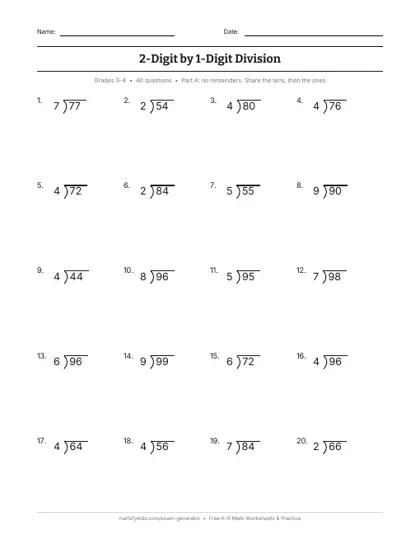
2-digit by 1-digit division worksheet: printable PDF with an answer key. · Make a fresh test
Division practice · division speed test · division chart · division for kids
Last reviewed
Questions parents ask
How do you divide a 2-digit number by a 1-digit number?
Share the tens first, then the ones. If a ten is left over, change it into 10 ones and add it to the ones before sharing them.
What is 2-digit by 1-digit division with remainders?
When the ones don’t share equally, the leftover is the remainder. 47 ÷ 3 = 15 r 2.
What is the easiest way to divide 2-digit numbers in your head?
Split the number into an easy multiple and the rest. 84 ÷ 6 = 60 ÷ 6 + 24 ÷ 6 = 10 + 4 = 14.
How do you check 2-digit division?
Multiply the answer by the divisor and add any remainder. 14 × 6 = 84.
What grade learns 2-digit by 1-digit division?
Grade 4 (4.NBT.B.6), with simple cases in grade 3 using facts and multiples of 10.