
Division facts within 100
All the division facts to 100 ÷ 10, the order to learn them, the best strategy for each and practice. Parent help is below.
🧒 Kids: divide within 100!
Pick a trick for each fact. Then tap Practice!
▶ Practice ⏱️ 1-minute challenge
Facts to know by heart
- 56 ÷ 8 = 7
- 63 ÷ 7 = 9
- 54 ÷ 6 = 9
- 72 ÷ 9 = 8
- 48 ÷ 6 = 8
- 81 ÷ 9 = 9
💡 Trick: ÷ 2? Halve! ÷ 10? Drop the 0! Others? Think of the times table!
More facts: ÷ 2, 5 and 10 · ÷ 3 and 4 · ÷ 6, 7, 8 and 9 · ÷ 0 and 1 · Fact families · Within 100
This part is for grown-ups: the trick that makes these facts easy, pictures to draw, what to say, common mistakes, questions with answers and a free worksheet.
The trick: choose the best strategy
Children who divide fluently within 100 do not use one method for everything. They look at the divisor and choose: halve for ÷ 2, halve twice for ÷ 4 and three times for ÷ 8, drop the 0 for ÷ 10, double and divide by 10 for ÷ 5, and think of the times table for the rest. With practice, the strategy becomes so quick that it feels like remembering.
- 18 ÷ 2: halve: 9
- 40 ÷ 10: drop the 0: 4
- 32 ÷ 4: halve twice: 16, 8
- 45 ÷ 5: double and ÷ 10: 90 ÷ 10 = 9
- 63 ÷ 7: think 7 × 9 = 63: 9
Patterns to spot
- Each division fact has a partner: 56 ÷ 8 = 7 and 56 ÷ 7 = 8.
- The division chart is the times table chart read backwards.
- Square numbers like 49, 64 and 81 divide by their own root: 64 ÷ 8 = 8.
- Bigger divisors give smaller answers: 36 ÷ 4 = 9, but 36 ÷ 9 = 4.
- If both numbers double, the answer stays the same: 12 ÷ 3 = 24 ÷ 6 = 4.
See it: pictures to draw with your child
Draw these on paper or a whiteboard. Seeing the counters makes the fact stick.
Facts you already know
There are 100 division facts from 1 ÷ 1 to 100 ÷ 10, but your child knows most of them already. Dividing by 1 and by 10, a number divided by itself, and halving for ÷ 2 cover almost 40 facts. Fact families halve the rest. That leaves about 15 facts to practice, such as 42 ÷ 6, 54 ÷ 9, 56 ÷ 7 and 72 ÷ 8, and each one has a strategy.
In real life: Division is everywhere at home: “48 pages in 6 days: how many pages a day?” “A pack of 36 pencils for 4 children: how many each?” Party planning, sharing pocket money and splitting bills all use these facts.
Worked examples
Example 1: 48 ÷ 6 by thinking multiplication
- Ask: 6 times what is 48?
- 6 × 8 = 48.
- So 48 ÷ 6 = 8.
Example 2: 64 ÷ 8 by halving
- 64 → 32 → 16 → 8.
- Three halvings, so 64 ÷ 8 = 8.
Example 3: a word problem
- “A coach has 72 seats in rows of 9.
- How many rows?”
- 72 ÷ 9: think 9 × 8 = 72.
- So 8 rows.
- Check: 8 × 9 = 72.
Common mistakes
What to say to your child
A short script for your first session. Pause after each line and let your child answer.
- “What is 36 ÷ 4? Which trick would you use?” (Halve twice!)
- “36 → 18 → 9. So 9.” “What about 36 ÷ 9?” (The partner: 4!)
- “How about 42 ÷ 6?” (6 × 7 = 42, so 7!)
- “And 70 ÷ 10?” (Drop the 0: 7!)
- “Choosing the right trick makes every fact quick.”
Questions to try (answers below)
Ask these out loud or write them down. The last one is a stretch.
- 24 ÷ 3
- 35 ÷ 7
- 40 ÷ 8
- 54 ÷ 9
- 42 ÷ 6
- 90 ÷ 10
- 81 ÷ 9
- A box holds 8 crayons. How many boxes for 64 crayons?
- Stretch: ? ÷ 7 = 8
Show the answers
- 8
- 5
- 5
- 6
- 7
- 9
- 9
- 8 boxes
- 56
Games to play at home
Dice division
Roll two dice, multiply, then ask both division facts.
Pocket money split
Share an amount like 60 rupees or 60 cents among 3, 4, 5 or 6 people.
Chart detective
Print the division chart and hide one answer with a coin; your child finds it.
A 5-day plan for division facts within 100
Ten minutes a day is enough. Short, regular practice helps facts stick far better than one long session.
- Day 1: Learn it with objects. Use the pictures above with real counters, fingers or toys.
- Day 2: Read the script together, then ask the first four questions.
- Day 3: Play one round in the practice tool at the top of the page, with no timer.
- Day 4: Play one of the games above for ten minutes.
- Day 5: Ask the rest of the questions, then try the 1-minute challenge and write down the score.
Next week, repeat the round in the practice tool and compare the fact map. When most facts are green, move on to the next page.
By grade
Grade 3 (3.OA.A.2 and 3.OA.B.6) learns division as sharing, grouping and unknown factors, and 3.OA.C.7 asks children to divide within 100 fluently by the end of the year. Grade 4 uses these facts in long division (4.NBT.B.6). In India, these facts are practiced in class 3 and 4 maths.
More for each grade: Grade 3 math and the CBSE class 3 maths guide; Grade 4 math and the CBSE class 4 maths guide.
What comes next
Division facts within 100 are the base for division with remainders and long division in grade 4. Test your speed with the division speed test, and keep the times tables sharp alongside.
Worksheet and more practice
Print a free worksheet with an answer key, or keep practicing online with the division practice trainer.
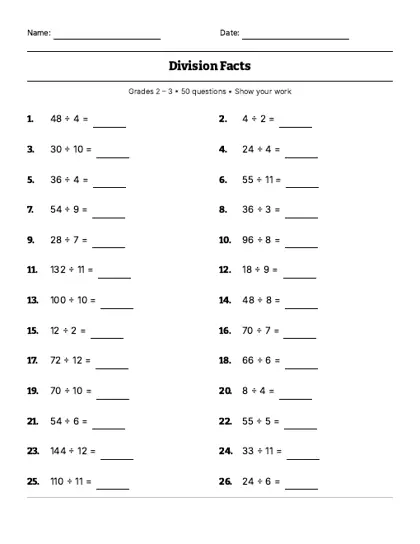 Division facts
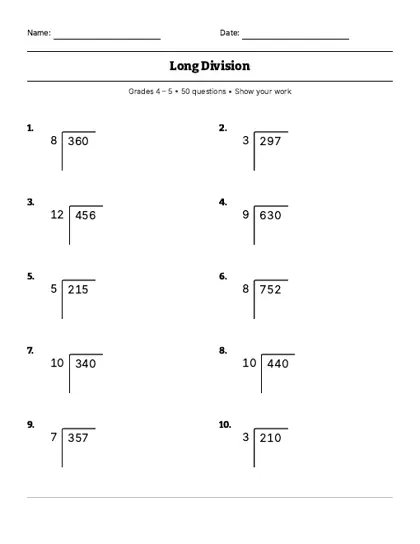 Division with remainders
More: division for kids · division facts lesson · division chart · times tables
Last reviewed
Questions parents ask
What are division facts within 100?
The division facts from 1 ÷ 1 to 100 ÷ 10, such as 56 ÷ 8 = 7. They come from the times tables to 10 × 10.
What is the fastest way to learn division facts?
Learn them through the times tables using fact families: 7 × 8 = 56 gives 56 ÷ 8 = 7 and 56 ÷ 7 = 8.
Which division facts are the hardest?
Facts from the 6, 7, 8 and 9 tables, like 42 ÷ 6, 56 ÷ 7, 63 ÷ 9 and 72 ÷ 8.
When should kids know division facts within 100?
By the end of grade 3. The Common Core asks children to divide within 100 fluently (3.OA.C.7).
How can my child practice division facts?
Use the practice tool on this page for five minutes a day, practice the matching times tables, and try the 1-minute speed test once a week.