
Decimals for kids
Decimals are how we write parts of a whole with place value: tenths, hundredths and thousandths. This page maps everything children learn about decimals from grade 4 to grade 6, explains the big idea with pictures, shows where kids get stuck, and links every lesson, worksheet and chart in the order to use them.
What kids learn about decimals, grade by grade
Grade 4: tenths and hundredths
Write fractions like 7/10 and 62/100 as 0.7 and 0.62, place them on a number line, and compare two decimals to hundredths (4.NF.C.6, 4.NF.C.7).
Grade 5: thousandths and all four operations
Read and write decimals to thousandths, compare and round them, and add, subtract, multiply and divide decimals to hundredths using place value (5.NBT.A.3, 5.NBT.A.4, 5.NBT.B.7).
Grade 6: fluency
Do all four operations with multi-digit decimals using the standard methods (6.NS.B.3), and switch between decimals, fractions and percents.
Where to start with decimals
Start with what the digits after the point mean, not with rules. A child who knows 0.65 is 6 tenths and 5 hundredths can compare, round and add decimals without memorizing anything new. If decimals are new, begin with place value and money.
The big idea behind decimals
Our number system goes up in tens to the left: ones, tens, hundreds. Decimals carry the same pattern to the right of the ones: each place is ten times smaller than the one before. The decimal point simply marks where the whole numbers end.
Which decimal is bigger?
Choose >, < or =. After each answer you’ll see both numbers as shaded grids.
Where kids get stuck with decimals
“Longer is bigger”
Children used to whole numbers think 0.65 is bigger than 0.7 because it has more digits. Fix: write both with the same number of places (0.70 and 0.65) and compare. See comparing decimals.
Lining up the digits instead of the points
When adding 3.5 + 1.25, children often line up the right-hand digits. Fix: line up the decimal points and fill gaps with zeros: 3.50 + 1.25. See adding and subtracting decimals.
0.5 or 0.05?
Mixing up tenths and hundredths, especially when converting fractions and percents. Fix: say the place value: five tenths, five hundredths. Money helps: 50¢ or 5¢?
Where does the point go when multiplying?
Fix: multiply as whole numbers, then count decimal places, and always estimate first. See multiplying decimals.
Decimals lessons, in order
- Comparing decimalsGrades 4–5 · which is bigger
- Rounding decimalsGrade 5 · nearest tenth and hundredth
- Adding and subtracting decimalsGrades 5–6 · line up the points
- Multiplying decimalsGrades 5–6 · count the places
- Multiplying by 10, 100, 1000Grades 3–5 · moving the point
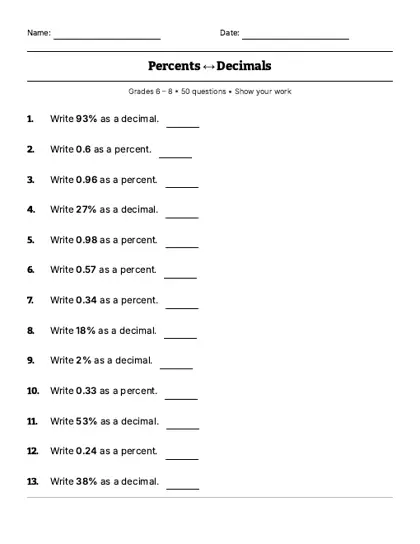
- Percents and decimalsGrade 6 · converting both ways
Decimals worksheets
Printable PDFs with answer keys, in roughly the order children meet them. Make a fresh decimals test any time.
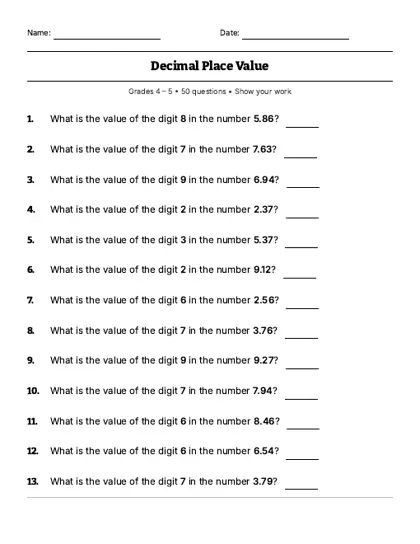 Decimal place valueGrade 5 · tenths to thousandths
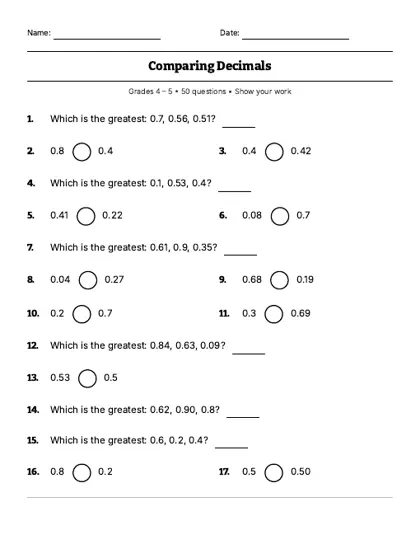 Comparing decimalsGrades 4–5
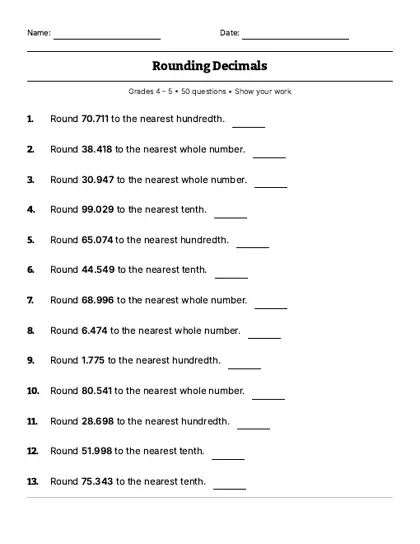 Rounding decimalsGrade 5
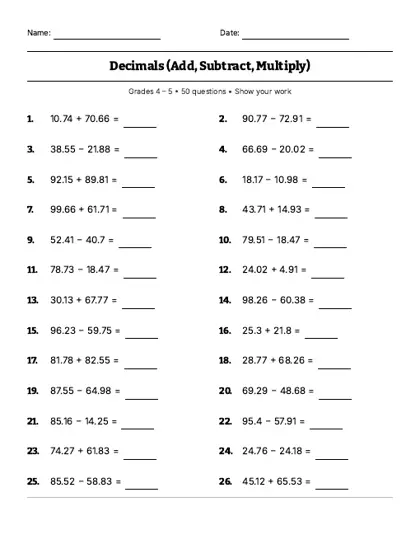 Adding and subtracting decimalsGrades 5–6
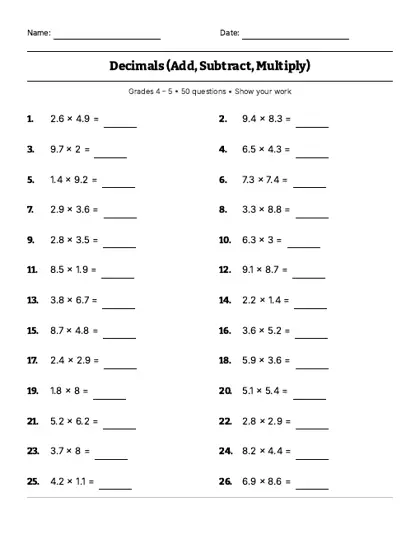 Multiplying decimalsGrades 5–6
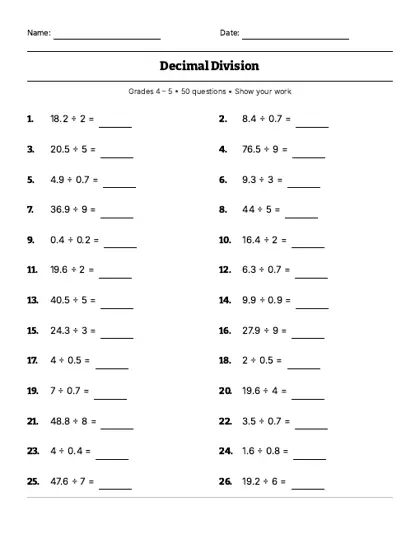 Dividing decimalsGrades 5–6
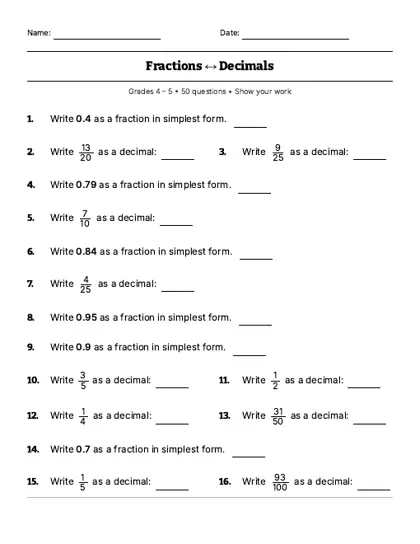 Fractions to decimalsGrades 4–5
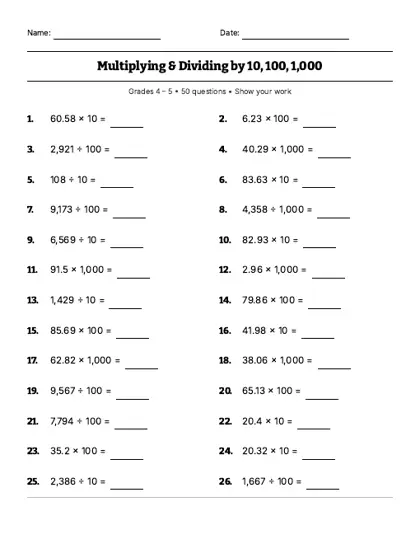 Multiply and divide by 10, 100, 1000Grades 3–5
 Percents and decimalsGrade 6
Decimals charts
- Decimals chart: place values, decimal and fraction equivalents.
- Place value chart: build numbers and see each digit’s value.
- Money chart and US coins chart: decimals children already use.
How to teach decimals at home
Use money every day
Dollars, dimes and pennies are ones, tenths and hundredths. Ask how to pay $2.35 with the fewest coins, or which costs more, $4.09 or $4.9.
Measure with a meter stick
A meter is 100 centimeters, so 1 cm is 0.01 m. Measure a book (0.28 m) and a table (0.75 m) and compare the decimals.
Put decimals on a number line
Draw a line from 0 to 1 split into ten parts. Ask your child to mark 0.3, 0.35 and 0.5. Seeing where 0.35 sits ends the “longer is bigger” idea.
Read sports times and scores
Race times like 9.58 seconds and batting averages are decimals with a story. Who was faster, and by how much?
Last reviewed
Questions parents ask
What is a decimal?
A decimal is a way of writing parts of a whole using place value. The digits after the decimal point are tenths, hundredths and thousandths, so 0.35 means 3 tenths and 5 hundredths, or 35 hundredths.
Which is bigger, 0.7 or 0.65?
0.7. Give both the same number of decimal places: 0.70 and 0.65. Seventy hundredths is more than sixty-five hundredths. A longer decimal is not automatically bigger.
What grade learns decimals?
Grade 4 introduces tenths and hundredths and links them to fractions (4.NF.C.6 and 4.NF.C.7). Grade 5 covers thousandths, rounding and all four operations to hundredths. Grade 6 makes all decimal operations fluent.
How do I explain decimals to my child?
Use money and a meter stick. A dime is a tenth of a dollar and a penny is a hundredth, so $0.35 is 3 dimes and 5 pennies. On a meter stick, each centimeter is 0.01 m.
Is 0.5 the same as 0.50?
Yes. Five tenths and fifty hundredths are the same amount. Zeros at the end of a decimal don’t change its value, which is why adding them helps when comparing.
How are decimals and fractions related?
Every decimal is a fraction with a denominator of 10, 100 or 1,000: 0.3 = 3/10 and 0.07 = 7/100. Going the other way, divide the top by the bottom: 3/4 = 3 ÷ 4 = 0.75.