
Multiplying decimals, step by step
To multiply decimals, multiply as if there were no decimal points, then count the decimal places in both numbers and put that many in the answer. 2.4 × 1.3: 24 × 13 = 312, two decimal places, so 3.12. This page shows why it works with pictures, worked examples for every tricky case, the mistakes children make, and a tool that shows the steps for any problem.
Multiplying decimals: the big idea
Decimals are tenths, hundredths and thousandths. When you multiply two of them, the pieces get smaller: a tenth of a tenth is a hundredth. That is why the answer has more decimal places than either number, and why counting the places tells you exactly where the point goes.
The picture below shows 0.6 × 0.4. Six tenths of the square are shaded one way and four tenths the other way. Where they overlap is the answer: 24 small squares out of 100, which is 0.24.
How to multiply decimals, step by step
- Estimate. Round each number to get a rough answer. 2.4 × 1.3 is about 2 × 1 = 2, or a bit more.
- Ignore the decimal points and multiply as whole numbers: 24 × 13 = 312. Line the numbers up on the right; the points do not need to line up.
- Count the decimal places in both numbers: one in 2.4, one in 1.3, so two altogether.
- Place the point that many places from the right of the answer: 3.12. Add zeros at the front if you run out of digits.
- Check against your estimate. 3.12 is close to 2 or 3, so it is sensible. 31.2 or 0.312 would not be.
Show the steps for any decimal multiplication
Type any two decimals, such as a homework problem, and see each step with the estimate and the check.
Worked examples: multiplying decimals
Example 1: 0.6 × 4 (Decimal times a whole number)
6 × 4 = 24. One decimal place in total, so 2.4. Check: 0.6 is a bit more than half, and half of 4 is 2, so 2.4 makes sense.
Example 2: 0.3 × 0.2 (A zero has to be added)
3 × 2 = 6. Two decimal places in total, but 6 has only one digit, so write a zero in front: 0.06. Writing 0.6 is the most common mistake.
Example 3: 2.4 × 1.3 (Decimal times decimal)
24 × 13 = 312. Two decimal places, so 3.12. Estimate: 2 × 1 = 2 and 3 × 1 = 3, so the answer should be between 2 and 4.
Example 4: 1.25 × 0.4 (Zeros at the end)
125 × 4 = 500. Three decimal places: 0.500. The zeros at the end don’t change the value, so the answer is 0.5.
Example 5: 3.6 × 10 (Multiplying by 10)
36 × 10 = 360, one decimal place, so 36.0 = 36. The shortcut: multiplying by 10 moves the point one place right.
Example 6: 0.05 × 0.02 (Very small answers)
5 × 2 = 10. Four decimal places in total, so the point goes four places from the right of 10: 0.0010, which is 0.001.
Why counting decimal places works
A decimal is a whole number divided by 10, 100 or 1,000. 2.4 is 24 ÷ 10 and 1.3 is 13 ÷ 10. So 2.4 × 1.3 is (24 × 13) ÷ (10 × 10) = 312 ÷ 100 = 3.12. Each decimal place in the question is one more “divide by 10”, and that is exactly what counting the places does.
The same problem as an area model shows the four pieces that make up the answer:
Common mistakes when multiplying decimals
How to teach multiplying decimals at home
Shop with prices
Three notebooks at $1.25 each: 125 × 3 = 375, two decimal places, $3.75. Money makes decimal answers easy to check.
Scale a recipe
Making 1.5 times a recipe that needs 0.75 cups of milk: 75 × 15 = 1,125, three places, 1.125 cups, a little more than 1 cup.
Shade hundred grids
On graph paper, draw 10 × 10 squares and shade problems like 0.3 × 0.7. Counting the overlap makes the answer visible.
Estimate out loud
Before every problem, ask: “About how big will the answer be?” Children who estimate first almost never misplace the point.
Multiplying decimals by grade
- Grade 5 (5.NBT.B.7): multiply decimals to hundredths using models, drawings and place value, and explain the reasoning.
- Grade 6 (6.NS.B.3): multiply multi-digit decimals fluently with the standard method.
Before this, children should be secure with multi-digit multiplication and multiplying by 10, 100 and 1000.
Practice multiplying decimals, with answers
Decimal worksheets, charts and practice
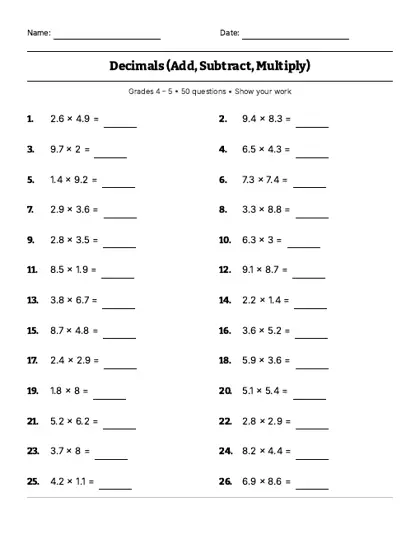
Multiplying decimals worksheet: 50 problems with an answer key.
Make a fresh decimals test with the free test maker.
Next: dividing decimals worksheet (PDF) · Related: adding and subtracting decimals · decimals chart · all decimals
Last reviewed
Questions parents ask
How do you multiply decimals?
Ignore the decimal points and multiply the numbers as if they were whole numbers. Count how many digits are after the decimal points in both numbers altogether, then put the decimal point that many places from the right of your answer. For 2.4 × 1.3: 24 × 13 = 312, two decimal places, so 3.12.
Do you line up the decimal points when multiplying?
No. Lining up the points is for adding and subtracting. When multiplying, line the numbers up on the right like whole numbers and count decimal places at the end.
Why is the answer smaller when you multiply two decimals?
Multiplying by a number less than 1 takes only part of the other number. 0.5 × 8 means half of 8, which is 4. So 0.6 × 0.4 = 0.24 is smaller than both.
What is 0.3 × 0.2?
0.06. 3 × 2 = 6, and there are two decimal places in total, so the 6 moves into the hundredths place with a zero in front of it.
How do you multiply a decimal by 10, 100 or 1000?
Move the decimal point one, two or three places to the right. 3.6 × 10 = 36 and 0.45 × 100 = 45.
What grade learns to multiply decimals?
Grade 5 multiplies decimals to hundredths using models and place value (Common Core 5.NBT.B.7). Grade 6 is expected to do it fluently with the standard method (6.NS.B.3).