
Number sense activities for kids (K–2)
Number sense is a child’s feel for numbers: how big they are, how they split apart and how they fit together. It is built in kindergarten to grade 2 through counting, number bonds, ten frames and skip counting. This page explains each idea with pictures, has an interactive ten frame, and is full of games and activities to do at home.
What kids learn about numbers, grade by grade
- Kindergarten (K.CC, K.OA): count to 100 by ones and tens, count objects to 20, compare groups, and find the pairs that make 10.
- Grade 1 (1.NBT, 1.OA): count to 120, tens and ones, 10 more and 10 less, and facts within 20 using strategies like making 10.
- Grade 2 (2.NBT, 2.OA): skip count by 5s, 10s and 100s, place value to 1,000, and even and odd numbers.
The big idea behind number sense
Numbers can be pulled apart and put back together in many ways. 8 is 5 and 3, it is 10 take away 2, and it is double 4. A child who sees all of those can add 8 + 6 as 8 + 2 + 4 = 14 instead of counting. That flexibility is what number sense is.
Ten is the number that matters most. Our whole number system is built on it, so knowing how far any number is from 10 is the foundation for addition, subtraction and place value.
Interactive ten frame
Slide to any number up to 20. See it on ten frames, how far it is from 10, and all the ways to make it.
Number bonds
A number bond shows a whole and two parts. They are the most useful facts a young child can learn, especially the bonds to 10: 1 + 9, 2 + 8, 3 + 7, 4 + 6, 5 + 5.
10 number sense activities
1. Quick dot cards
Flash dot patterns (like dice) for a second. “How many? How did you see it?” This builds subitizing, recognizing amounts without counting.
2. Ten frame snap
Show a ten frame with some counters. Your child says how many, and how many more to make 10.
3. Hidden objects
Put 7 buttons under a cup, then lift it to show 4. How many are still hidden? That is a number bond.
4. Count by tens
Bundle straws or sticks into tens with rubber bands. Count 10, 20, 30… then the loose ones.
5. Number line jumps
Chalk a number line outside. Jump on 3 more, back 2, on 10.
6. Dice games
Roll two dice and add. Who can say the answer without counting the dots?
7. Make 10 cards
With a deck of cards (no picture cards), find pairs that make 10.
8. Skip counting songs
Count by 2s, 5s and 10s with a beat or a clap. It is the start of multiplication.
9. Estimation jar
Fill a jar with pasta or buttons. Guess, then count in groups of 10 to check.
10. Number of the day
Pick a number and find as many ways as you can to make it: 12 is 10 + 2, 6 + 6, 15 − 3, a dozen eggs.
Where kids get stuck
Counting from 1 every time
Children who recount all the objects haven’t yet trusted “counting on”. Practice starting from the bigger number.
Skipping or double-counting objects
Fix: touch and move each object as it is counted.
Teen numbers
“Fourteen” sounds like 4 first, so children write 41. Fix: show 14 as 1 ten and 4 ones on a ten frame.
Number sense lessons
Number sense worksheets
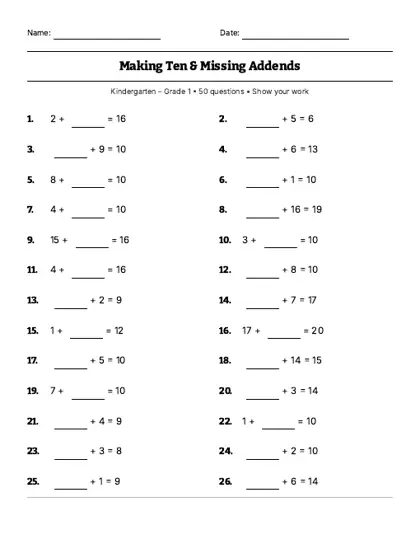 Number bondsKindergarten and grade 1
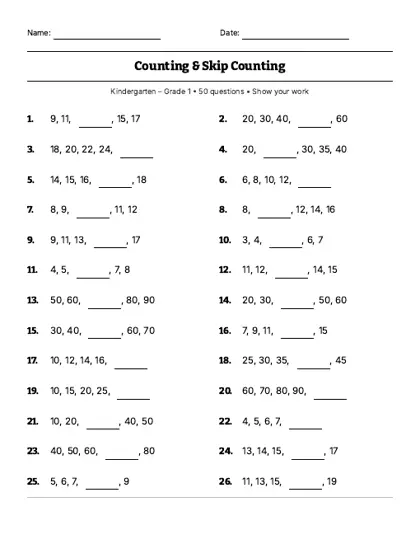 Skip countingGrades 1–2
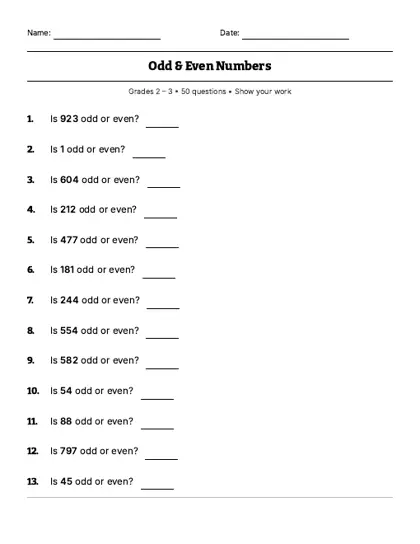 Even and odd numbersGrade 2
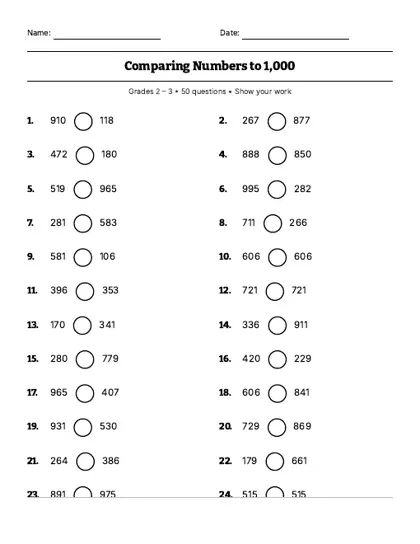 Comparing numbersGrades 1–2
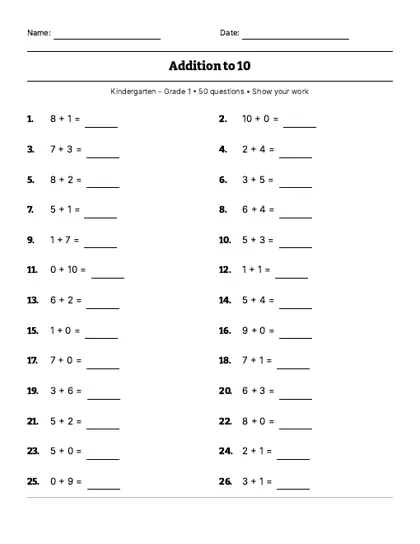 Addition to 10Kindergarten–grade 1
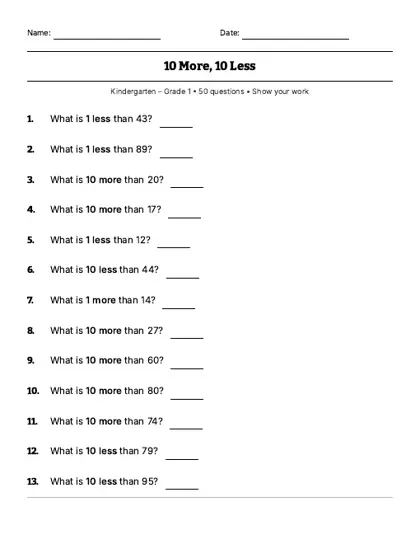 10 more, 10 lessGrade 1
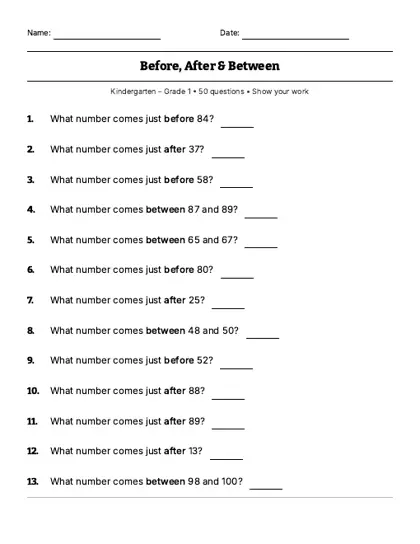 Before, after and betweenKindergarten–grade 1
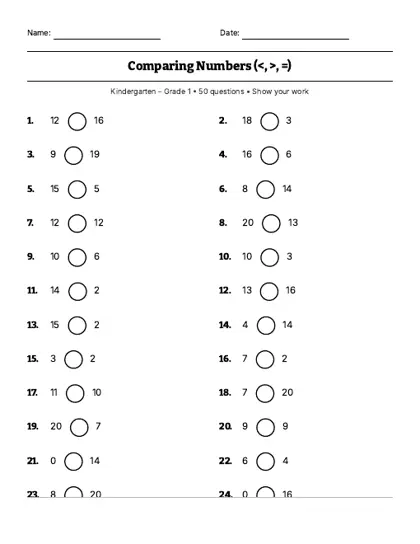 Comparing numbers to 100Grade 1
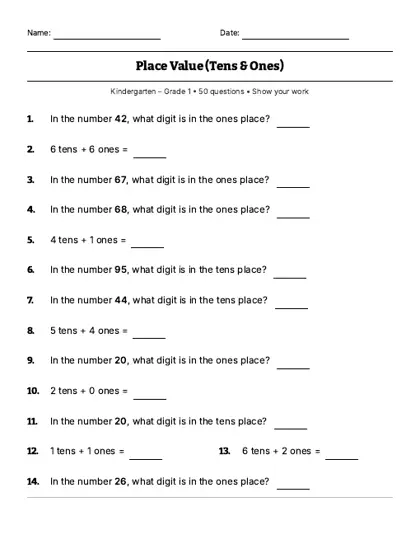 Tens and onesGrade 1
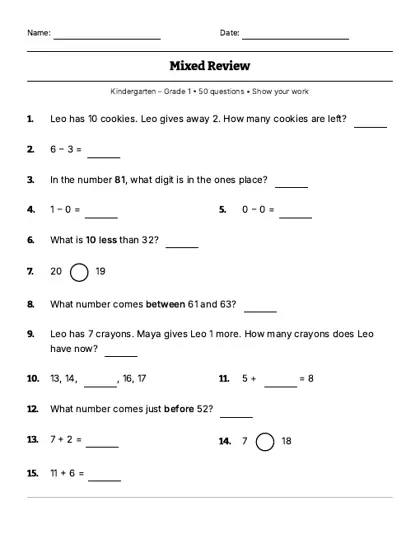 Mixed review K–1Check for gaps
Make a fresh number bonds test · Numbers chart · Number patterns chart
Last reviewed
Questions parents ask
What is number sense?
Number sense is a feel for numbers: knowing how big they are, how they relate to each other and how they can be split and combined. A child with good number sense knows that 9 + 6 is 15 because 9 is one less than 10, without counting.
How do I build my child’s number sense?
Count real things every day, use ten frames and number lines, play dice and card games, and ask “how do you know?” more than “what is the answer?”
What are number bonds?
Number bonds show how a number splits into two parts: 7 is 5 and 2, or 4 and 3. Knowing the bonds to 10 by heart makes adding and subtracting much faster.
What is subitizing?
Recognizing how many things there are at a glance without counting, like the dots on a die. It is an early sign of strong number sense and can be practiced with dot cards and ten frames.
What should a kindergartner know about numbers?
Count to 100 by ones and tens, count objects to 20, write numbers to 20, compare two groups, and know the pairs that make 10 (Common Core K.CC and K.OA).
Why does number sense matter later?
Children who see numbers flexibly can estimate, spot wrong answers and choose quick strategies. Weak number sense is one of the most common reasons children struggle with later math.