
More and less: comparing groups
To compare two groups, match them one to one. The group with some left over has more. The other has fewer, or less.
The idea: match them up
Before children compare numbers, they compare groups. Put two rows of objects side by side and match them one to one.
The group with some left over has more. If none are left over, the groups are the same. This works even before a child can count well.
See it: pictures to draw with your child
Copy these onto paper or a whiteboard. A quick sketch makes the idea concrete before any written method.
Count and compare
Once children can count, they compare by counting both groups. 7 is more than 4, because 7 comes later when we count.
Encourage both ways. Matching shows why 7 is more, and counting is quicker. Kindergarten compares groups to 10 (K.CC.C.6) and numbers to 10 (K.CC.C.7).
How many more?
“How many more?” asks for the difference. Match the groups, then count the ones left over. 7 and 4 leave 3 over, so 7 is 3 more than 4.
This is the start of subtraction as comparing. Grade 1 (1.OA.A.1) solves word problems like “Sam has 7, Ava has 4. How many more does Sam have?”
More, fewer and less
“More” and “the same” are easy words. “Fewer” and “less” are harder, and children use them less often.
Use “fewer” for things you can count, like fewer apples. “Less” is fine for amounts, like less water. Many teachers accept both at this age.
More and fewer in real life
Sharing snacks is the best place to practice. Who has more crackers? How many more does your sister need to have the same?
Setting the table works too. Are there more plates or more forks? Matching one fork to each plate is exactly the matching your child will use in math.
Key words
- More: a bigger amount. 7 is more than 4.
- Fewer: a smaller number of things. 4 apples are fewer than 7.
- Less: a smaller amount. Often used in place of fewer.
- The same: equal: none left over when you match.
- Match: pair one object from each group, again and again.
Teaching tip: line them up
Big objects spread out can look like more. A row of 5 large toys may look longer than a row of 7 small beads.
Lining the groups up one to one removes the trick. Then ask your child to count both groups to check.
A week of practice
Ten minutes a day is plenty. Short, regular practice beats one long session at the weekend.
- Day 1: match two groups of toys and say which has more.
- Day 2: count two groups and compare.
- Day 3: find how many more by matching.
- Day 4: use the words fewer and the same.
- Day 5: the quiz on this page, then a round of more and fewer practice.
If one day goes badly, repeat it rather than moving on. Each day builds on the one before.
Ready for symbols? Move on to comparing numbers with >, < and =.
Quiz: which row has more?
Match them up, then look for the extras.
Where this fits: number sense step by step
What to say to your child
A short script for teaching it the first time. Pause after each line and let your child do the next step.
- “Let’s line up the cars and the dolls.” (Line up.)
- “Match each car with a doll.” (Matches.)
- “Are any cars left over?” (Yes, 2.)
- “So which has more?” (The cars.)
- “How many more cars?” (2.)
More worked examples
Example 1: More
Top row 6, bottom row 2. Match them: 4 are left over in the top row. The top row has more.
Example 2: The same
Top row 5, bottom row 5. Match them: none left over. They are the same.
Example 3: How many more
8 red and 5 blue. Match them: 3 red are left over, so there are 3 more red.
Example 4: Fewer
3 cats and 7 dogs. There are fewer cats.
Practice questions (answers below)
Ask these out loud or write them down. Check each answer, and ask “how did you get that?” for one or two.
- Which is more, 6 or 9?
- Which is fewer, 3 or 5?
- 4 apples and 4 pears: which is more?
- How many more is 7 than 5?
- How many more is 10 than 6?
- 5 cups and 8 spoons: are there fewer cups or spoons?
- Which is more, 12 or 21?
- How many fewer is 3 than 9?
- Stretch: Sam has 8 cards and Ava has 3. How many more does Sam have?
Show the answers
- 9
- 3
- the same
- 2
- 4
- cups
- 21
- 6
- 5
Common mistakes
How to teach it at home
Snack compare
Give two bowls of raisins or crackers. Which has more? Line them up to check.
More or fewer dice
Each player rolls a dice. Who has more dots, and how many more?
Sock match
Match socks from two piles. Which pile has some left over?
By grade
- Kindergarten (K.CC.C.6, K.CC.C.7): compare two groups by matching or counting, and compare two numbers to 10.
- Grade 1 (1.OA.A.1): solve comparison word problems, like how many more.
- In India, class 1 Mango Treat compares groups as numbers 1 to 9 are learned.
- Next: comparing numbers with symbols and subtraction as comparing.
More for each grade: Kindergarten math; Grade 1 math and the CBSE class 1 maths guide.
Worksheets and practice
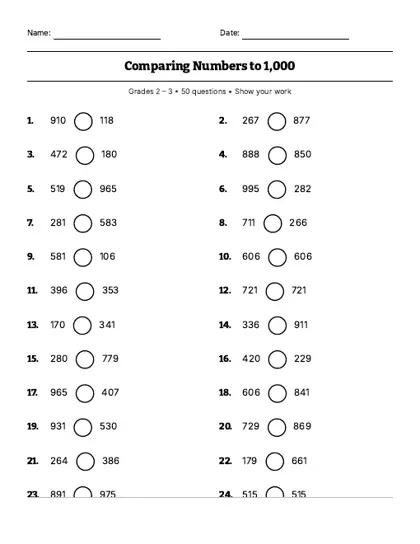
Comparing numbers worksheet: printable PDF with an answer key. · Make a fresh test
Number sense practice · hundreds chart · number sense for kids · number chart · counting worksheet · hundreds chart worksheet · comparing numbers lesson
Last reviewed
Questions parents ask
How do you teach more and less?
Line up two groups and match them one to one. The group with some left over has more.
What is the difference between fewer and less?
Fewer is for things you can count, like fewer apples. Less is for amounts, like less juice.
How do you find how many more?
Match the two groups and count the ones left over. That is how many more.
What grade learns more and less?
Kindergarten, under Common Core K.CC.C.6 and K.CC.C.7.
When do children use the symbols > and <?
Usually in grade 1, after they can compare groups and numbers in words.