
How to teach counting
Counting is more than saying numbers in order. Children need to match one number to each object, know that the last number said is how many, and count on from any number. This page explains each counting skill, how to spot what is missing, a ten frame tool, and simple activities for kindergarten.
The five counting skills
- Number words in order: 1, 2, 3… to 100 by the end of kindergarten.
- One-to-one: one number for each object, no skipping or double counting.
- The last number is how many: after counting 7 blocks, the answer is 7 without recounting.
- Order doesn’t matter: the total is the same counted left to right or in any order.
- Counting on: start at 5 and continue 6, 7, 8, rather than starting from 1.
Count on a ten frame
Slide to any number to 20. Ten frames show amounts at a glance.
Teen numbers and counting past 20
Teen numbers are tricky because “fourteen” says the 4 first. Show 14 as one full ten frame and 4 more. Past 20, the pattern becomes regular: twenty-one, twenty-two… and counting by tens (10, 20, 30…) helps children count to 100.
Spotting what is missing
- Counts out loud correctly but gets the wrong total → one-to-one: touch and move each object.
- Recounts from 1 when asked “how many?” → the last number tells how many.
- Starts from 1 to add one more → practice counting on.
- Gets stuck at 29, 39 → practice the decade changes by counting by tens.
Common mistakes
How to teach it at home
Count everything
Stairs, grapes, cars, socks, many times a day.
Snack counting
“Take 8 crackers.” Then: “How many if you eat 1?”
Board games
Moving a counter along squares is one-to-one practice.
By grade
- Kindergarten (K.CC.A.1 to K.CC.B.5): count to 100 by ones and tens, count up to 20 objects, and know the last number says how many.
- Grade 1 (1.NBT.A.1): count to 120 from any number.
- Next: number bonds and skip counting.
Worksheets and practice
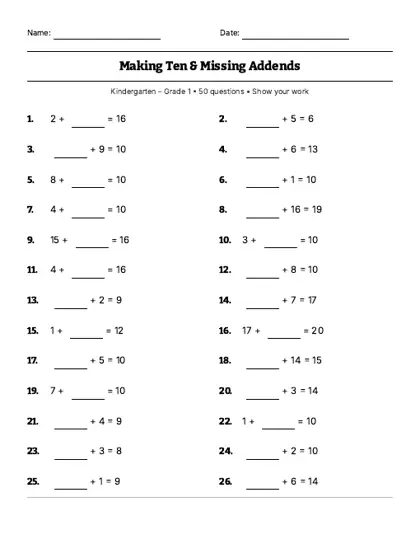
Number bonds worksheet: printable PDF with an answer key. · Make a fresh test
Before, after and between (PDF) · Numbers chart · Number sense
Last reviewed
Questions parents ask
How high should a kindergartner count?
To 100 by ones and tens by the end of kindergarten, and count up to 20 objects accurately.
What is one-to-one correspondence?
Matching exactly one number word to each object counted. It is the most important early counting skill.
What is counting on?
Starting from a number other than 1, such as 5, and continuing: 6, 7, 8. It is the first step toward adding.
Why does my child recount every time?
They haven’t yet linked the last number said to the total. Ask “how many?” right after counting.
How do I help with teen numbers?
Show them as 10 and some more, with a full ten frame plus extra counters.