
2-digit by 1-digit multiplication, step by step
To multiply a 2-digit number by a 1-digit number, multiply the tens and the ones separately and add: 47 × 6 = 40 × 6 + 7 × 6 = 240 + 42 = 282. The written method does the same with carrying. This page shows both with pictures, has a step-by-step tool, and covers the mistakes children make.
The big idea: split the number
47 is 40 + 7. Six lots of 47 are six lots of 40 plus six lots of 7. An area model draws this as a rectangle split into two parts.
Two ways to write it
Partial products
Write each part on its own line: 7 × 6 = 42, 40 × 6 = 240, then add: 282. Good for understanding.
Standard method (with carrying)
- Multiply the ones: 6 × 7 = 42. Write 2, carry 4.
- Multiply the tens: 6 × 4 = 24, add the carried 4: 28. Write 28.
- Answer: 282.
Long multiplication step by step
Type any problem, like 47 × 6.
Worked examples
23 × 3 (no carrying)
3 × 3 = 9, 3 × 2 = 6: 69.
36 × 4
4 × 6 = 24, write 4 carry 2. 4 × 3 = 12, + 2 = 14: 144.
58 × 7
7 × 8 = 56, write 6 carry 5. 7 × 5 = 35, + 5 = 40: 406.
Mental: 25 × 4
20 × 4 = 80 and 5 × 4 = 20: 100.
Common mistakes
How to teach it at home
Shop in packs
Four packs of 24 cans: 20 × 4 + 4 × 4 = 96.
Double and double again
× 4 is double-double: 36 → 72 → 144.
Times table first
This skill depends on fluent facts. Five minutes of tables a day pays off here.
By grade
- Grade 3 (3.NBT.A.3): multiply one-digit numbers by multiples of 10.
- Grade 4 (4.NBT.B.5): multiply up to 4 digits by 1 digit with place value strategies.
- Next: 2-digit by 2-digit multiplication.
Worksheets and practice
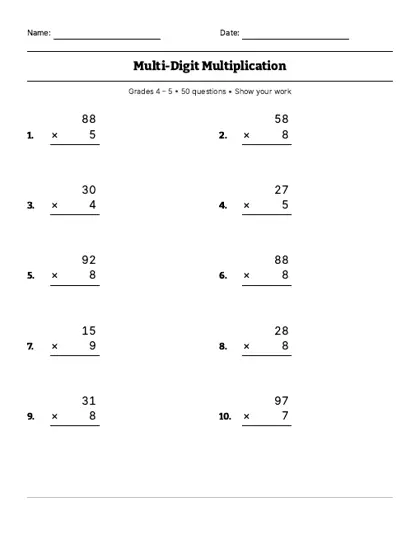
2-digit by 1-digit multiplication worksheet: printable PDF with an answer key. · Make a fresh test
Last reviewed
Questions parents ask
How do you multiply a 2-digit number by a 1-digit number?
Multiply the ones, then the tens, and add, carrying when needed. 47 × 6: 6 × 7 = 42 (write 2, carry 4), 6 × 4 = 24 + 4 = 28, so 282.
What is the area model?
A rectangle split into the tens and ones of the number. Each part is multiplied, and the parts are added: 47 × 6 = 240 + 42.
What are partial products?
The separate products you add up: for 47 × 6 they are 40 × 6 = 240 and 7 × 6 = 42.
Why do you carry in multiplication?
Because a product like 42 is 4 tens and 2 ones. The 4 tens belong in the tens column.
What grade learns 2-digit by 1-digit multiplication?
Grade 4 (4.NBT.B.5), building on grade 3 times tables.