
How to find equivalent fractions
Equivalent fractions are different fractions for the same amount: 1/2 = 2/4 = 4/8. To find one, multiply or divide the top and bottom by the same number. This page shows why with fraction bars, has an explorer to try any fraction, works examples including missing numbers, and covers common mistakes.
Equivalent fractions: the big idea
Cut each half of a bar in two and you have quarters: 1/2 becomes 2/4. The amount hasn’t changed; it is just cut into more, smaller pieces. Multiplying the numerator and denominator by the same number does exactly that.
How to find equivalent fractions, step by step
- Choose a number to multiply by, such as 2, 3 or 4.
- Multiply the numerator and the denominator by that number. 2/3 × 2/2 = 4/6.
- Or divide both by a number that goes into both: 6/9 ÷ 3/3 = 2/3.
Multiplying top and bottom by the same number is multiplying by 1 (2/2 = 1), which is why the value doesn’t change.
Equivalent fractions explorer
Choose a fraction and slide the multiplier. The shaded amount never changes.
Worked examples
Example 1: two fractions equal to 3/4
× 2: 6/8. × 3: 9/12.
Example 2: 2/5 = ?/20
5 × 4 = 20, so multiply the top by 4 too: 8/20.
Example 3: 12/16 = 3/?
12 ÷ 4 = 3, so divide the bottom by 4 too: 3/4.
Example 4: are 4/6 and 6/9 equivalent?
Both simplify to 2/3, so yes. Or cross-multiply: 4 × 9 = 36 and 6 × 6 = 36.
Why equivalent fractions matter
They are needed for comparing fractions, adding fractions with different denominators and simplifying. They also connect fractions to decimals and percents: 3/4 = 75/100 = 0.75 = 75%.
Common mistakes
How to teach it at home
Fold paper strips
Fold a strip in half, then in quarters, then eighths. Shade half and read it each way.
Pizza slices
Cut a pizza into 4, then each slice in half. Two quarters become four eighths.
Measuring cups
Pour two 1/4 cups into a 1/2 cup. They fill it exactly.
By grade
- Grade 3 (3.NF.A.3): simple equivalent fractions with models, like 1/2 = 2/4.
- Grade 4 (4.NF.A.1): explain and generate equivalent fractions with any denominators.
Worksheets and practice
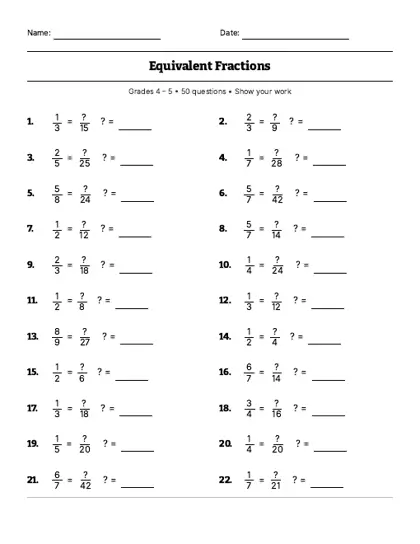
Equivalent fractions worksheet: printable PDF with an answer key. · Make a fresh test
Last reviewed
Questions parents ask
What are equivalent fractions?
Fractions that name the same amount, like 1/2, 2/4 and 4/8.
How do you find an equivalent fraction?
Multiply or divide the numerator and denominator by the same number. 3/4 × 2/2 = 6/8.
How do you check if two fractions are equivalent?
Simplify both, or cross-multiply. 2/3 and 8/12: 2 × 12 = 24 and 3 × 8 = 24, so they are equivalent.
Why doesn’t multiplying the top and bottom change the fraction?
Because you are multiplying by a fraction equal to 1, like 2/2 or 3/3. Multiplying by 1 never changes a number.
What grade learns equivalent fractions?
Grade 3 with pictures and simple cases, and grade 4 with any denominators (4.NF.A.1).