
How to learn the times tables
Learn the times tables in the right order and use a trick for each one, and most facts come for free. There are 100 facts to 10 × 10, but with turn-arounds and patterns only about 15 are genuinely hard. This page gives the best order, a trick for every table from 2 to 12, an array explorer, a practice tool and a worksheet for each table.
The best order to learn the times tables
- 2, 5 and 10: easy patterns.
- 4 (double the 2s) and 3.
- 9 and 11: pattern tricks.
- 6, 8 and 7: by now most of these are already known as turn-arounds.
- 12 last.
Turn-arounds halve the work: once you know 3 × 8, you know 8 × 3.
A trick for every table
| Table | Trick | Worksheet |
|---|---|---|
| 2× | Double the number. | 2 times table worksheet |
| 3× | Double it, then add one more lot. | 3 times table worksheet |
| 4× | Double, then double again. | 4 times table worksheet |
| 5× | Ends in 0 or 5; half of the 10 times. | 5 times table worksheet |
| 6× | 5 times plus one more lot (or double the 3 times). | 6 times table worksheet |
| 7× | 5 times plus 2 times. Only 7 × 7 and 7 × 8 are new by now. | 7 times table worksheet |
| 8× | Double, double, double. | 8 times table worksheet |
| 9× | 10 times minus one lot. The digits always add to 9. | 9 times table worksheet |
| 10× | Add a 0 on the end. | 10 times table worksheet |
| 11× | Up to 11 × 9, repeat the digit: 11 × 6 = 66. | 11 times table worksheet |
| 12× | 10 times plus 2 times: 12 × 7 = 70 + 14 = 84. | 12 times table worksheet |
See any fact as an array
The hard facts
After the tricks, the facts most children still miss are 6 × 7, 6 × 8, 7 × 8, 7 × 7, 8 × 8 and their turn-arounds. Give them extra time: 7 × 8 = 56 (“5, 6, 7, 8”), 6 × 8 = 48, 6 × 7 = 42.
Times tables practice
Pick a table or mixed. Missed facts show the answer and the trick.
A 5-minute daily routine
- Say one table forwards and backwards.
- Answer 10 mixed facts from that table.
- Revisit two facts from older tables.
- Stop while it is going well.
Five minutes a day for a few weeks works better than long weekend sessions.
Common mistakes
How to teach it at home
Times tables in the car
Quick-fire facts on the way to school.
Multiplication war
Flip two cards, multiply; biggest product wins.
Sing them
Times table songs help many children with the order.
By grade
- Grade 2 (2.OA.C.4): arrays and repeated addition.
- Grade 3 (3.OA.C.7): know all products of two one-digit numbers from memory by the end of the year.
- See also what multiplication means.
Worksheets and practice
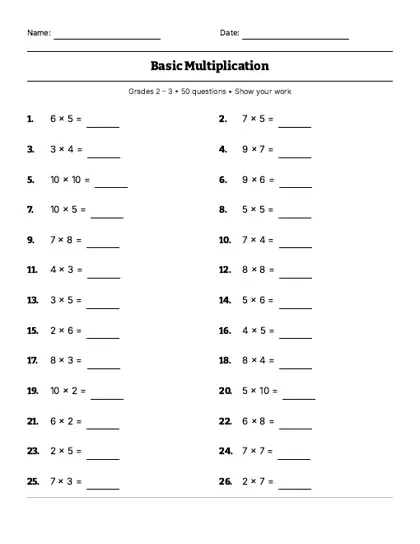
Multiplication facts worksheet: printable PDF with an answer key. · Make a fresh test
Mixed times tables worksheet · Multiplication chart · Math Galaxy
Last reviewed
Questions parents ask
What is the fastest way to learn times tables?
Learn them in a good order (2, 5, 10, then 4, 3, 9, 11, then 6, 7, 8, 12), use a trick for each one, and practice for five minutes every day.
Which times tables are hardest?
The 6, 7 and 8 tables, especially 6 × 7, 6 × 8 and 7 × 8. By the time children reach them, most of the facts are already known as turn-arounds.
What is the trick for the 9 times table?
Multiply by 10 and subtract one lot: 9 × 7 = 70 − 7 = 63. The digits of the answer always add to 9.
When should kids know their times tables?
By the end of grade 3, all facts up to 10 × 10 (Common Core 3.OA.C.7). Many schools also expect the 11 and 12 tables.
Should my child learn times tables to 12?
It helps. 12s appear in time, measurement and money, and the 12 times table is easy once the 10s and 2s are known.