
Division with remainders, step by step
When a number can’t be shared equally, the part left over is the remainder. 23 ÷ 4 = 5 remainder 3: four groups of 5 use 20, and 3 are left. This page shows remainders with a sharing tool, explains how to find them, what to do with them in word problems (round up, round down or use them), and links to long division.
What a remainder means
A remainder is what is left when you have made as many equal groups as you can. It is always smaller than the number you divide by: if it weren’t, you could make another group.
See remainders
Share any number into groups. The red dots are the remainder.
How to find the remainder, step by step
- Find the biggest multiple of the divisor that fits: for 23 ÷ 4, 4 × 5 = 20 (4 × 6 = 24 is too big).
- That gives the answer (quotient): 5.
- Subtract to find what is left: 23 − 20 = 3.
- Write it: 23 ÷ 4 = 5 r 3. Check: 4 × 5 + 3 = 23.
What to do with the remainder in word problems
| Question | What to do | Answer |
|---|---|---|
| 30 children, 4 per car. How many cars? | Round up: everyone needs a seat | 8 cars |
| 30 cookies, 4 per bag. How many full bags? | Round down: only full bags count | 7 bags |
| 30 cookies, 4 per bag. How many left over? | The remainder is the answer | 2 cookies |
| $30 shared by 4 people | Split the remainder: decimals | $7.50 each |
Bigger numbers: long division with remainders
Common mistakes
How to teach it at home
Deal cards unevenly
Deal 23 cards to 4 players. What is left in your hand?
Car seats
How many cars for a class trip? Remainders that round up make sense here.
Leftover pizza
Share 10 slices between 3 people.
By grade
- Grade 3: division facts with no remainder.
- Grade 4 (4.NBT.B.6, 4.OA.A.3): divide up to 4 digits by 1 digit with remainders, and interpret remainders in word problems.
- Next: long division.
Worksheets and practice
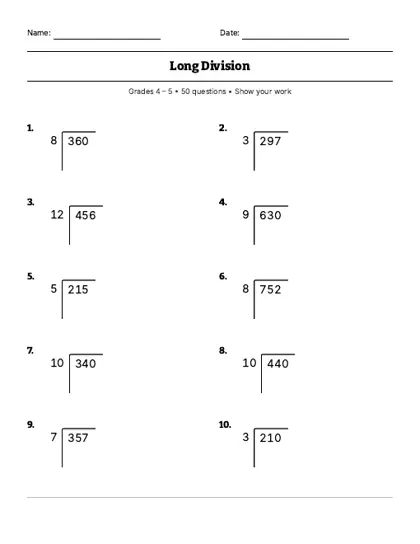
Division with remainders worksheet: printable PDF with an answer key. · Make a fresh test
Last reviewed
Questions parents ask
What is a remainder?
The amount left over after dividing into as many equal groups as possible. In 23 ÷ 4 = 5 r 3, the remainder is 3.
Can a remainder be bigger than the divisor?
No. If it were, you could make another group. The remainder is always less than the number you divide by.
How do you write a remainder as a fraction?
Put the remainder over the divisor: 23 ÷ 4 = 5 r 3 = 5 3/4.
Do you round up or down with remainders?
It depends on the question. Round up when everything must fit (cars for children), round down when only full groups count (full bags).
How do you check a division with a remainder?
Multiply the answer by the divisor and add the remainder: 4 × 5 + 3 = 23.