
Factors, multiples and primes for kids
Factors are the numbers that divide into a number exactly; multiples are what you get when you multiply it. This page explains factors, multiples, prime and composite numbers, prime factorization, GCF and LCM from grade 4 to grade 6, with a factor finder for any number, the common mistakes, and worksheets.
What kids learn, grade by grade
- Grade 4 (4.OA.B.4): factor pairs for numbers to 100, multiples, and whether a number is prime or composite.
- Grade 5: factors in action, for simplifying fractions and finding common denominators.
- Grade 6 (6.NS.B.4): greatest common factor and least common multiple, and using the distributive property: 36 + 8 = 4(9 + 2).
Factors and multiples: the big idea
Factors fit into a number; multiples come out of it. 3 is a factor of 12 because 12 ÷ 3 has no remainder. 12 is a multiple of 3 because 3 × 4 = 12. Every number has a few factors (a finite list) and endless multiples.
A factor rainbow pairs up the factors: each arch joins two numbers that multiply to make the whole.
Factor finder
Type any number up to 10,000 to see its factor pairs, whether it is prime, its prime factorization and its first multiples.
Prime and composite numbers
A prime number has exactly two factors: 1 and itself (2, 3, 5, 7, 11, 13…). A composite number has more than two (4, 6, 8, 9, 10…). 1 is neither: it has only one factor.
Every composite number can be written as a product of primes in exactly one way, its prime factorization: 36 = 2 × 2 × 3 × 3. Build it with a factor tree: split 36 into 6 × 6, then each 6 into 2 × 3.
Greatest common factor and least common multiple
| GCF | LCM | |
|---|---|---|
| Means | Biggest number that divides both | Smallest number both divide into |
| Example (12 and 18) | 6 | 36 |
| Used for | Simplifying fractions, splitting into equal groups | Common denominators, events that repeat |
| Size | Never bigger than the smaller number | Never smaller than the bigger number |
A word-problem clue: “largest equal groups” or “greatest number of identical bags” means GCF. “When will they next happen together?” means LCM.
Where kids get stuck
Factors and multiples lessons
Factors and multiples worksheets
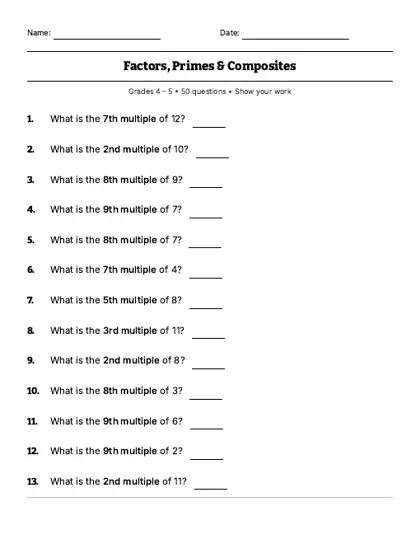 Factors and multiplesGrade 4
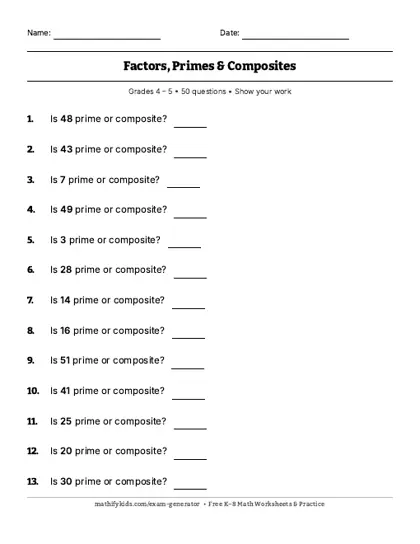 Prime numbersGrades 4–5
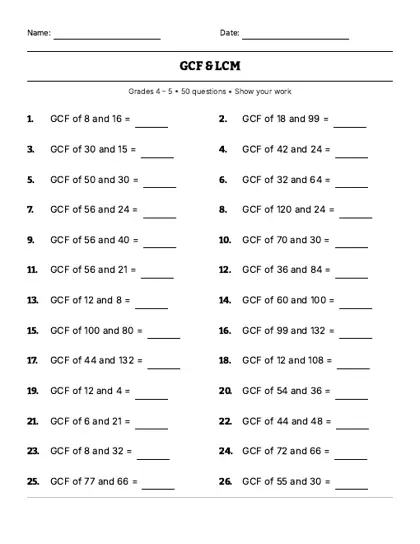 Greatest common factorGrade 6
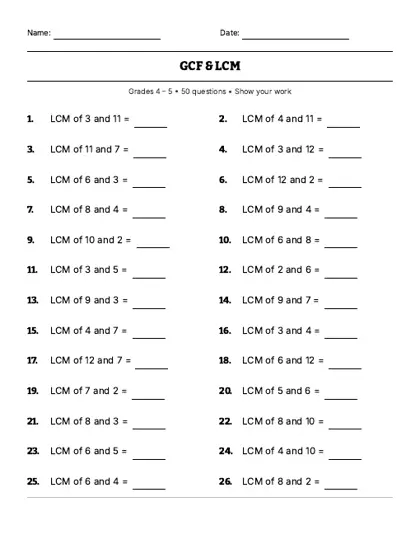 Least common multipleGrade 6
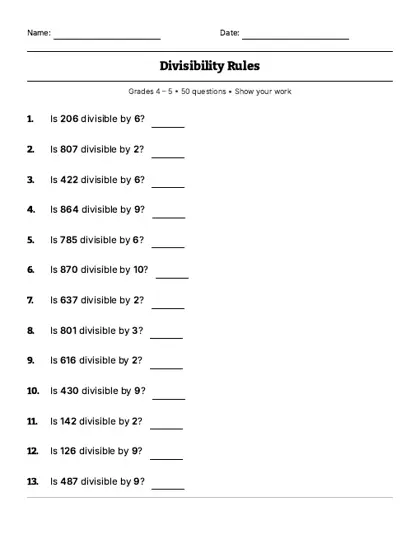 Divisibility rulesGrades 4–5
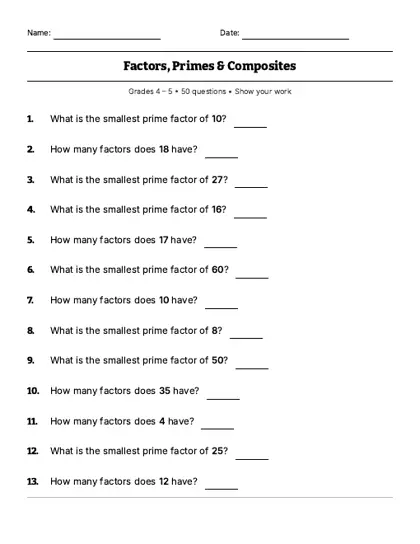 Factors
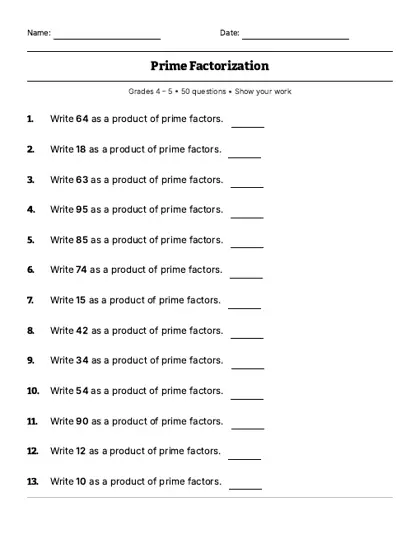 Prime factorization
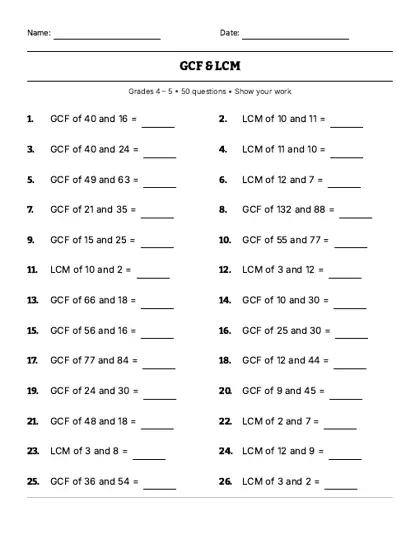 GCF and LCM mixed
Make a fresh factors test · Make a GCF and LCM test · Factors and multiples chart · Prime numbers chart
How to teach factors and multiples at home
Build rectangles
Give your child 12 blocks and ask how many different rectangles they can make: 1 × 12, 2 × 6, 3 × 4. Those are the factor pairs. A prime number of blocks only makes one long line.
Fizz buzz
Count around the table, saying “fizz” for multiples of 3 and “buzz” for multiples of 5. It is a classic multiples game.
Hot dogs and buns
Hot dogs come in packs of 10 and buns in packs of 8. What is the fewest of each to buy so none are left over? That is the LCM (40).
Related: multiplication · division · 4th grade math · 6th grade math
Last reviewed
Questions parents ask
What is the difference between factors and multiples?
Factors go into a number exactly; multiples come out of it. The factors of 12 are 1, 2, 3, 4, 6 and 12. The multiples of 12 are 12, 24, 36, 48 and so on, forever.
What is a prime number?
A whole number greater than 1 with exactly two factors: 1 and itself. 2, 3, 5, 7, 11 and 13 are prime. 1 is not prime, because it has only one factor.
How do you find the GCF of two numbers?
List the factors of each and pick the biggest one they share. The factors of 12 are 1, 2, 3, 4, 6, 12 and of 18 are 1, 2, 3, 6, 9, 18, so the GCF is 6.
How do you find the LCM of two numbers?
List multiples of each until you find the first one they share. Multiples of 4: 4, 8, 12, 16… Multiples of 6: 6, 12… so the LCM is 12.
Is 2 a prime number?
Yes. 2 is the only even prime number: its only factors are 1 and 2. Every other even number has 2 as a factor, so it is composite.
What grade learns factors and multiples?
Grade 4 finds factor pairs, multiples and prime and composite numbers to 100 (4.OA.B.4). Grade 6 finds the greatest common factor and least common multiple (6.NS.B.4).