
Prime numbers worksheets
Deciding whether numbers are prime or composite. A prime number has exactly two factors: 1 and itself.
Download the free prime numbers worksheet (PDF)
Prime numbers worksheet
What’s on the worksheet
- 50 questions on prime numbers, sized for US Letter paper
- 4 pages of questions
- Written for grades 4–5, matching Common Core 4.OA.B.4
- Name and date lines at the top, and room to show the work
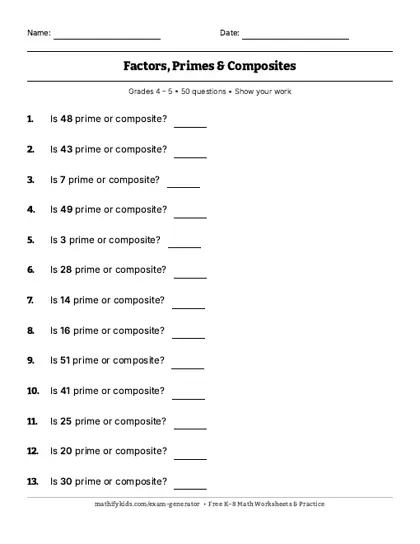
Sample questions from this worksheet
- Is 48 prime or composite?
- Is 43 prime or composite?
- Is 7 prime or composite?
- Is 49 prime or composite?
- Is 3 prime or composite?
- Is 28 prime or composite?
Practice prime numbers online
Between worksheets, a few minutes on screen keeps the skill fresh:
- prime or composite practice: 10 numbers to sort, with the factors shown.
- Prime Number Bingo: clues like “the next prime after 13”.
- prime numbers lesson: the list to 100 and an interactive sieve.
Children remember the primes to 20 quickly; the ones above 50 take longer. Numbers like 51, 57, 87 and 91 look prime but are not. For the next step, the prime and composite numbers worksheet adds a 1 to 100 chart to circle, and the prime factorization worksheet turns composite numbers into factor trees. After the sheet, circle the numbers your child got wrong and test them again with the divisibility rules for 3 and 7.
Preview the worksheet
Make a new prime numbers worksheet
Need another page for extra practice, a retake or a second group in class? The free Mathify Kids test maker builds a fresh prime numbers worksheet with different numbers every time. Choose how many questions, print it with its own answer key, or let your child take it on screen and see the score straight away.
Prime numbers: a worked example (Is 29 prime? Is 27 prime?)
- 29: it doesn’t divide by 2, 3 or 5, and 7 × 7 = 49 is already bigger than 29.
- So 29 has only the factors 1 and 29. It is prime.
- 27 = 3 × 9, so it has more than two factors. It is composite.
How to use it at home and in class
At home
Only test divisors up to the number that squares past it. For 29, stop once 6 × 6 = 36 is past 29. Ten problems a day works better than a whole sheet at once. Mark them together, then ask your child to explain one they got wrong: finding the mistake themselves is where the learning happens.
In class
Use the first row as a warm-up, a full page for independent practice, or five questions as an exit ticket. For a retake or a second group, make a new version with the test maker so every child gets different numbers.
Mistakes to watch for
- Thinking every odd number is prime, like 9, 15 or 27.
- Calling 1 a prime number.
What to practice before and after prime numbers
- Before: factors and multiples. If this sheet is a struggle, go back a step.
- After: greatest common factor, once this one is mostly right.
- Learn it first: the prime numbers lesson and the prime and composite numbers chart.
More factors & multiples worksheets
Last reviewed
Questions parents ask
Is 1 a prime number?
No. A prime number has exactly two different factors. 1 has only one factor, itself.
What grade is this prime numbers worksheet for?
It is written for grades 4–5 and matches Common Core standard 4.OA.B.4.
Can I get a different version of this prime numbers worksheet?
Yes. Use the free Mathify Kids test maker to make a new prime numbers worksheet with different numbers every time. You choose how many questions, and every version comes with its own answer key.