
Ratios for kids
A ratio compares two amounts: 2 cups of flour for every 3 cups of milk. Ratios, rates and unit rates are the big new idea of grade 6 and lead straight to percents, proportions and slope. This page explains them with tape diagrams and ratio tables, has a ratio table tool, and covers the mistakes kids make, with worksheets.
What kids learn about ratios, grade by grade
- Grade 6 (6.RP.A.1 to 6.RP.A.3): ratio language, ratio tables and tape diagrams, unit rates, and percents as rates per 100.
- Grade 7 (7.RP.A.1 to 7.RP.A.3): unit rates with fractions, proportional relationships and their graphs, and multi-step percent problems.
- Grade 8: slope as a rate of change, which is a ratio drawn as a line.
The big idea behind ratios
A ratio says “for every”. For every 2 cups of flour, use 3 cups of milk. Make a bigger batch and both amounts grow together: 4 and 6, 6 and 9. The amounts change but the ratio stays the same. A tape diagram shows this with equal boxes.
Ratio tables
A ratio table lists equivalent ratios in rows. Multiply or divide both columns by the same number to get a new row. To answer “3 notebooks cost $4.50, how much do 7 cost?”, find the row for 1 (divide by 3: $1.50), then multiply by 7: $10.50.
Ratio table tool
Type a ratio and what the two amounts are. The table fills in equivalent ratios and the unit rate.
Rates and unit rates
A rate is a ratio between two different kinds of quantity: miles and hours, dollars and pounds. A unit rate is the rate for 1: 60 miles per hour, $2 per pound. Unit rates make comparisons easy:
- 12 oz for $3.60 is $0.30 per ounce; 18 oz for $4.86 is $0.27 per ounce. The bigger box is the better deal.
- 150 miles in 3 hours is 50 miles per hour.
- Typing 240 words in 4 minutes is 60 words per minute.
Where kids get stuck with ratios
Ratios worksheets
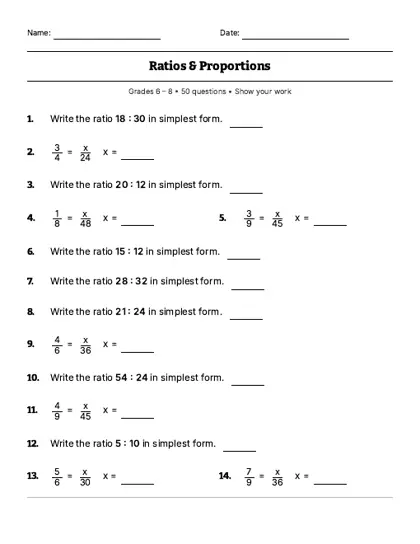 Ratios
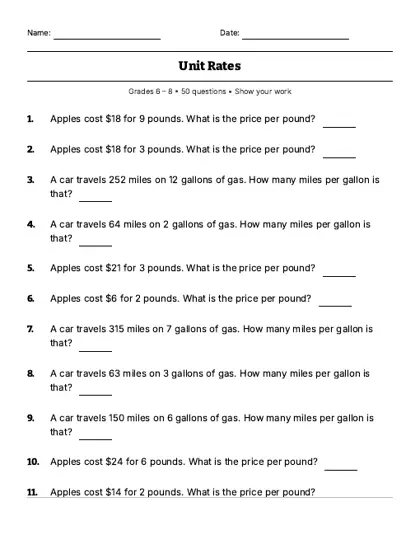 Unit ratesGrade 6
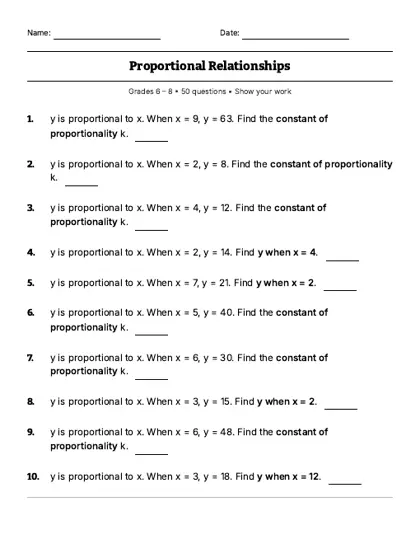 Proportional relationshipsGrade 7
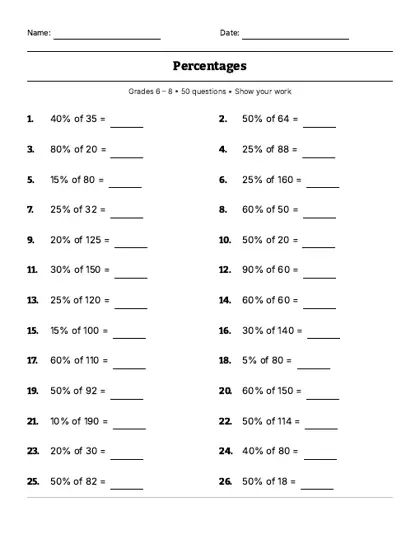 Percent of a numberGrade 6
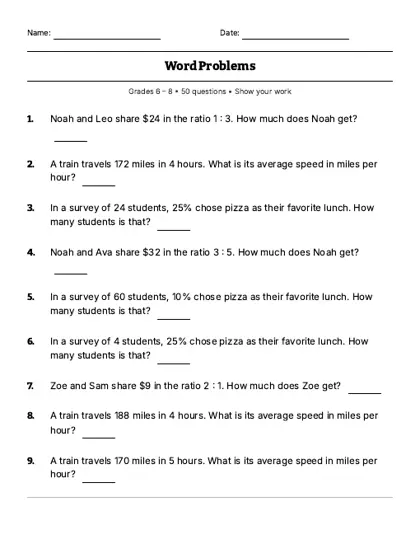 Word problems, grades 6–8Mixed
Make a fresh ratios test · Make a unit rates test
How to teach ratios at home
Cook from a recipe
Double or halve a recipe together. If pancakes need 2 eggs for every 1 cup of flour, how many eggs for 3 cups?
Compare unit prices
Many shelf labels show the price per ounce. Check them together and work one out yourselves.
Mix paint or juice
Mix 1 part juice concentrate to 3 parts water. Then make a bigger jug with the same taste: the ratio must stay 1:3.
Use maps
A map scale like 1 inch to 10 miles is a ratio. Measure a distance and convert it.
Related: percentages · fractions · 6th grade math · 7th grade math
Last reviewed
Questions parents ask
What is a ratio?
A ratio compares two amounts. If a recipe uses 2 cups of flour for every 3 cups of milk, the ratio of flour to milk is 2 to 3, written 2:3 or 2/3.
What is a unit rate?
A rate for one unit of something: miles per hour, dollars per pound, words per minute. If 3 notebooks cost $4.50, the unit rate is $1.50 per notebook.
How do you find equivalent ratios?
Multiply or divide both parts by the same number. 2:3 = 4:6 = 6:9. A ratio table lists equivalent ratios in rows.
Does the order of a ratio matter?
Yes. 2:3 flour to milk is not the same as 3:2. Always check which amount comes first in the question.
What is the difference between a ratio and a fraction?
A fraction compares a part to the whole; a ratio can compare a part to a part. In a class of 12 girls and 18 boys, the ratio of girls to boys is 12:18 (2:3), but the fraction of the class that is girls is 12/30 (2/5).
What grade learns ratios?
Grade 6 introduces ratios, ratio tables, unit rates and percents (6.RP.A.1 to 6.RP.A.3). Grade 7 builds on them with proportional relationships, constant of proportionality and percent problems (7.RP).