
Proportional relationships
Two amounts are in a proportional relationship when their ratio never changes. The table has a constant ratio and the graph is a line through 0.
The idea: a ratio that stays the same
Apples cost $2 a pound. 1 pound costs $2, 3 pounds cost $6 and 5 pounds cost $10. Cost ÷ pounds is always 2, so cost is proportional to weight.
Now a taxi charges $3 to start plus $2 a mile. 1 mile costs $5 and 2 miles cost $7. The ratios are 5 and 3.5, so this relationship is not proportional.
See it: pictures to draw with your child
Copy these onto paper or a whiteboard. A quick sketch makes the idea concrete before any written method.
Test 1: check the table
Divide each y by its x. If every answer is the same, the relationship is proportional. That shared number is the constant of proportionality, k.
A table that includes (0, 0) is a good sign, but you still need to check the ratios. Zero cost for zero pounds fits; $3 for zero miles does not.
Test 2: check the graph
A proportional relationship makes a straight line through the origin, the point (0, 0). Both things have to be true.
A straight line that crosses the y-axis above 0 is not proportional, like the taxi fare. A curved line is not proportional either, even if it starts at 0.
Test 3: check the equation
A proportional relationship can be written y = kx, where k is a number. Cost = 2 × pounds is proportional.
An equation with something added, like y = 2x + 3, is not proportional. Neither is y = x², because the ratio y ÷ x keeps changing.
Check two pairs
Type two (x : y) pairs from a table. If the ratios are equivalent, the pairs could be proportional.
Proportional relationships in real life
Many everyday rates are proportional: pay at a fixed hourly rate, the cost of fuel by the litre and the distance at a steady speed.
Others are not. A phone plan with a monthly fee, a taxi with a starting charge and a child’s height against age all fail the tests. Asking “is it proportional?” is a great habit.
Quiz: proportional or not?
Decide from the table or equation, or find k.
Where this fits: ratios step by step
- What is a ratio
- Part-to-part and part-to-whole ratios
- Equivalent ratios
- Simplifying ratios
- Ratio tables
- Double number lines
- Tape diagrams
- Comparing ratios
- Unit rates
- Unit price and best buy
- Speed, distance and time
- Solving proportions
- Proportional relationships (this page)
- Constant of proportionality
- Scale drawings and maps
- Ratio word problems
What to say to your child
A short script for teaching it the first time. Pause after each line and let your child do the next step.
- “Apples cost $2 a pound. What do 3 pounds cost?” (6 dollars.)
- “Divide the cost by the pounds. What do you get each time?” (2.)
- “The taxi costs $5 for 1 mile and $7 for 2 miles. Divide. Same answer?” (No: 5 and 3.5.)
- “Where does each graph start?” (The apples at 0, the taxi at 3.)
- “So which one is proportional?” (The apples.)
More worked examples
Example 1: a table
x: 2, 4, 6. y: 5, 10, 15. y ÷ x = 2.5 every time, so it is proportional, with k = 2.5.
Example 2: a table that fails
x: 1, 2, 3. y: 4, 7, 10. y ÷ x = 4, 3.5, 3.33. Not proportional.
Example 3: an equation
y = 7x is proportional with k = 7. y = 7x + 1 is not.
Example 4: a story
A pool fills at 15 litres a minute. Litres = 15 × minutes, so it is proportional.
Practice questions (answers below)
Ask these out loud or write them down. Check each answer, and ask “how did you get that?” for one or two.
- x: 1, 2, 3. y: 3, 6, 9. Proportional?
- x: 1, 2, 3. y: 2, 4, 7. Proportional?
- y = 5x. Proportional?
- y = x + 5. Proportional?
- A line through (0, 0) and (4, 8). Proportional?
- A line through (0, 2) and (2, 6). Proportional?
- $12 an hour pay. Proportional?
- $10 a month plus $1 a song. Proportional?
- x: 2, 5, 8. y: 1, 2.5, 4. k?
- Stretch: is y = 3/x proportional?
Show the answers
- Yes, k = 3
- No
- Yes
- No
- Yes, k = 2
- No
- Yes
- No
- 0.5
- No, the ratio y ÷ x changes
Common mistakes
How to teach it at home
Shop receipt
Check if price is proportional to amount for loose fruit.
Taxi talk
Work out a taxi fare with a starting charge and see why it is not proportional.
Walk graph
Plot distance walked against minutes and look for a line through 0.
By grade
- Grade 7 (7.RP.A.2a): decide if two quantities are proportional from tables and graphs.
- Grade 7 (7.RP.A.2c): write equations like t = pn.
- Grade 8: proportional relationships lead to slope and linear functions.
- In India, direct proportion is taught in class 8. Next: the constant of proportionality.
More for each grade: Grade 7 math and the CBSE class 7 maths guide.
Worksheets and practice
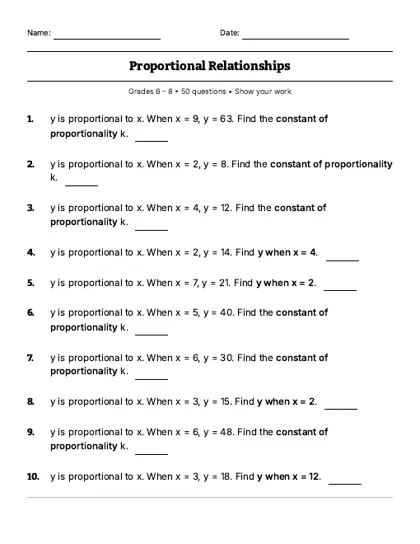
Proportional relationships worksheet: printable PDF with an answer key. · Make a fresh test
Ratio practice · ratio calculator · unit rate calculator · ratio games · ratios for kids · percentages
Last reviewed
Questions parents ask
What is a proportional relationship?
A relationship where y ÷ x is always the same number, so y = kx.
How do you know if a table is proportional?
Divide each y by its x. If every answer is the same, the table is proportional.
How do you know if a graph is proportional?
It is a straight line through the origin, (0, 0).
Is y = 2x + 3 proportional?
No. It is a straight line, but it does not pass through (0, 0).
What grade learns proportional relationships?
Grade 7 under Common Core 7.RP.A.2. In India, direct proportion in class 8.