
How to use a double number line
A double number line puts two amounts side by side. Matching marks show equivalent ratios, so you can read off missing values.
The idea: two number lines that move together
A double number line is two number lines, one above the other, that start at 0 together. Each mark on the top line lines up with a matching mark below.
For example, if 3 notebooks cost $4, mark 3 on the top and 4 below. Then 6 lines up with 8 and 9 with 12. Every pair is the same ratio, 3 : 4.
See it: pictures to draw with your child
Copy these onto paper or a whiteboard. A quick sketch makes the idea concrete before any written method.
How to draw a double number line
- Draw two lines of the same length, one above the other. Label each line with its unit, like notebooks and dollars.
- Put 0 at the left end of both lines.
- Mark the ratio you know, like 3 and $4, at the same point on both lines.
- Add equal steps along both lines: 6 and $8, 9 and $12.
- Find the mark for the value you need and read the matching number.
Using the line to find a unit rate
Split the first step into equal parts to reach 1. If 3 notebooks cost $4, divide both by 3: 1 notebook costs $1.33.
Halfway marks help too. If 4 laps take 10 minutes, then 2 laps take 5 minutes and 1 lap takes 2.5 minutes. See unit rates for more.
Draw a double number line
Type an amount and a quantity. The calculator draws the line and finds the unit rate.
Double number lines for percents
Put 0% to 100% on one line and the amounts on the other. If a game costs $60, then 100% lines up with $60, 50% with $30 and 10% with $6.
To find 30% of $60, count three 10% steps: $18. This picture is the main tool on percent of a number.
Why teachers love double number lines
A double number line shows the size of the numbers, not just a list. Children can see that the amounts grow together and that 0 matches 0.
It also leads to graphs. If you stand the lines up as axes, the matching pairs become points on a straight line through the origin.
Quiz: double number lines
Find the number that goes where the ? is.
Where this fits: ratios step by step
- What is a ratio
- Part-to-part and part-to-whole ratios
- Equivalent ratios
- Simplifying ratios
- Ratio tables
- Double number lines (this page)
- Tape diagrams
- Comparing ratios
- Unit rates
- Unit price and best buy
- Speed, distance and time
- Solving proportions
- Proportional relationships
- Constant of proportionality
- Scale drawings and maps
- Ratio word problems
What to say to your child
A short script for teaching it the first time. Pause after each line and let your child do the next step.
- “3 notebooks cost $4. Let’s draw two lines, notebooks on top and dollars below.”
- “Where does 0 go?” (At the start of both lines.)
- “Mark 3 and 4 together. What comes next?” (6 and 8.)
- “How much do 12 notebooks cost?” (16 dollars.)
- “What about 1 notebook?” (Split the first step into 3: about 1.33 dollars.)
More worked examples
Example 1: going up
2 cups of flour make 15 cookies. Mark 2, 4, 6 above and 15, 30, 45 below. 6 cups make 45 cookies.
Example 2: going down
100% is 80 points. Halve both: 50% is 40. Halve again: 25% is 20.
Example 3: a gap in the middle
4 tickets cost $18. 2 tickets cost $9, so 6 tickets cost $18 + $9 = $27.
Example 4: speed
A car goes 60 km in 1 hour. Mark 1, 2, 3 hours above and 60, 120, 180 km below. In 2.5 hours it goes 150 km.
Practice questions (answers below)
Ask these out loud or write them down. Check each answer, and ask “how did you get that?” for one or two.
- 2 : 5. What goes with 6?
- 3 : 10. What goes with 12?
- 4 : 7. What goes with 20?
- 5 : 8. What goes with 40 on the bottom line?
- 1 hour : 45 km. How far in 4 hours?
- 100% = 50. What is 20%?
- 100% = 80. What is 75%?
- 6 eggs : 2 cakes. Eggs for 5 cakes?
- 10 minutes : 4 laps. Laps in 25 minutes?
- Stretch: 3 pens cost $2. How much for 1 pen?
Show the answers
- 15
- 40
- 35
- 25
- 180 km
- 10
- 60
- 15
- 10
- About $0.67
Common mistakes
How to teach it at home
Recipe lines
Draw a double number line for a recipe and read off amounts for more people.
Road trip
Mark hours and kilometres for a car journey.
Savings line
Mark weeks and dollars saved at a fixed amount per week.
By grade
- Grade 6 (6.RP.A.3): solve ratio, rate and percent problems with double number lines.
- Grade 7: double number lines lead to graphs of proportional relationships.
- In India, the same idea appears as the unitary method in classes 6 to 8.
- Next: tape diagrams.
More for each grade: Grade 6 math and the CBSE class 6 maths guide.
Worksheets and practice
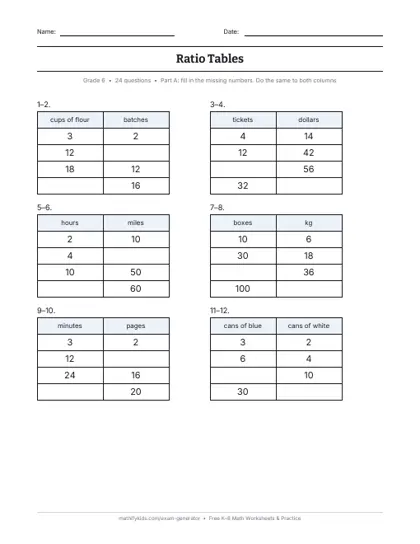
Ratio tables worksheet: printable PDF with an answer key. · Make a fresh test
Ratio practice · ratio calculator · unit rate calculator · ratio games · ratios for kids · percentages
Last reviewed
Questions parents ask
What is a double number line?
Two number lines, one above the other, with matching marks. Each pair of marks is an equivalent ratio.
How do you make a double number line?
Draw two lines from 0, mark the known ratio on both, then add equal steps along both lines.
When should you use a double number line?
For ratios, rates and percents, especially when you need a missing value or a unit rate.
How is a double number line different from a ratio table?
It shows the same pairs, but drawn to scale, so you can see how big the numbers are.
What grade learns double number lines?
Grade 6 under Common Core 6.RP.A.3. In India, class 6.