
Ratio tables
A ratio table lists equivalent ratios in rows. Multiply, divide or add rows to find a missing number. A quiz for kids, parent help below.
🧒 Kids: fill the table!
Each row is the same ratio, just bigger or smaller. Find the pattern and fill the gap. Then try the quiz!
💡 Trick: 1 pack has 6 pens. 3 packs? Times 3 on both sides: 18 pens!
More ratios: What is a ratio · Equivalent ratios · Simplifying ratios · Ratio tables · Tape diagrams · Unit rates
This part is for grown-ups: the key idea, pictures to draw, what to say, common mistakes, questions with answers and a free worksheet.
The trick: whatever you do to one column, do to the other
A ratio table has one column for each amount and one row for each equivalent ratio. To get a new row, multiply or divide both columns by the same number. You can also add two rows together.
- 1 pack : 6 pens, × 4: 4 packs : 24 pens
- 10 hours : $80, ÷ 10: 1 hour : $8
- 2 : 7 plus 3 : 10.5: 5 : 17.5
- Missing value: find the number you multiplied by, then use it on the other column
Patterns to spot
- Each column grows like a times table.
- The row for 1 is the unit rate.
- Adding two rows gives another correct row.
- Rows can go in any order, not only 1, 2, 3.
- Dividing every number in one column by the matching number in the other always gives the same answer.
- The pairs in a ratio table make a straight line through 0 on a graph.
See it: pictures to draw with your child
Draw these on paper or a whiteboard. A quick sketch makes the idea concrete before any rules.
What your child already knows
Children already know times tables and how to multiply and divide. A ratio table is just two times tables side by side, lined up so that each row keeps the same ratio.
In real life: Price lists, recipe charts, fuel use and exchange rates are ratio tables. Make one together when shopping: 1 bag costs $3, 2 bags $6, 5 bags $15.
Four ways to fill a ratio table
- Multiply: times both columns by the same number to jump down the table.
- Divide: divide both columns by the same number to go back up, often to the row for 1.
- Add two rows: the row for 2 plus the row for 3 makes the row for 5.
- Use the unit rate: find the row for 1, then multiply to reach any row.
For example, if 4 tickets cost $18, then 2 tickets cost $9 and 6 tickets cost $18 + $9 = $27. The ratio table tool fills tables for you.
Worked examples
Example 1: Missing value by multiplying
- 3 cups of flour make 24 cookies.
- How many cookies from 9 cups? 3 × 3 = 9, so multiply the cookies by 3 too: 24 × 3 = 72 cookies.
Example 2: Through the row for 1
- 4 notebooks cost $6.
- How much do 10 cost?
- Divide by 4: 1 notebook costs $1.50.
- Multiply by 10: $15.
Example 3: Adding rows
- 2 laps take 5 minutes and 3 laps take 7.5 minutes.
- How long for 5 laps?
- Add the rows: 5 + 7.5 = 12.5 minutes.
Common mistakes
What to say to your child
A short script for your first session. Pause after each line and let your child answer.
- “1 pack has 6 pens. How many pens in 2 packs?” (12.)
- “What did we do to the packs? What did we do to the pens?” (Times 2 both times.)
- “How many pens in 10 packs?” (60.)
- “If we know 2 packs and 3 packs, how do we get 5 packs?” (Add the rows.)
- “What is the row for 1 called?” (The unit rate.)
Questions to try (answers below)
Ask these out loud or write them down. The last one is a stretch.
- 1 : 4, 2 : 8, 3 : ?
- 2 : 5, 4 : 10, 8 : ?
- 10 : 30, 5 : 15, 1 : ?
- 3 cups make 12 pancakes. 6 cups make?
- 4 tickets cost $20. 1 ticket costs?
- 5 hours earn $60. 3 hours earn?
- 2 : 3 and 3 : 4.5. What is the row for 5?
- 6 apples cost $4. 9 apples cost?
- Stretch: 8 m of rope weighs 2 kg. How much does 20 m weigh?
Show the answers
- 12
- 20
- 3
- 24
- $5
- $36
- 5 : 7.5
- $6
- 5 kg
Games to play at home
Shopping table
Make a ratio table of prices for 1 to 10 items of something you buy often.
Recipe rows
Write a recipe as a ratio table for 1, 2 and 4 batches.
Table race
Each player fills a ratio table to 10 rows. Check with a calculator.
A 5-day plan for ratio tables
Ten minutes a day is enough. Short, regular practice works far better than one long session.
- Day 1: Learn it with real things: counters, snacks, a recipe or a price label, like the pictures above.
- Day 2: Read the script together, then ask the first four questions.
- Day 3: Do the quiz at the top of the page and read the hints for anything missed.
- Day 4: Play one of the games at home for ten minutes.
- Day 5: Ask the rest of the questions, then do a round of the matching ratio practice skill.
By grade
Grade 6 (Common Core 6.RP.A.3a) makes tables of equivalent ratios, finds missing values and plots the pairs on a coordinate plane. Grade 7 uses tables to decide if quantities are proportional. In India, the unitary method in classes 6 to 8 uses the same idea.
More for each grade: Grade 6 math and the CBSE class 6 maths guide.
What comes next
Next, try tape diagrams and unit rates. Practice tables with ratio practice.
Worksheet and more practice
Print a free worksheet with an answer key, or keep practicing online with ratio practice.
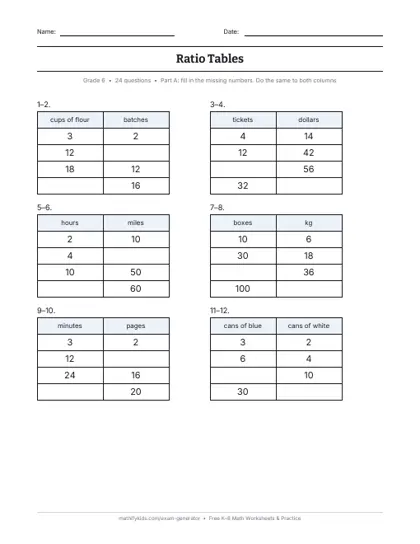 Ratio tables
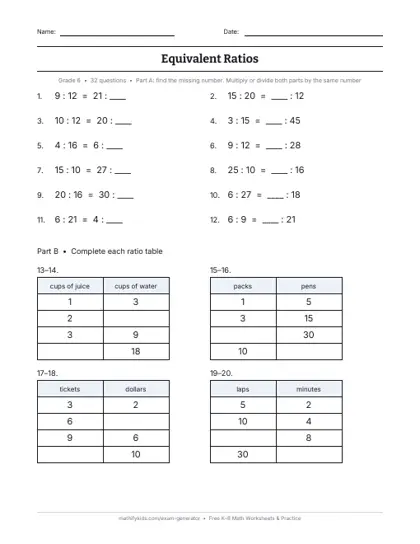 Equivalent ratios
Printable PDFs: ratios worksheet · unit rates worksheet · make a fresh ratio test
More: ratios for kids · ratio calculator · unit rate calculator · ratio practice · percentages for kids · fractions for kids
Last reviewed
Questions parents ask
What is a ratio table?
A table of equivalent ratios, with one column for each amount and one row for each ratio.
How do you fill in a ratio table?
Multiply or divide both columns by the same number, or add two rows together.
How do you find a missing value in a ratio table?
Find what the known number was multiplied or divided by, then do the same to the other column.
What is the row for 1 in a ratio table?
It is the unit rate: the amount for one. Once you know it, you can reach any row.
What grade learns ratio tables?
Grade 6 under Common Core 6.RP.A.3a. In India, class 6.