
1st grade math
First grade is the year children move from counting to calculating: addition and subtraction within 20 with real strategies, tens and ones, and telling time. This page lists every skill in order, what mastery looks like, signs a child needs help, and free 1st grade worksheets and lessons.
What 1st graders learn in math
The Common Core focuses grade 1 on four things: addition and subtraction within 20 using strategies, place value with tens and ones, measuring length with units, and reasoning about shapes. By the end of the year, facts within 10 should be fluent.
1st grade math skills, in order
Operations and algebraic thinking
Word problems to 20, addition and subtraction facts using strategies like counting on, making 10 and doubles, fact families, and understanding the equals sign (is 6 = 4 + 2 true?).
Number and operations in base ten
Count to 120, tens and ones, compare two-digit numbers with >, < and =, add within 100 using tens and ones, and find 10 more or 10 less in your head.
Measurement and data
Order objects by length and measure them with units, tell time to the hour and half hour, and read simple charts with up to three categories.
Geometry
Tell defining features (closed, three sides) from features that don’t matter (color, size), put shapes together to make new shapes, and split circles and rectangles into halves and fourths.
What mastery looks like by the end of the year
- Adds and subtracts within 20 using a strategy, and within 10 from memory.
- Solves 8 + 5 by making 10: 8 + 2 + 3.
- Knows that 47 is 4 tens and 7 ones, and compares 47 and 74.
- Says 10 more and 10 less than any number to 100 without counting.
- Tells time to the hour and half hour on an analog clock.
- Splits a rectangle into two halves or four fourths.
Signs your child needs extra help
- Counts every fact from 1 on fingers, even small ones like 3 + 2.
- Writes 74 for “forty-seven” or mixes up teen numbers.
- Thinks the equals sign means “the answer comes next”.
- Can’t find 10 more than 36 without counting on by ones.
- Has no strategy for facts like 9 + 6 except counting.
Number bonds to 10 are the key to almost every grade 1 strategy. If they are shaky, start with the number bonds lesson.
Try a 1st grade math problem
Tap a question to see the answer and how to get it.
What is 8 + 5?
13. Make 10: 8 + 2 = 10, then 3 more.
What is 13 − 4?
9. Take 3 to get to 10, then 1 more.
What is 10 more than 36?
46. The tens digit goes up by 1.
Which is bigger, 47 or 74?
74. It has 7 tens; 47 has only 4 tens.
Is 7 = 3 + 4 true?
Yes. Both sides are worth 7.
What time is it when the big hand is on 6 and the small hand is just past 2?
Half past 2, or 2:30.
1st grade math worksheets
Each one is a free PDF with an answer key and its own page with a preview, tips and a button to make a new version.
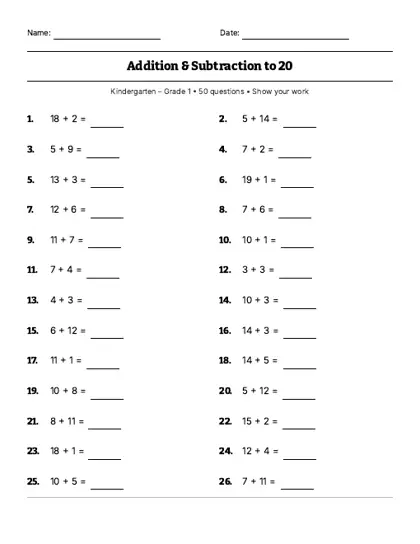 Addition factsGrades 1–2
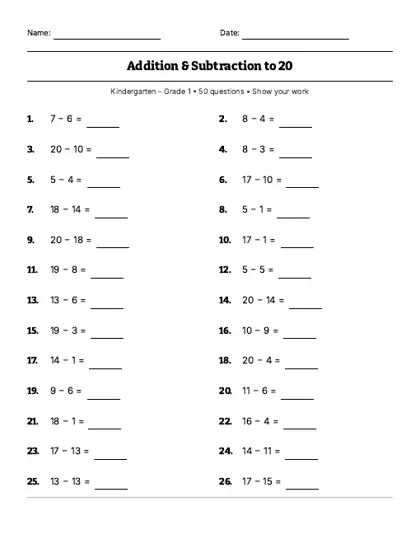 Subtraction factsGrades 1–2
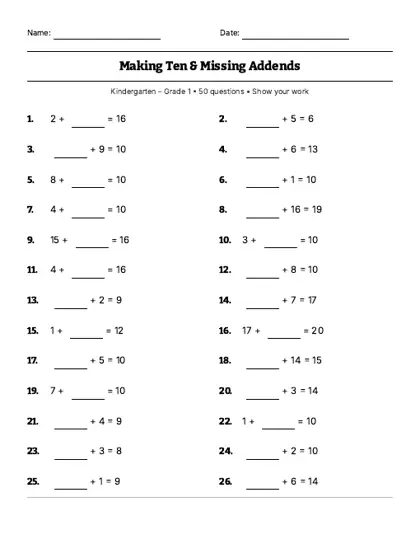 Number bondsKindergarten and grade 1
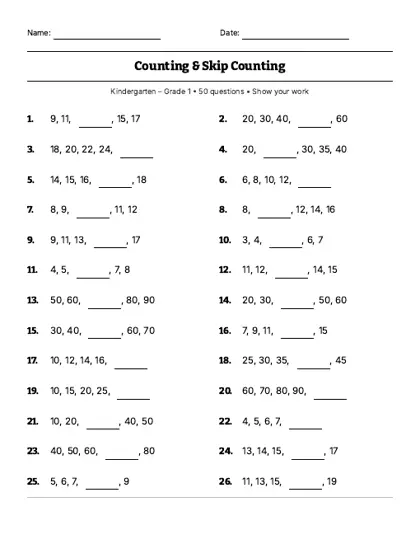 Skip countingGrades 1–2
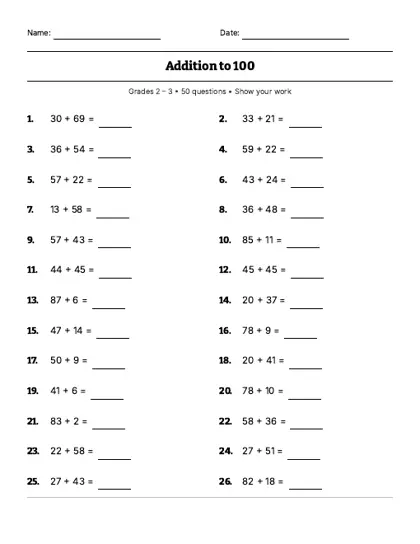 2-digit additionGrades 1–2
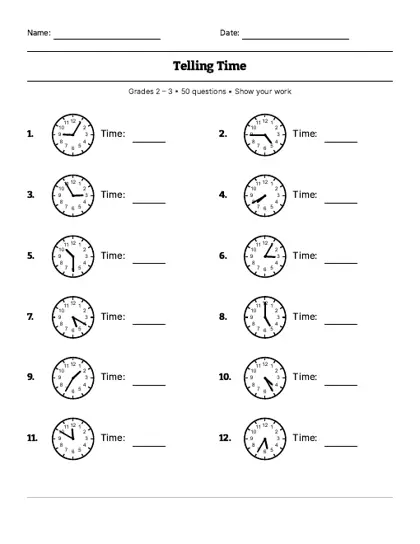 Telling timeGrades 1–3
More 1st grade PDFs
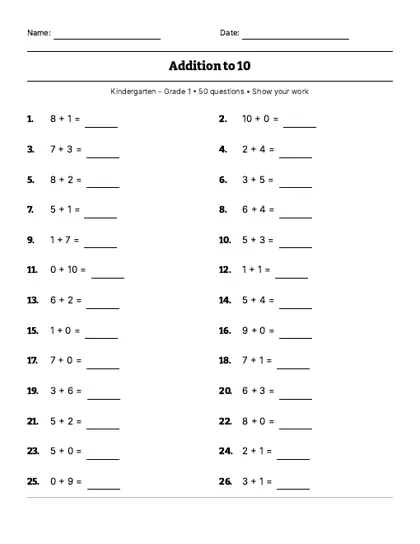 Addition to 10Kindergarten–grade 1
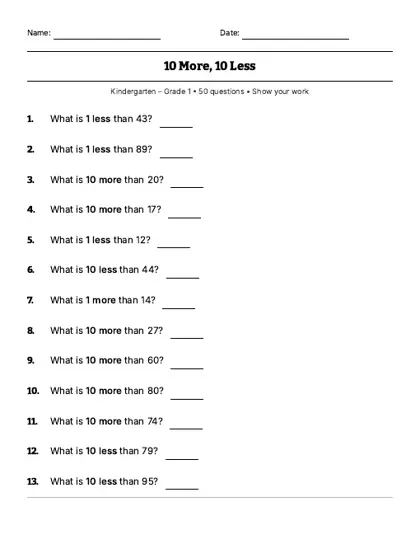 10 more, 10 lessGrade 1
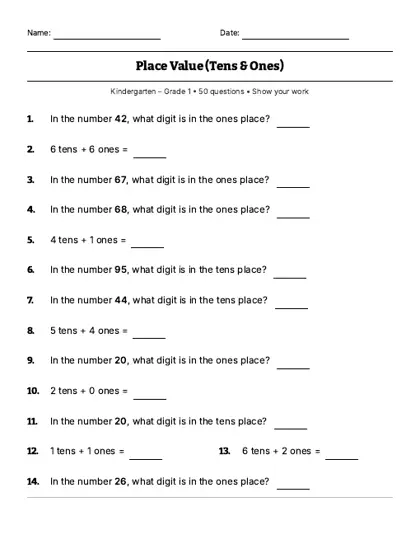 Tens and onesGrade 1
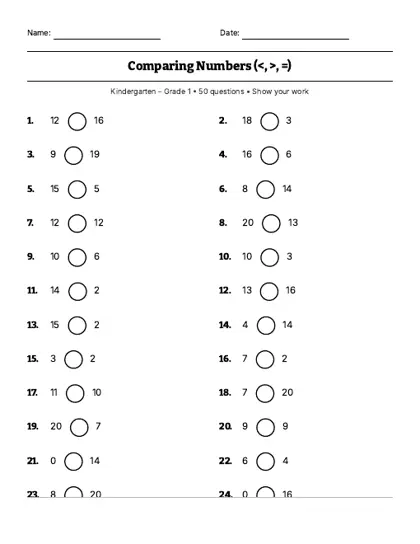 Comparing numbers to 100Grade 1
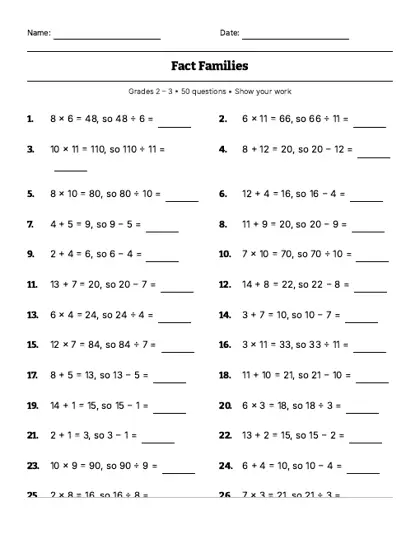 Fact familiesGrades 1–3
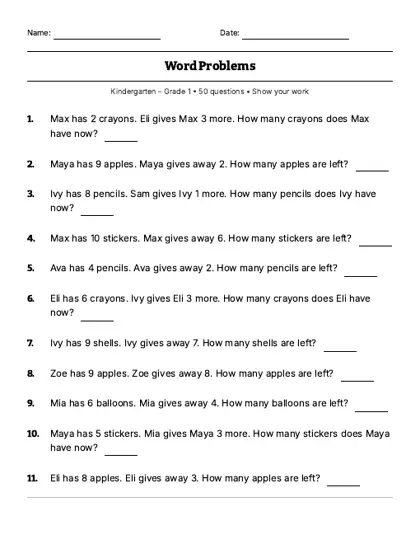 Word problems K–1Adding and taking away
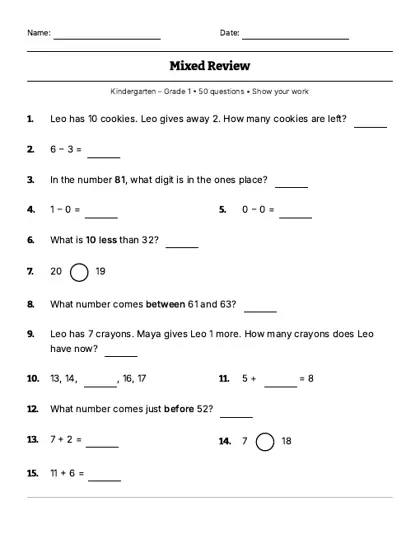 Mixed review K–1End-of-year check
1st grade math lessons and charts
- Addition factsStrategies to 20
- Subtraction factsThink addition
- Number bondsPairs that make 10
- Place valueTens and ones
- Comparing numbersGreater than, less than
- Telling timeHour and half hour
- Addition chartFacts to 20
- Time chartReading clocks
How to help with 1st grade math at home
Play make 10
With a deck of cards (aces to 9), find pairs that make 10. It is the most useful game for grade 1.
Count by tens
Count money in dimes, or bundle straws in tens. Ask “what is 10 more?” while counting.
Read real clocks
Ask the time on an analog clock at breakfast, after school and at bedtime.
Dice addition
Roll two dice and add, saying the strategy: “5 and 6, that’s double 5 plus 1, 11.”
See kindergarten math for the year before and 2nd grade math for what comes next.
Last reviewed
Questions parents ask
What math do 1st graders learn?
Addition and subtraction within 20 with strategies, tens and ones, counting to 120, comparing two-digit numbers, 10 more and 10 less, measuring length, telling time to the half hour, and halves and fourths of shapes.
Should 1st graders know their addition facts?
By the end of grade 1, facts within 10 should be fluent (1.OA.C.6). All facts within 20 are expected from memory by the end of grade 2.
How do I help my 1st grader with addition?
Teach counting on from the bigger number, then making 10 (8 + 5 = 8 + 2 + 3) and doubles. Practice a few facts daily with games.
What place value do 1st graders learn?
Tens and ones: that 10 ones make a ten, that 47 is 4 tens and 7 ones, and how to compare two-digit numbers.
Do 1st graders learn to tell time?
Yes, to the hour and half hour on analog and digital clocks (1.MD.B.3).
My child is behind in 1st grade math. Where do I start?
With counting and number bonds to 10. They are the base for every strategy in grade 1.