
3D shapes worksheet
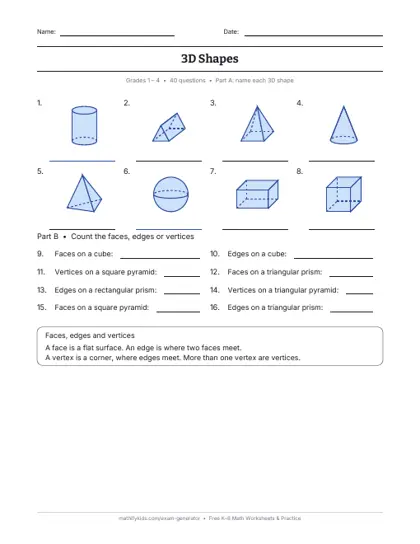
Forty questions on 3D shapes: name cubes, prisms, pyramids, cylinders, cones and spheres, count faces, edges and vertices, solve riddles, match nets and name real objects.
Download the free 3D shapes worksheet (PDF)
3D shapes worksheet
What’s on the worksheet
- 40 questions on 3D shapes, sized for US Letter paper
- 2 pages of questions plus an answer key on the last page
- Written for grades 1–4, matching Common Core K.G.A.2, 1.G.A.2, 2.G.A.1
- Name and date lines at the top, and room to show the work
Sample questions from this worksheet
- Name the 3D shape (picture).
- Edges on a cube:
- Vertices on a square pyramid:
- I have 2 triangle faces and 3 rectangle faces. What am I?
- Which 3D shape does this net fold into?
- Name the 3D shape of a can of soup.
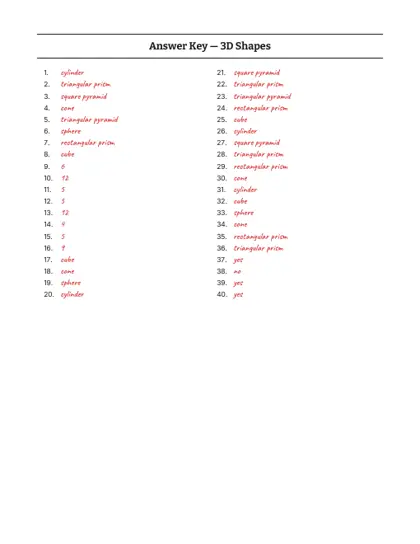
Preview the worksheet and answer key
Practice 3D shapes online
Between worksheets, a few minutes of online practice keeps the skill fresh. The 3D shapes practice draws a solid and asks for its name or its faces, edges and vertices. For a game, try Shape Match with 3D shapes, or Geometry Bingo with sides, faces and edges.
3D shapes: a worked example (How many edges does a cube have?)
- A cube has a top square with 4 edges.
- The bottom square has 4 more edges.
- 4 edges go straight up the sides, joining top to bottom.
- 4 + 4 + 4 = 12 edges.
How to use it at home and in class
At home
Collect a box, a can, a ball and an ice cream cone before starting, and let your child hold each shape while they answer. Count edges by running a finger along them, and put a sticker on each vertex. For Part D, unfold a small cereal box to see a real net. The faces, edges and vertices lesson has a table for every shape. Ten problems a day works better than a whole sheet at once. Mark them together with the answer key, then ask your child to explain one they got wrong: finding the mistake themselves is where the learning happens.
In class
Use the first row as a warm-up, a full page for independent practice, or five questions as an exit ticket. For a retake or a second group, make a new version with the test maker so every child gets different numbers.
Mistakes to watch for
- Counting only the faces you can see in the picture, not the hidden ones.
- Mixing up edges (lines) and vertices (corners).
- Calling a cube a square, or a sphere a circle: those are flat shapes.
- Thinking a pyramid and a prism are the same because both have triangles.
What to practice before and after 3D shapes
- Before: naming 2D shapes. If this sheet is a struggle, go back a step.
- After: lines, rays and line segments, once this one is mostly right.
- Learn it first: the 3D shapes lesson and the 3d shapes chart.
More geometry worksheets
Last reviewed
Questions parents ask
How many faces, edges and vertices does a cube have?
6 faces, 12 edges and 8 vertices. A rectangular prism has the same numbers, but its faces are rectangles instead of squares.
What grade is this 3D shapes worksheet for?
It is written for grades 1–4 and matches Common Core standards K.G.A.2, 1.G.A.2, 2.G.A.1.
Is there an answer key for this 3D shapes worksheet?
Yes. The last page of the PDF has every answer, so you can mark the sheet in a few minutes and talk through any mistakes together.