
How to tell time on a clock
To tell time on an analog clock, read the short hand for the hour and the long hand for the minutes, counting by 5s round the numbers. This page covers o’clock and half past (grade 1), times to 5 minutes (grade 2), to the minute and elapsed time (grade 3), with an interactive clock that also adds time.
The two hands
- Short hand (hour): points to the hour. Between two numbers, it is still the earlier hour.
- Long hand (minutes): each number is 5 minutes. On the 3 it is 15 minutes, on the 6 it is 30, on the 9 it is 45.
Interactive clock
Set the hour and minutes. Add time to see elapsed time worked out.
How to read the time, step by step
- Hour: which number has the short hand just passed? That is the hour.
- Minutes: count by 5s from the 12 to the long hand, then add single minutes for the small marks.
- Say it: 3:45, or “quarter to 4”.
Quarter past, half past, quarter to
| 3:00 | three o’clock |
| 3:15 | quarter past three |
| 3:30 | half past three |
| 3:45 | quarter to four |
| 3:50 | ten to four |
Elapsed time (grade 3)
Count on in easy chunks. From 2:45 to 3:20: 15 minutes to 3:00, then 20 more, so 35 minutes. A number line with the hours marked helps. Remember 60 minutes make an hour, so 2:30 + 45 minutes is 3:15, not 2:75.
Common mistakes
How to teach it at home
Ask the time often
Use an analog clock at home and ask the time at meals and bedtime.
How long until…?
“The movie starts at 4:15. It’s 3:50. How long?”
Make a paper clock
With movable hands, set times and read them.
By grade
- Grade 1 (1.MD.B.3): to the hour and half hour.
- Grade 2 (2.MD.C.7): to the nearest 5 minutes, with a.m. and p.m.
- Grade 3 (3.MD.A.1): to the minute, and elapsed time.
Worksheets and practice
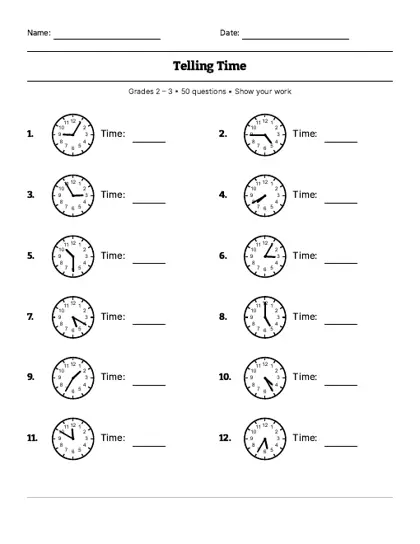
Telling time worksheet: printable PDF with an answer key. · Make a fresh test
Last reviewed
Questions parents ask
How do you teach a child to tell time?
Start with o’clock and half past, then counting by 5s for minutes, then single minutes. Practice on a real analog clock every day.
Which hand shows the hour?
The short hand. The long hand shows the minutes.
What does quarter to mean?
15 minutes before the next hour. Quarter to 4 is 3:45.
How do you work out elapsed time?
Count on from the start time in easy chunks: to the next hour, then the rest.
What grade learns to tell time?
Grade 1 to the half hour, grade 2 to 5 minutes, grade 3 to the minute and elapsed time.