
Rounding decimals
To round a decimal, look at the next digit to the right: 5 or more rounds up, 4 or less rounds down. 3.47 rounds to 3.5.
The big idea: which is closer?
Rounding asks one question: which nice number is this closest to? On a number line, 3.47 sits between 3.4 and 3.5. It is only 3 hundredths from 3.5 but 7 hundredths from 3.4, so it rounds to 3.5.
The digit just to the right of the rounding place tells you which way is closer. That is why the rule looks at only one digit.
See it: pictures to draw with your child
Copy these onto paper or a whiteboard. A quick sketch makes the idea concrete before any written method.
Rounding decimals on a number line
Type a decimal and choose nearest whole number, tenth or hundredth.
How to round decimals, step by step
- Find the rounding place. Tenths is the first digit after the point, hundredths the second.
- Look one place to the right. Underline it if that helps.
- 5 or more: add 1 to the rounding digit. 4 or less: leave it.
- Drop every digit after the rounding place. Don’t replace them with zeros, as you would with whole numbers.
Rounding to a whole number, a tenth or a hundredth
- Nearest whole number: look at the tenths. 12.6 rounds to 13, and 8.39 rounds to 8.
- Nearest tenth: look at the hundredths. 6.83 rounds to 6.8, and 2.75 rounds to 2.8.
- Nearest hundredth: look at the thousandths. 6.832 rounds to 6.83, and 1.005 rounds to 1.01.
The same number can round differently to different places: 4.376 is 4 to the nearest whole, 4.4 to the nearest tenth and 4.38 to the nearest hundredth.
The tricky case: rounding up past 9
Round 4.96 to the nearest tenth. The hundredths digit is 6, so round up: 9 tenths become 10 tenths. But 10 tenths is 1 whole, so the answer is 5.0, not 4.10.
Keep the zero in 5.0 when the question asks for the nearest tenth. It shows the number was rounded to one decimal place.
Why does 5 round up?
A number like 2.45 is exactly halfway between 2.4 and 2.5. Neither is closer, so we need a rule, and the school rule is to round halfway numbers up. That keeps things simple: 5, 6, 7, 8 and 9 round up, while 0 to 4 round down.
Some scientists and banks use other rules for exact halves, but children only need the round-up rule until high school.
Where rounding is used
Rounding is everywhere decimals get long. Calculators show answers like 2.6666667, which we round to 2.67. Race times, distances on a map and the weather forecast are all rounded to make them easy to read.
Rounding is also the first step of estimating. Round each number, do the easy sum in your head, and you have a check for the exact answer.
Rounding money
For estimating, round prices to the nearest dollar: $4.79 is about $5 and $12.25 is about $12. Calculations with money round to the nearest cent, which is the nearest hundredth. See estimating with decimals.
Quiz: rounding decimals
Round each decimal. Type answers with a point, like 3.5.
Where this fits: decimals step by step
- What are decimals
- Tenths
- Hundredths
- Decimal place value
- Reading and writing decimals
- Thousandths
- Decimals on a number line
- Comparing decimals
- Ordering decimals
- Rounding decimals (this page)
- Estimating with decimals
- Decimals and money
- Adding decimals
- Subtracting decimals
- × and ÷ by 10, 100 and 1,000
- Decimals × whole numbers
- Multiplying decimals
- Dividing decimals by whole numbers
- Dividing decimals
- Decimals to fractions
- Fractions to decimals
- Decimal word problems
What to say to your child
A short script for teaching it the first time. Pause after each line and let your child do the next step.
- “Is 3.47 closer to 3.4 or 3.5?” (3.5.)
- “Which digit told you?” (The 7.)
- “7 is 5 or more, so round up.”
- “Now 4.96 to the nearest tenth.” (5.0: 9 tenths plus 1 is 10 tenths.)
- “About how much is $12.25?” (About $12.)
More worked examples
Example 1: nearest tenth
3.47 → look at 7 → 3.5.
Example 2: nearest hundredth
6.832 → look at 2 → 6.83.
Example 3: nearest whole
12.6 → look at 6 → 13.
Example 4: past 9
4.96 to the nearest tenth → 5.0.
Practice questions (answers below)
Ask these out loud or write them down. Check each answer, and ask “how did you get that?” for one or two.
- Round 2.3 to the nearest whole
- Round 7.8 to the nearest whole
- Round 4.35 to the nearest tenth
- Round 6.12 to the nearest tenth
- Round 3.456 to the nearest hundredth
- Round 9.95 to the nearest tenth
- Round $5.49 to the nearest dollar
- Round 0.749 to the nearest tenth
- Round 12.505 to the nearest hundredth
- Stretch: round 2.999 to the nearest hundredth
Show the answers
- 2
- 8
- 4.4
- 6.1
- 3.46
- 10.0
- $5
- 0.7
- 12.51
- 3.00
Common mistakes
How to teach it at home
Price estimates
Round shopping prices to the nearest dollar and keep a running total.
Sports times
Round race times to the nearest tenth of a second.
Measurements
Round heights in metres to one decimal place.
By grade
- Grade 5 (5.NBT.A.4): round decimals to any place.
- Before: rounding whole numbers.
- Next: estimating with decimals.
More for each grade: Grade 5 math and the CBSE class 5 maths guide.
Worksheets and practice
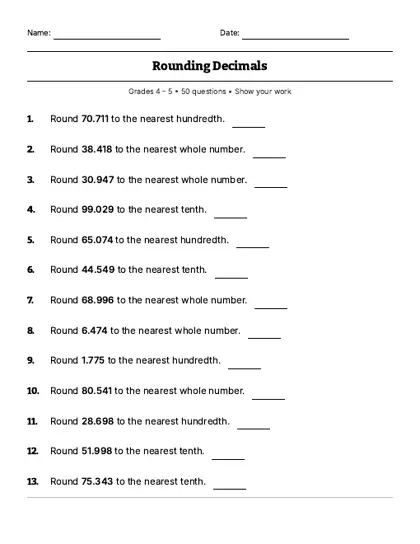
Rounding decimals worksheet: printable PDF with an answer key. · Make a fresh test
Decimal practice · decimal calculator · place value chart · decimals quiz · decimal levels · decimal games · decimals for kids
Last reviewed
Questions parents ask
How do you round a decimal to the nearest tenth?
Look at the hundredths digit. If it is 5 or more, round the tenths up; if 4 or less, leave it. Then drop the rest.
How do you round to the nearest hundredth?
Look at the thousandths digit and use the same 5-or-more rule.
What is 4.96 rounded to the nearest tenth?
5.0. The 9 tenths become 10 tenths, which is one more whole.
Do you add zeros when rounding decimals?
No. Drop the digits after the rounding place. 3.47 rounds to 3.5, not 3.50.
What grade learns rounding decimals?
Grade 5 (5.NBT.A.4).