
Dividing decimals
To divide by a decimal, move the point in both numbers the same number of places until the divisor is a whole number. Then divide as normal.
The big idea: make the divisor whole
Dividing by a whole number is easy, so the trick is to turn the divisor into one. Multiply both numbers by 10, 100 or 1,000. That doesn’t change the answer, because a division is like a fraction: 3.25 ÷ 2.5 = 32.5 ÷ 25, just as 6/8 = 3/4.
See it: pictures to draw with your child
Copy these onto paper or a whiteboard. A quick sketch makes the idea concrete before any written method.
How to divide decimals, step by step
- Count the decimal places in the divisor (the number you divide by): 2.5 has 1.
- Move the point that many places right in both numbers: 3.25 ÷ 2.5 becomes 32.5 ÷ 25.
- Divide by the whole number, putting the point above the point: 32.5 ÷ 25 = 1.3.
- Check: 1.3 × 2.5 = 3.25.
Divide any two decimals
Try 3.25 ÷ 2.5, then 0.6 ÷ 0.03. The calculator shows the moved points.
When you need extra zeros
Sometimes the dividend runs out of places when you move the point. Fill the gaps with zeros.
For example, 6 ÷ 0.03 needs the point moved 2 places: 6 becomes 600, and 0.03 becomes 3. So 6 ÷ 0.03 = 600 ÷ 3 = 200.
Why the answer can be bigger
Dividing by a number less than 1 gives a bigger answer. That surprises many children. 6 ÷ 0.5 asks “how many halves are in 6?”, and the answer is 12. Thinking “how many fit?” makes it sensible: twelve 50-cent coins make $6.
Estimate to check
Estimate before dividing: 9.6 ÷ 2.4 is about 10 ÷ 2.5 = 4. If your answer is 0.4 or 40, a point has moved too far. See estimating with decimals and × and ÷ by 10, 100 and 1,000 for how points move.
Dividing decimals as “how many fit?”
Most decimal division questions can be read as “how many of these fit into that?”.
For example, 2.4 ÷ 0.4 asks how many 0.4s fit into 2.4. Count up in 0.4s: 0.4, 0.8, 1.2, 1.6, 2.0, 2.4. That is 6.
A number line shows the same thing as jumps. Draw a line from 0 to 2.4 and mark jumps of 0.4. Counting the jumps gives the answer, and it shows why dividing by a small number gives a big answer.
Money gives quick practice too. How many 25-cent coins make $3?
Four make a dollar, so twelve make $3. That means 3 ÷ 0.25 = 12.
Once this idea is secure, the move-the-point method feels natural. Moving both points is just a faster way of counting the same jumps.
Encourage children to check with multiplication every time. If 2.4 ÷ 0.4 = 6, then 6 × 0.4 should give 2.4, and it does.
Quiz: dividing decimals
Move both points first. Type answers with a point where needed.
Where this fits: decimals step by step
- What are decimals
- Tenths
- Hundredths
- Decimal place value
- Reading and writing decimals
- Thousandths
- Decimals on a number line
- Comparing decimals
- Ordering decimals
- Rounding decimals
- Estimating with decimals
- Decimals and money
- Adding decimals
- Subtracting decimals
- × and ÷ by 10, 100 and 1,000
- Decimals × whole numbers
- Multiplying decimals
- Dividing decimals by whole numbers
- Dividing decimals (this page)
- Decimals to fractions
- Fractions to decimals
- Decimal word problems
What to say to your child
A short script for teaching it the first time. Pause after each line and let your child do the next step.
- “How many 50-cent coins make $3?” (6.)
- “So 3 ÷ 0.5 = 6. The answer is bigger than 3!”
- “Now 3.25 ÷ 2.5. Make 2.5 whole: × 10.” (25.)
- “Do the same to 3.25.” (32.5.) “32.5 ÷ 25?” (1.3.)
- “Check: 1.3 × 2.5.” (3.25.)
More worked examples
Example 1: one place
4.8 ÷ 0.6 = 48 ÷ 6 = 8.
Example 2: two places
0.36 ÷ 0.04 = 36 ÷ 4 = 9.
Example 3: adding zeros
6 ÷ 0.03 = 600 ÷ 3 = 200.
Example 4: decimal answer
3.25 ÷ 2.5 = 32.5 ÷ 25 = 1.3.
Practice questions (answers below)
Ask these out loud or write them down. Check each answer, and ask “how did you get that?” for one or two.
- 2.4 ÷ 0.4
- 1.5 ÷ 0.3
- 0.72 ÷ 0.08
- 6 ÷ 0.5
- 4.5 ÷ 1.5
- 3.25 ÷ 2.5
- 0.9 ÷ 0.03
- How many 0.25 L cups from 3 L?
- Estimate 19.6 ÷ 4.9
- Stretch: 0.006 ÷ 0.002
Show the answers
- 6
- 5
- 9
- 12
- 3
- 1.3
- 30
- 12
- About 4
- 3
Common mistakes
How to teach it at home
Cups and jugs
How many 0.25 L cups fill a 2 L jug? Pour and check.
Coins
How many 20-cent coins make $3.60?
Fabric
How many 0.4 m pieces can be cut from 2.8 m?
By grade
- Grade 5 (5.NBT.B.7): divide decimals to hundredths using models and place value.
- Grade 6 (6.NS.B.3): divide multi-digit decimals fluently with the standard algorithm.
- Next: decimals to fractions.
More for each grade: Grade 5 math and the CBSE class 5 maths guide; Grade 6 math and the CBSE class 6 maths guide.
Worksheets and practice
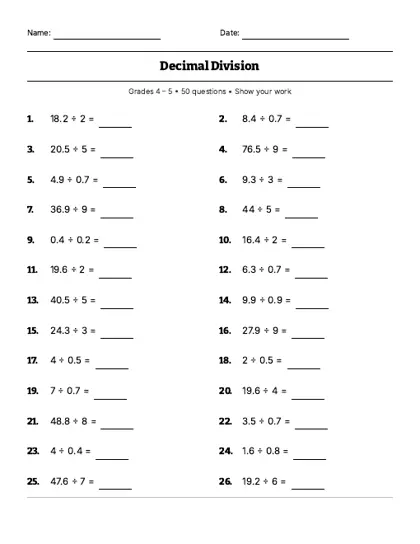
Dividing decimals worksheet: printable PDF with an answer key. · Make a fresh test
Decimal practice · decimal calculator · place value chart · decimals quiz · decimal levels · decimal games · decimals for kids
Last reviewed
Questions parents ask
How do you divide decimals?
Move both points the same number of places until the divisor is whole. Then divide: 3.25 ÷ 2.5 = 32.5 ÷ 25 = 1.3.
Why can you move both points?
Multiplying both numbers by the same amount doesn’t change a division, just as 6/8 = 3/4.
Why is 6 ÷ 0.5 bigger than 6?
It asks how many halves fit in 6. Twelve do.
What if I run out of digits when moving the point?
Add zeros: 6 ÷ 0.03 = 600 ÷ 3 = 200.
What grade learns dividing decimals?
Grade 5 meets it with models; grade 6 learns the standard method (6.NS.B.3).