
Metric conversion for kids
Metric units go up in tens, so converting is just multiplying or dividing by 10, 100 or 1,000, which means moving the decimal point. 2.5 m = 250 cm and 1,500 g = 1.5 kg. This page explains the prefixes, the conversion tables, the staircase method and a converter.
The metric prefixes
| Prefix | Means | Example |
|---|---|---|
| kilo- | 1,000 | 1 km = 1,000 m |
| centi- | 1/100 | 100 cm = 1 m |
| milli- | 1/1,000 | 1,000 mm = 1 m, 1,000 mL = 1 L |
The base units are the meter (length), gram (mass) and liter (capacity). The same prefixes work for all three.
Metric conversions to know
| Length | 10 mm = 1 cm · 100 cm = 1 m · 1,000 m = 1 km |
| Mass | 1,000 g = 1 kg |
| Capacity | 1,000 mL = 1 L |
How to convert: move the decimal point
- Bigger unit to smaller (m to cm): multiply, so the point moves right. 2.5 m × 100 = 250 cm.
- Smaller unit to bigger (g to kg): divide, so the point moves left. 1,500 g ÷ 1,000 = 1.5 kg.
- Count the zeros in the conversion number: that is how many places the point moves.
See multiplying by 10, 100 and 1000 for the place value behind it.
Unit converter
Pick a measure and units (try m to cm, or g to kg).
Worked examples
3.2 km to m
× 1,000: 3,200 m.
45 mm to cm
÷ 10: 4.5 cm.
750 mL to L
÷ 1,000: 0.75 L.
2 kg 300 g in grams
2,000 + 300 = 2,300 g.
Common mistakes
How to teach it at home
Kitchen scales
Weigh fruit in grams, then say it in kilograms.
Water bottles
Read mL on bottles and add them up to liters.
Measure the room
Measure in meters and centimeters, then convert.
By grade
- Grade 4 (4.MD.A.1): convert from larger to smaller metric units.
- Grade 5 (5.MD.A.1): convert in both directions, including decimals.
- See also customary units.
Worksheets and practice
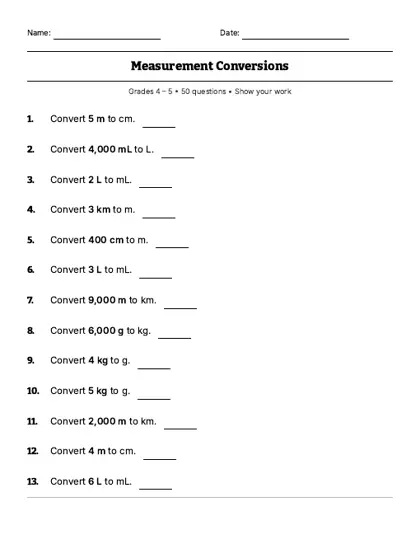
Metric units worksheet: printable PDF with an answer key. · Make a fresh test
Last reviewed
Questions parents ask
How many centimeters are in a meter?
100.
How many grams are in a kilogram?
1,000.
How many milliliters are in a liter?
1,000.
How do you convert metric units?
Multiply or divide by 10, 100 or 1,000, which moves the decimal point. To a smaller unit, multiply; to a bigger unit, divide.
Why is the metric system easier?
Every conversion is a power of 10, so you only move the decimal point. Customary units use numbers like 12, 3 and 16.