
3-digit subtraction with borrowing, step by step
To subtract 3-digit numbers, line them up by place value and subtract one column at a time, starting with the ones. When a top digit is too small, borrow: trade 1 from the next column for 10 in this one. This page shows how and why it works, the mistakes children make, and ways to practice, with a step-by-step tool you can use with any problem from homework.
3-digit subtraction: the big idea
A 3-digit number is made of hundreds, tens and ones. 452 is 4 hundreds, 5 tens and 2 ones. Subtracting 128 means taking away 1 hundred, 2 tens and 8 ones.
The only tricky part is when a column doesn’t have enough. You can’t take 8 ones from 2 ones. But one of the tens can be swapped for 10 ones, so you have 12 ones instead. The number hasn’t changed, only how it is split up. That swap is borrowing, also called regrouping.
How to subtract 3-digit numbers with borrowing, step by step
- Line up the numbers so hundreds, tens and ones sit in columns. The bigger number goes on top.
- Start with the ones. If the top digit is smaller than the bottom one, borrow: cross out the tens digit, write one less above it, and put a 1 in front of the ones digit (2 becomes 12).
- Subtract the ones, then move left to the tens. Use the new tens digit, and borrow from the hundreds if it is still too small.
- Subtract the hundreds.
- Check by adding your answer to the bottom number. You should get the top number.
Try any subtraction problem
Type the problem from your child’s worksheet. The tool shows each column, each borrow and the reason for it, one step at a time.
Worked examples: from no borrowing to subtracting across zeros
The red numbers show what each digit becomes after borrowing. A crossed-out digit has been traded.
Example 1: No borrowing needed
Every top digit is bigger than the one below it, so each column is a basic subtraction fact: 4 − 3 = 1, 8 − 5 = 3, 6 − 2 = 4.
Example 2: Borrow once, from the tens
2 ones is not enough to take 8. Trade 1 ten for 10 ones: the 5 tens become 4 and the 2 ones become 12. Then 12 − 8 = 4, 4 − 2 = 2, 4 − 1 = 3.
Example 3: Borrow twice
Ones: trade a ten, 15 − 7 = 8. Tens: now only 3 tens, not enough for 8, so trade a hundred: 13 − 8 = 5. Hundreds: 5 − 2 = 3.
Example 4: Borrowing across a zero
There are no tens to trade, so go to the hundreds. 5 hundreds become 4, the 0 tens become 10, then 9 when one ten moves to the ones, and 3 ones become 13. Then 13 − 8 = 5, 9 − 7 = 2, 4 − 1 = 3.
Example 5: Borrowing across two zeros
Write 700 as 6 hundreds, 9 tens and 10 ones in one go. Then every column works: 10 − 6 = 4, 9 − 5 = 4, 6 − 2 = 4.
Subtracting across zeros
Problems like 503 − 178 and 700 − 256 are where most children get stuck, because the column they want to borrow from is empty. The fix is to borrow from the hundreds first:
- 503 is 5 hundreds, 0 tens and 3 ones. Trade 1 hundred for 10 tens: 4 hundreds, 10 tens, 3 ones.
- Now trade 1 of those tens for 10 ones: 4 hundreds, 9 tens, 13 ones. It is still 503.
- Every column now has enough: 13 − 8, 9 − 7, 4 − 1.
A shortcut many teachers use: read the first two digits as one number. 50 tens, take 1 away, gives 49 tens. So 503 becomes 4 | 9 | 13 in one move.
Why borrowing works
Each place is worth 10 of the place to its right: 1 hundred = 10 tens and 1 ten = 10 ones. Borrowing doesn’t take anything from anywhere; it just rewrites the same number in a way that has enough in each column. 452 and “4 hundreds, 4 tens, 12 ones” are exactly the same amount.
That is why the answer can always be checked by adding back. Subtraction undoes addition, so if 452 − 128 = 324, then 324 + 128 must equal 452.
Other ways to subtract 3-digit numbers
The column method works for every problem. These two are faster for some, and they build number sense.
Count up on a number line
For 503 − 178, start at 178 and jump to friendly numbers: +22 to 200, +300 to 500, +3 to 503. Add the jumps: 22 + 300 + 3 = 325.
Adjust both numbers
Adding the same amount to both numbers keeps the difference the same. 503 − 178 = 505 − 180 = 325. Choose the amount that makes the bottom number easy, such as a multiple of 10.
Common mistakes with 3-digit subtraction
How to teach 3-digit subtraction at home
Trade with money
Use $1 bills, dimes and pennies as hundreds, tens and ones. To pay 8¢ when you only have 2 pennies, swap a dime at the “bank” for 10 pennies. Children feel what borrowing is before they write it.
Build it with blocks first
Base-ten blocks, or bundles of 10 straws with rubber bands, make the trade visible. Do three or four problems with blocks, then the same problems on paper.
Say the place values out loud
“2 ones take away 8 ones, I can’t. Trade a ten: now 12 ones take away 8 ones is 4 ones.” Saying “ones” and “tens” stops children treating digits as separate numbers.
Estimate before you start
645 − 287 is about 650 − 300 = 350. If the answer comes out as 442 or 58, your child can see it is wrong without your help.
Be the mistake detective
Write a problem with one of the common mistakes above and ask your child to find and fix it. Explaining someone else’s error is one of the fastest ways to understand the method.
3-digit subtraction by grade
- Grade 2 (2.NBT.B.7): subtract within 1,000 using blocks, drawings and place value, and explain the strategy.
- Grade 3 (3.NBT.A.2): subtract within 1,000 fluently, using place value or the relationship between addition and subtraction.
- Grade 4 (4.NBT.B.4): use the standard written method for multi-digit numbers. See multi-digit subtraction.
Before this, children should be secure with 2-digit subtraction and subtraction facts to 20. If borrowing is shaky, the gap is usually there.
Practice 3-digit subtraction: problems with answers
Choose a level. Check your answers, then tap “Show steps” next to any that went wrong to see where.
3-digit subtraction worksheets, charts and practice
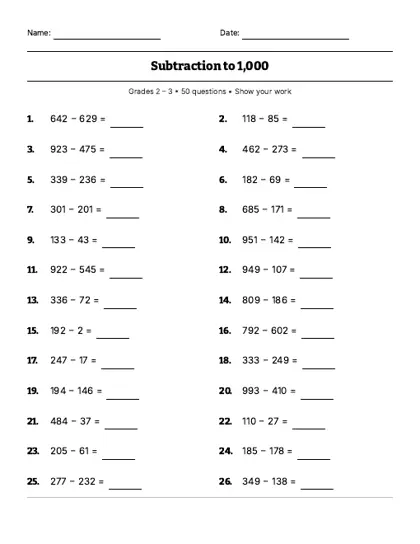
3-digit subtraction worksheet: 50 problems with an answer key, ready to print.
Make a fresh 3-digit subtraction test with the free test maker: new numbers every time.
Subtraction chart for the wall, and Math Galaxy for game practice.
Next steps: multi-digit subtraction · Related: 3-digit addition
Last reviewed
Questions parents ask
What is the difference between borrowing and regrouping?
They are the same step. Regrouping is the word most US schools use today; borrowing is the older name. Both mean trading 1 from the next place for 10 of the place you are working in.
How do you subtract 3-digit numbers with zeros?
When the next column is 0 there is nothing to take, so go one more column left. Trade 1 hundred into 10 tens, then 1 of those tens into 10 ones. The 0 ends up as 9. For 503 − 178, the 503 becomes 4 hundreds, 9 tens and 13 ones, and the answer is 325.
What grade learns 3-digit subtraction?
Grade 2 subtracts within 1,000 using blocks, drawings and place value (Common Core 2.NBT.B.7). Grade 3 is expected to do it fluently (3.NBT.A.2), and grade 4 uses the standard written method for bigger numbers.
How can my child check a subtraction answer?
Add the answer to the number that was taken away. If you get the top number, the answer is right. For 645 − 287 = 358, check that 358 + 287 = 645.
My child keeps taking the small digit from the big one. How do I fix it?
Go back to base-ten blocks or coins for a few problems. When a child has to physically swap a ten for ten ones to take 8 away from 2, the written step starts to make sense. Then say the rule out loud: always top minus bottom.
Should my child learn other ways to subtract?
Yes. Counting up on a number line and adjusting both numbers are quicker for problems like 500 − 197, and they build number sense. The column method is the one that works for every problem, so learn both.