
How to find the greatest common factor (GCF)
The greatest common factor (GCF) of two numbers is the biggest number that divides into both. For 12 and 18 it is 6. Find it by listing factors or by prime factorization. This page shows both methods, has a GCF finder, and explains where the GCF is used: simplifying fractions and splitting things into equal groups.
Method 1: list the factors
- Factors of 12: 1, 2, 3, 4, 6, 12.
- Factors of 18: 1, 2, 3, 6, 9, 18.
- Common factors: 1, 2, 3, 6. The greatest is 6.
Method 2: prime factorization
12 = 2 × 2 × 3 and 18 = 2 × 3 × 3. The primes they share are one 2 and one 3: 2 × 3 = 6. This method is faster for big numbers.
GCF finder
Common factors are in bold; the greatest is highlighted.
Where the GCF is used
- Simplifying fractions: divide top and bottom by the GCF: 12/18 = 2/3.
- Equal groups: 24 red and 36 blue beads into identical bags with none left: the most bags is GCF(24, 36) = 12.
- Factoring expressions (grade 6): 24 + 36 = 12(2 + 3).
Common mistakes
How to teach it at home
Party bags
24 lollipops and 16 stickers into identical bags: how many bags at most? (8)
Tile a floor
The largest square tile that fits a 12 × 18 area exactly is 6 × 6.
Simplify recipes
Use the GCF to simplify a ratio like 12 cups : 18 cups.
By grade
- Grade 4: factor pairs.
- Grade 6 (6.NS.B.4): GCF of two numbers up to 100, and using it with the distributive property.
- See also least common multiple.
Worksheets and practice
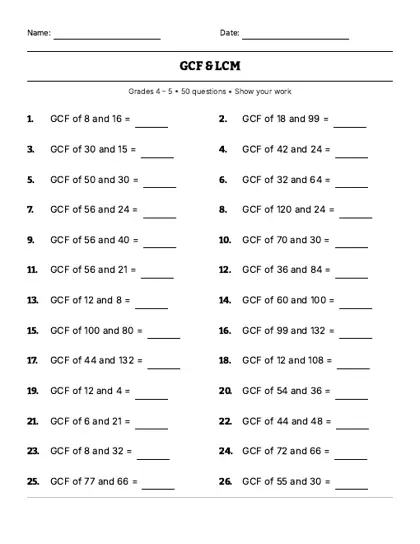
Greatest common factor worksheet: printable PDF with an answer key. · Make a fresh test
Last reviewed
Questions parents ask
What is the GCF?
The greatest common factor: the largest number that divides into two or more numbers exactly. GCF(12, 18) = 6.
How do you find the GCF?
List the factors of each number and pick the largest one they share, or multiply the primes they have in common.
What is the GCF of two prime numbers?
1, unless they are the same prime.
What is the difference between GCF and LCM?
The GCF is the biggest number that divides both; the LCM is the smallest number both divide into. GCF(4, 6) = 2 and LCM(4, 6) = 12.
What is the GCF used for?
Simplifying fractions, splitting things into the largest equal groups, and factoring expressions.