
Subtraction strategies: how to learn subtraction facts
Subtraction facts are easiest when children think addition: 13 − 8 asks “8 plus what makes 13?” Together with counting back, counting up and subtracting through 10, that turns the facts to 20 into something children work out quickly rather than count. This page explains each strategy, fact families, and has a practice tool with hints.
The big idea: subtraction undoes addition
If 8 + 5 = 13, then 13 − 5 = 8 and 13 − 8 = 5. These three numbers are a fact family. A child who knows the addition facts already knows the subtraction facts, if they learn to see them.
Five subtraction strategies
| Strategy | Example | Best for |
|---|---|---|
| Count back | 11 − 2 → 10, 9 | Taking away 1, 2 or 3 |
| Count up | 12 − 9 → 10, 11, 12: 3 | Numbers close together |
| Think addition | 13 − 8: 8 + 5 = 13, so 5 | Any fact |
| Subtract through 10 | 14 − 6 = 14 − 4 − 2 = 8 | Teen numbers minus 6–9 |
| Subtract 10, add 1 | 15 − 9 = 15 − 10 + 1 = 6 | Minus 9 |
Fact families
A fact family links four facts: 5 + 8 = 13, 8 + 5 = 13, 13 − 5 = 8, 13 − 8 = 5. Draw a triangle with 13 at the top and 5 and 8 at the bottom corners. Cover any number and the other two give it back.
Subtraction facts practice
Any you miss show the answer and the “think addition” hint.
Common mistakes
How to teach it at home
Hide and seek counters
Show 12 counters, hide some under a cup, show what’s left. How many are hiding?
Fact family triangles
Make triangle cards and cover one corner.
Count-up change
Pay 20¢ for a 14¢ item and count up the change: 15, 16… 20, so 6¢.
By grade
- Kindergarten (K.OA.A.5): fluent within 5.
- Grade 1 (1.OA.C.6): subtract within 20 with strategies; fluent within 10.
- Grade 2 (2.OA.B.2): all facts within 20 from memory.
- Next: 2-digit subtraction.
Worksheets and practice
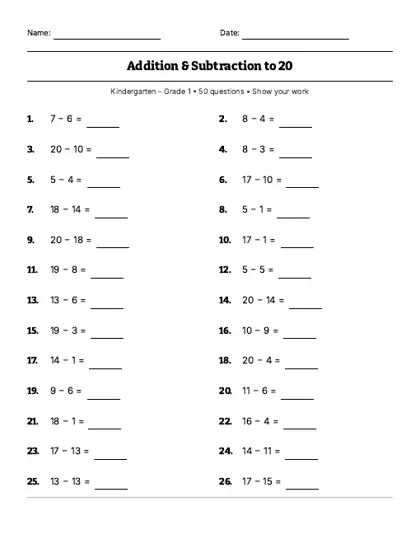
Subtraction facts worksheet: printable PDF with an answer key. · Make a fresh test
Subtraction to 10 (PDF) · Fact families (PDF) · Subtraction chart
Last reviewed
Questions parents ask
What is the best strategy for subtraction facts?
Think addition. For 13 − 8, ask “8 plus what makes 13?” Children who know their addition facts get the subtraction facts almost free.
What is a fact family?
Three numbers linked by addition and subtraction, giving four facts: 5 + 8 = 13, 8 + 5 = 13, 13 − 5 = 8 and 13 − 8 = 5.
Should my child count back to subtract?
Only for small take-aways like 11 − 2. For 12 − 9, counting up from 9 is much faster.
What is subtracting through 10?
Breaking the number you take away so you land on 10 first. 14 − 6 = 14 − 4 − 2 = 8.
When should kids know subtraction facts?
Within 10 by the end of grade 1, and all facts within 20 by the end of grade 2.