
Comparing numbers: greater than and less than
To compare two numbers, count the digits first: more digits means bigger. If they have the same number of digits, compare from the left, place by place, until you find a difference. Then write >, < or =. This page explains the method with place value, has a comparing game, covers ordering numbers, and shows the mistakes kids make.
Greater than, less than and equal to
| Symbol | Means | Example |
|---|---|---|
| > | is greater than | 8 > 3 |
| < | is less than | 3 < 8 |
| = | is equal to | 5 + 3 = 8 |
The open side of > and < always faces the bigger number. Read from left to right: 8 > 3 is “eight is greater than three”.
The big idea: place value decides
A digit’s value depends on its place. In 476 the 4 is worth 400; in 467 the 6 is worth 60. So when comparing, the biggest place matters most. The hundreds decide before the tens even get a look.
How to compare numbers, step by step
- Count the digits. More digits means bigger: 1,001 > 899.
- Same number of digits? Line them up by place value.
- Compare from the left. Hundreds first, then tens, then ones.
- Stop at the first difference. That place decides.
- Write the symbol with its open side facing the bigger number.
Comparing numbers game
Pick >, < or =. Each answer explains which place decided it.
Worked examples: comparing numbers
Example 1: 64 and 46
Same number of digits. Tens: 6 > 4, so 64 > 46.
Example 2: 476 and 467
Hundreds are the same (4). Tens: 7 > 6, so 476 > 467.
Example 3: 899 and 1,001
1,001 has four digits; 899 has three. 899 < 1,001, even though 8 and 9 are big digits.
Example 4: 5,060 and 5,006
Thousands same, hundreds same (0). Tens: 6 > 0, so 5,060 > 5,006.
Example 5: 300 + 40 + 5 and 345
Expanded form adds up to 345, so 300 + 40 + 5 = 345.
Ordering numbers from least to greatest
Order 452, 425, 524 and 245:
- All have three digits, so look at the hundreds: 2, 4, 4, 5. 245 is smallest and 524 is biggest.
- 452 and 425 tie on hundreds, so compare tens: 2 < 5, so 425 comes first.
- Least to greatest: 245, 425, 452, 524.
Common mistakes when comparing numbers
How to teach comparing numbers at home
Card war with place value
Each player draws three cards to make a 3-digit number. The bigger number wins. Then let players arrange their cards to make the biggest number possible.
Price comparisons
Which costs more: the $249 bike or the $294 bike? Real prices give real reasons to compare.
Number line
Put two numbers on a number line. The one further right is bigger, every time.
Comparing numbers by grade
- Kindergarten (K.CC.C.6, K.CC.C.7): compare groups of objects and numbers to 10.
- Grade 1 (1.NBT.B.3): compare two-digit numbers with >, < and =.
- Grade 2 (2.NBT.A.4): compare three-digit numbers.
- Grade 4 (4.NBT.A.2): compare multi-digit numbers to 1,000,000. Then comparing decimals in grades 4 and 5.
Comparing numbers worksheets
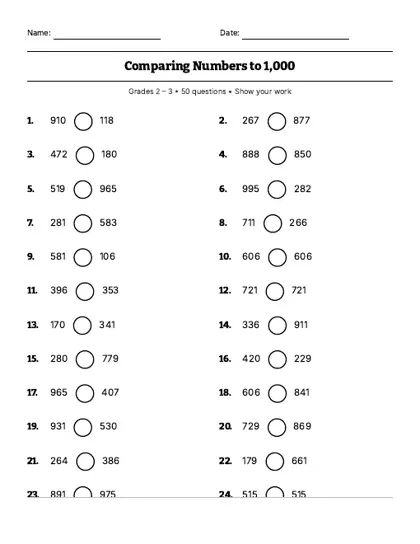
Comparing numbers worksheet: 50 problems with an answer key.
Comparing numbers to 100 (PDF, grade 1) · Make a fresh comparing test · Place value
Last reviewed
Questions parents ask
How do you compare two numbers?
First count the digits: the number with more digits is bigger. If they have the same number of digits, compare from the left, place by place. The first place where the digits differ decides.
How do you remember which way the greater than sign goes?
The wide, open side always faces the bigger number, and the point faces the smaller one. Some children imagine a hungry alligator that always eats the bigger number. 8 > 3 reads “8 is greater than 3”.
Is 99 bigger than 100?
No. 100 has three digits and 99 has only two, so 100 is bigger, even though 9 is a bigger digit than 1.
How do you order numbers from least to greatest?
Compare them in pairs, or line them up by place value and compare the biggest place first. 452, 425, 524 in order is 425, 452, 524.
What does = mean when comparing?
The two sides have exactly the same value. 300 + 40 + 5 = 345 because both sides are the same number.
What grade learns comparing numbers?
Kindergarten compares groups and numbers to 10. Grade 1 compares two-digit numbers with > , < and = (1.NBT.B.3). Grade 2 compares three-digit numbers (2.NBT.A.4), and grade 4 compares numbers into the millions (4.NBT.A.2).