
How to find the least common multiple (LCM)
The least common multiple (LCM) of two numbers is the smallest number both divide into. For 4 and 6 it is 12. Find it by listing multiples or by prime factorization. This page shows both methods, has an LCM finder, and explains where the LCM is used: common denominators and things that repeat on a schedule.
Method 1: list the multiples
- Multiples of 4: 4, 8, 12, 16, 20, 24…
- Multiples of 6: 6, 12, 18, 24…
- The first one they share is 12.
Tip: list multiples of the bigger number and check each one against the smaller.
Method 2: prime factorization
4 = 2 × 2 and 6 = 2 × 3. Take each prime the most times it appears in either: two 2s and one 3. 2 × 2 × 3 = 12.
LCM finder
The first shared multiple is highlighted.
Where the LCM is used
- Common denominators: to add 1/4 + 1/6, use LCM(4, 6) = 12. See adding fractions.
- Things that repeat: one bus every 12 minutes and another every 18 minutes leave together again after LCM(12, 18) = 36 minutes.
- Buying in packs: hot dogs in 10s and buns in 8s: buy 40 of each so none are left.
Common mistakes
How to teach it at home
Bus timetables
Two buses every 10 and 15 minutes: when do they leave together? (30)
Hot dogs and buns
Packs of 10 and 8: how many of each to match? (40)
Clap patterns
One person claps every 3 beats, another every 4: when do they clap together?
By grade
- Grade 4: multiples.
- Grade 5: common denominators when adding fractions.
- Grade 6 (6.NS.B.4): LCM of two numbers up to 12.
- See also greatest common factor.
Worksheets and practice
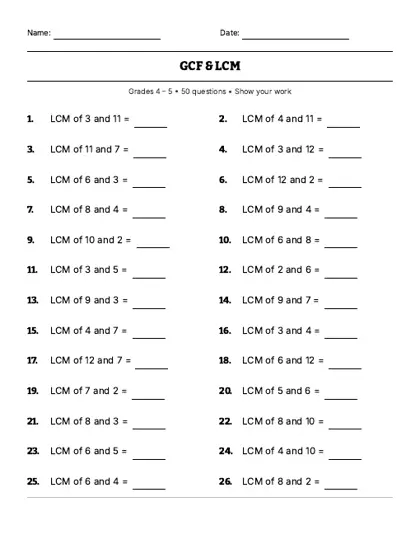
Least common multiple worksheet: printable PDF with an answer key. · Make a fresh test
Last reviewed
Questions parents ask
What is the LCM?
The least common multiple: the smallest number that two or more numbers all divide into. LCM(4, 6) = 12.
How do you find the LCM?
List multiples of each number until you find the first one they share, or multiply each prime the most times it appears in either number.
Is the LCM always the two numbers multiplied?
Only when they have no common factor except 1, like 4 and 9 (LCM 36). Otherwise it is smaller: LCM(4, 6) = 12, not 24.
What is the LCM used for?
Finding common denominators, and working out when repeating events happen together.
What is the relationship between GCF and LCM?
GCF × LCM = the product of the two numbers. For 4 and 6: 2 × 12 = 24 = 4 × 6.