
Number bonds: the bonds to 10 and beyond
A number bond shows how a number splits into two parts: 10 is 7 and 3. The bonds to 10 (1 + 9, 2 + 8, 3 + 7, 4 + 6, 5 + 5) are the most useful facts a young child can learn, because they unlock making 10, fact families and mental math. This page explains them with pictures, a ten frame tool and games.
What a number bond is
The whole sits at the top and the two parts below. Reading it gives addition (7 + 3 = 10) and subtraction (10 − 3 = 7) at once.
The bonds to 10
| 0 + 10 | 1 + 9 | 2 + 8 | 3 + 7 | 4 + 6 | 5 + 5 |
Plus their turn-arounds (9 + 1, 8 + 2…). On a ten frame, the empty boxes always show the other part.
Ten frame: find the partner to 10
Slide to any number. The tool shows its partner to 10 and every way to make it.
How number bonds help
- Making 10: 8 + 5 = 8 + 2 + 3 = 13, using the bond 2 + 8.
- Subtraction: 10 − 4 = 6, because 4 and 6 make 10.
- Bigger numbers: 30 + 70 = 100 uses the same bond 3 + 7.
Common mistakes
How to teach it at home
Hidden objects
Show 10 counters, hide some under a cup. How many are hidden?
Fingers
Hold up 6 fingers: how many are down?
Make 10 with cards
Find card pairs that make 10.
By grade
- Kindergarten (K.OA.A.3, K.OA.A.4): split numbers to 10 in different ways and find the partner to 10.
- Grade 1 (1.OA.C.6): use making 10 to add and subtract within 20.
- Next: addition facts.
Worksheets and practice
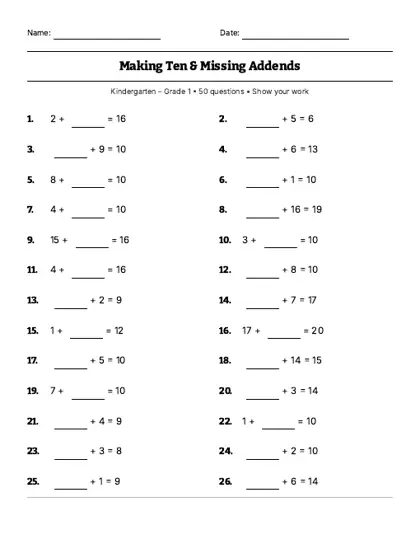
Number bonds worksheet: printable PDF with an answer key. · Make a fresh test
Last reviewed
Questions parents ask
What are number bonds?
Pairs of numbers that make a whole: 7 and 3 make 10. They show how a number can be split into two parts.
What are the number bonds to 10?
0 + 10, 1 + 9, 2 + 8, 3 + 7, 4 + 6 and 5 + 5, plus their turn-arounds.
Why are number bonds important?
They make adding and subtracting fast and are the key to the make-10 strategy and mental math.
How do I teach number bonds?
With ten frames, fingers and hidden-object games, a few minutes every day.
When do kids learn number bonds?
Kindergarten for numbers to 10, and grade 1 uses them for facts to 20.