
How to simplify fractions
To simplify a fraction, divide the top and bottom by the same number until nothing but 1 divides both. Divide by the greatest common factor and it takes one step: 18/24 ÷ 6/6 = 3/4. This page shows why with fraction bars, has a tool to simplify any fraction, and covers the mistakes children make.
Simplifying fractions: the big idea
Simplifying is finding the equivalent fraction with the smallest numbers. 6/8 and 3/4 are the same amount; 3/4 just uses fewer, bigger pieces. A fraction is in simplest form when the top and bottom have no common factor except 1.
How to simplify fractions, step by step
- Find the greatest common factor (GCF) of the numerator and denominator. For 18/24 it is 6.
- Divide both by it: 18 ÷ 6 = 3, 24 ÷ 6 = 4.
- Check: 3 and 4 share no factor but 1, so 3/4 is in simplest form.
Can’t find the GCF? Divide by any common factor (2, 3, 5…) and repeat until you can’t go further: 18/24 → 9/12 → 3/4.
Simplify any fraction
Type a fraction to see its GCF, the division and both as bars.
Worked examples
Example 1: 4/10
GCF 2: 2/5.
Example 2: 12/16
GCF 4: 3/4.
Example 3: 15/45
GCF 15: 1/3.
Example 4: 7/9
GCF 1: already in simplest form.
Example 5: 20/8
GCF 4: 5/2, which is 2 1/2 as a mixed number.
Common mistakes
How to teach it at home
Share a chocolate bar
A bar with 12 squares, 8 eaten: 8/12. Group the squares in fours: 2/3 eaten.
Factor detective
Ask: what number goes into both? Use the divisibility rules for 2, 3 and 5.
Measuring cups
4/8 of a cup is 1/2 cup. Pour to check.
By grade
- Grade 4 (4.NF.A.1): recognize and generate equivalent fractions, including simpler ones.
- Grade 5: simplify answers to fraction problems.
- Grade 6 (6.NS.B.4): greatest common factor. See GCF.
Worksheets and practice
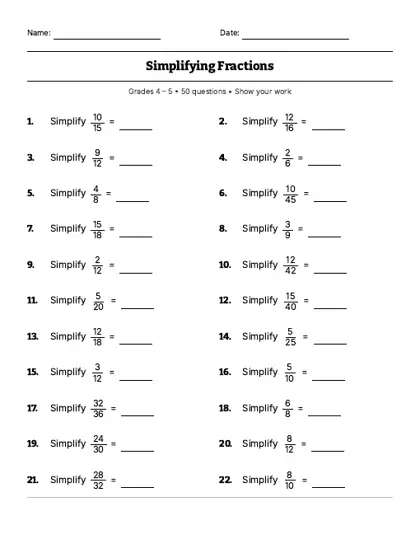
Simplifying fractions worksheet: printable PDF with an answer key. · Make a fresh test
Equivalent fractions · Factors and multiples · All fractions
Last reviewed
Questions parents ask
How do you simplify a fraction?
Divide the numerator and denominator by their greatest common factor. 18/24: the GCF is 6, so 3/4.
What is simplest form?
A fraction whose numerator and denominator have no common factor other than 1, like 3/4 or 2/5.
Does simplifying change the value of a fraction?
No. 6/8 and 3/4 are the same amount; simplifying just uses smaller numbers.
How do you simplify an improper fraction?
Simplify the same way, then change it to a mixed number if needed. 20/8 = 5/2 = 2 1/2.
What if I can’t find the GCF?
Divide by any common factor, like 2, and repeat until the fraction can’t be divided further.