
Comparing fractions, step by step
To compare fractions, make them easy to compare: with the same denominator, the bigger numerator wins; with the same numerator, the smaller denominator wins. Otherwise use a common denominator or compare each to 1/2. This page shows each method with fraction bars and has a tool to compare any two fractions.
The big idea
A fraction has two parts: the size of the pieces (denominator) and how many you have (numerator). You can only compare counts fairly when the pieces are the same size.
Four ways to compare fractions
1. Same denominator
Same size pieces: compare the numerators. 5/8 > 3/8.
2. Same numerator
Same number of pieces: bigger pieces win, so the smaller denominator is bigger. 3/4 > 3/8.
3. Compare to 1/2 (benchmark)
3/8 is less than half (4/8); 4/6 is more than half (3/6). So 3/8 < 4/6.
4. Common denominator
Rewrite both with the same denominator. 3/5 and 2/3 become 9/15 and 10/15, so 3/5 < 2/3.
Compare any two fractions
Type two fractions. The tool picks the method and shows both as bars.
Ordering fractions
To order 1/2, 3/8 and 3/4, rewrite them as eighths: 4/8, 3/8 and 6/8. Least to greatest: 3/8, 1/2, 3/4.
Common mistakes
How to teach it at home
Pizza choice
Would you rather have 1/3 or 1/4 of a pizza? Cut two and see.
Fraction war
Draw two cards to make a fraction. The bigger fraction wins.
Measuring cups
Which holds more, 2/3 cup or 3/4 cup? Fill and compare.
By grade
- Grade 3 (3.NF.A.3d): compare fractions with the same numerator or the same denominator.
- Grade 4 (4.NF.A.2): compare fractions with different numerators and denominators.
Worksheets and practice
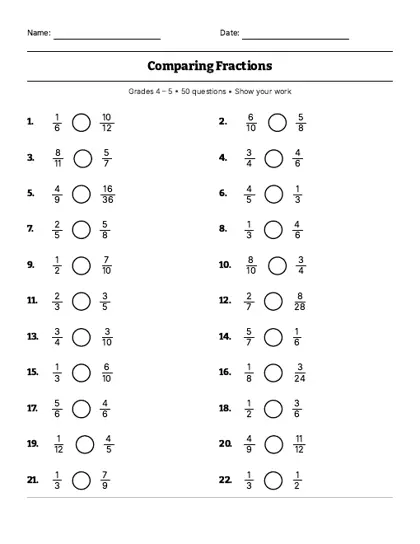
Comparing fractions worksheet: printable PDF with an answer key. · Make a fresh test
Last reviewed
Questions parents ask
How do you compare fractions with different denominators?
Rewrite them with a common denominator and compare the numerators. 3/5 = 9/15 and 2/3 = 10/15, so 2/3 is bigger.
Which is bigger, 1/3 or 1/4?
1/3. The whole is cut into fewer pieces, so each piece is bigger.
What is a benchmark fraction?
An easy fraction like 1/2 or 1 to compare against. 3/8 is less than 1/2 and 5/8 is more.
Can you compare fractions by cross-multiplying?
Yes. For 3/5 and 2/3: 3 × 3 = 9 and 2 × 5 = 10, so 3/5 < 2/3. It is a shortcut for using a common denominator.
What grade learns comparing fractions?
Grade 3 for the same numerator or denominator, and grade 4 for any fractions (4.NF.A.2).