
The coordinate plane for kids: plotting points step by step
The coordinate plane is a grid made by two number lines: the x-axis across and the y-axis up. Every point has an address, written as an ordered pair (x, y): how far across, then how far up or down. This page covers the parts of the plane, how to plot and read points, the four quadrants, distance between points, and an interactive game to practice.
The coordinate plane: the big idea
Think of a city map with numbered streets going across and numbered avenues going up. To tell someone where you are, you give two numbers. The coordinate plane works the same way. The ordered pair (4, 3) means: start at the corner where the axes meet, go 4 across, then 3 up.
The order matters. (4, 3) and (3, 4) are different places, the same way 4th Street at 3rd Avenue isn’t 3rd Street at 4th Avenue.
Parts of the coordinate plane
- x-axis: the horizontal number line. Positive numbers to the right, negative to the left.
- y-axis: the vertical number line. Positive numbers up, negative down.
- Origin: the point (0, 0) where the axes cross.
- Ordered pair: the address of a point, (x, y). x is always first.
- Quadrants: the four sections, numbered I, II, III and IV counterclockwise from the top right.
How to plot points on the coordinate plane, step by step
- Start at the origin, (0, 0).
- Move across by the x-coordinate. Right if it is positive, left if it is negative.
- Move up or down by the y-coordinate. Up if positive, down if negative.
- Draw a dot and label it with a letter.
How to read the coordinates of a point
Work backwards. From the point, look straight down (or up) to the x-axis: that number is x. Then look straight across to the y-axis: that number is y. Write them in brackets, x first: (x, y). For point D above, straight up to the x-axis reads −4 and straight across to the y-axis reads −3, so D is (−4, −3).
Coordinate plane game: plot it, name it, find the quadrant
Choose a game and a grid. Grade 5 children can start with the first quadrant.
The four quadrants of the coordinate plane
The signs of x and y tell you the quadrant without drawing anything:
| Quadrant | Where | x | y | Example |
|---|---|---|---|---|
| I | top right | + | + | (3, 5) |
| II | top left | − | + | (−3, 5) |
| III | bottom left | − | − | (−3, −5) |
| IV | bottom right | + | − | (3, −5) |
Points on an axis, like (0, 4) or (−2, 0), are not in any quadrant.
Reflecting a point
Flipping a point over an axis changes one sign. Reflect (3, 2) over the x-axis and it lands at (3, −2): same across, opposite up and down. Reflect it over the y-axis and it lands at (−3, 2).
Distance between two points on the coordinate plane
When two points share an x-coordinate or a y-coordinate, they are on the same straight line and the distance is easy to count.
- Same side of the axis: subtract. From (2, 3) to (2, 8) is 8 − 3 = 5 units.
- Opposite sides of the axis: add the distances to the axis. From (−3, 2) to (4, 2) is 3 + 4 = 7 units.
Common mistakes on the coordinate plane
How to teach the coordinate plane at home
Play battleships on graph paper
Each player draws a 10 × 10 grid and hides “ships” on points. Calling out (x, y) guesses is hours of coordinate practice that doesn’t feel like it.
Make a floor grid
Use masking tape to make axes on the floor. Call out a pair and have your child walk to it: across first, then up. Walking it fixes the order.
Draw a connect-the-points picture
Give a list of points to plot and join in order. A star, a house or a fish appears if every point is right, so mistakes show up on their own.
Use a real map
Many maps have a grid with letters across and numbers down. Finding a place by its grid square is the same skill.
The coordinate plane by grade
- Grade 5 (5.G.A.1, 5.G.A.2): plot and read points in the first quadrant and use them for real-world graphs.
- Grade 6 (6.NS.C.6, 6.NS.C.8, 6.G.A.3): all four quadrants, reflections, distance between points, and drawing polygons from coordinates.
- Grade 8: graphing lines and slope (slope worksheet, PDF), building on the same skills.
Children need to be comfortable with negative numbers on a number line before moving to four quadrants.
Coordinate plane worksheets and practice
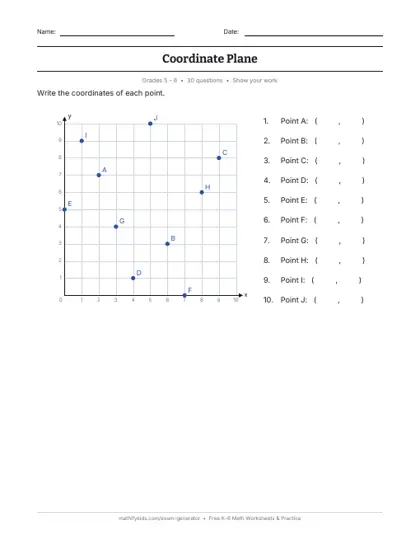
Coordinate plane worksheet: read points, plot points and name quadrants, with an answer key.
Distance on the coordinate plane worksheet (PDF) for grade 6.
Make a fresh distance-between-points test with the free test maker.
Related: lines and line segments chart · geometry
Last reviewed
Questions parents ask
How many quadrants are in a coordinate plane?
Four. The x-axis and y-axis cross at the origin and split the plane into quadrants I, II, III and IV, numbered counterclockwise starting from the top right.
Which comes first, x or y?
x always comes first. In (4, 3), go 4 across along the x-axis, then 3 up. A common memory aid is “along the corridor, then up the stairs”.
What is the origin on a coordinate plane?
The point (0, 0), where the x-axis and the y-axis cross. Every point is measured from the origin.
Which quadrant is (−3, 4) in?
Quadrant II. x is negative (left) and y is positive (up), and the top-left quadrant is quadrant II.
What quadrant is a point on an axis in?
None. Points on the x-axis or y-axis, such as (5, 0) or (0, −2), sit on the border between quadrants and don’t belong to any of them.
What grade learns the coordinate plane?
Grade 5 plots points in the first quadrant (Common Core 5.G.A.1). Grade 6 extends to all four quadrants with negative numbers and finds distances between points (6.NS.C.6 and 6.NS.C.8).