
Teaching multiplication facts: what multiplication means
Before memorizing times tables, children need to know what multiplication means: equal groups. 4 × 6 is 4 groups of 6. Arrays, skip counting and two simple properties turn that meaning into facts children can work out and then remember. This page explains each idea with an array explorer and a practice tool.
Multiplication is equal groups
3 plates with 4 cookies each is 3 × 4 = 12. The first number is how many groups; the second is how many in each group. Adding works (4 + 4 + 4) but multiplication is the shortcut.
Arrays
Arranging the groups in rows makes an array. Arrays show the answer at a glance and explain the turn-around property.
Array explorer
Skip counting
Counting by 4s (4, 8, 12, 16…) finds 4 × anything. It is the bridge between adding and knowing the facts, and fine as a starting point.
Properties that make facts easier
- Turn-around (commutative): 3 × 8 = 8 × 3. Learn one, know both.
- Break apart (distributive): 7 × 8 = 5 × 8 + 2 × 8 = 40 + 16 = 56.
- × 1 and × 0: any number × 1 is itself; any number × 0 is 0.
Practice multiplication facts
Multiplication and division together
Every array shows a division too: 4 rows of 6 is 24, so 24 ÷ 4 = 6 and 24 ÷ 6 = 4. Teaching them together means children learn division facts almost for free. See division facts.
Common mistakes
How to teach it at home
Find equal groups
Egg cartons, wheels on cars, legs on chairs.
Build arrays
Arrange coins or blocks in rows and columns.
Story problems
Make up “groups of” stories at dinner: 4 people, 3 meatballs each.
By grade
- Grade 2 (2.OA.C.3, 2.OA.C.4): equal groups, arrays and repeated addition.
- Grade 3 (3.OA.A.1, 3.OA.B.5, 3.OA.C.7): meaning of multiplication, properties, and fluency to 10 × 10.
- Next: learning the times tables.
Worksheets and practice
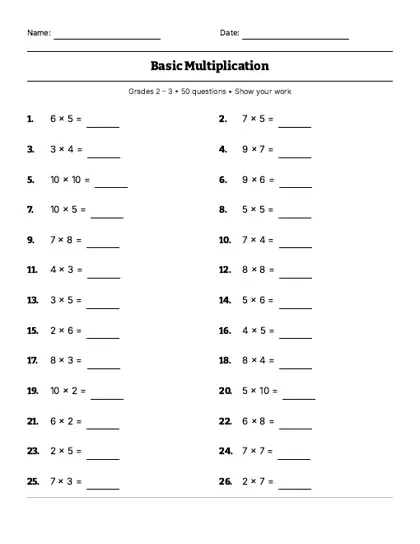
Multiplication facts worksheet: printable PDF with an answer key. · Make a fresh test
Last reviewed
Questions parents ask
How do you explain multiplication to a child?
As equal groups: 3 × 4 is 3 groups of 4. Show it with real objects, then as an array of rows and columns.
What is an array in multiplication?
Objects arranged in equal rows and columns. 4 rows of 6 is an array for 4 × 6 = 24.
What is the commutative property?
The order doesn’t matter: 3 × 8 = 8 × 3. Turn an array around and it has the same number of objects.
Is skip counting the same as multiplication?
It is a way to find multiplication facts. Children should move from skip counting to knowing the facts from memory by the end of grade 3.
When do kids learn multiplication?
The idea starts in grade 2 with equal groups and arrays. Grade 3 learns the meaning, properties and all facts to 10 × 10.