
Multi-digit multiplication with the standard algorithm
Multi-digit multiplication, like 347 × 26, uses one row for each digit of the bottom number, with a placeholder zero for the tens row, then adds the rows. It is the method grade 5 is expected to use fluently. This page walks through it, has a tool that steps through any problem up to 9,999 × 99, and shows how to estimate and check.
347 × 26, step by step
- Row 1, multiply by 6 (the ones): 6 × 7 = 42 (write 2, carry 4); 6 × 4 = 24 + 4 = 28 (write 8, carry 2); 6 × 3 = 18 + 2 = 20. Row 1 = 2,082.
- Row 2, multiply by 2 tens: write a 0 first, then 2 × 347 = 694. Row 2 = 6,940.
- Add: 2,082 + 6,940 = 9,022.
- Estimate: about 350 × 25 = 8,750. Close enough.
Long multiplication step by step
Up to 9,999 × 99. Each row lists every multiplication and carry.
Why the algorithm works
347 × 26 = 347 × 6 + 347 × 20. The rows are exactly those two products. The placeholder zero is the “× 10” in 20. Every carry is a ten moving into the next place, the same as in addition.
Worked examples
1,234 × 5
One row: 6,170.
508 × 43
508 × 3 = 1,524; 508 × 40 = 20,320; total 21,844. The zero in 508 still needs its own multiplication: 3 × 0 = 0, plus any carry.
2,019 × 11
2,019 + 20,190 = 22,209.
Common mistakes
How to teach it at home
Yearly totals
$347 a month for 12 months, or 26 weeks of $45.
Estimate first
Round both numbers and multiply in your head before starting.
Find the error
Work a problem with one deliberate mistake and ask your child to find it.
By grade
- Grade 4 (4.NBT.B.5): up to 4 digits by 1 digit, and 2 digits by 2 digits.
- Grade 5 (5.NBT.B.5): fluently multiply multi-digit whole numbers with the standard algorithm.
- Next: multiplying decimals.
Worksheets and practice
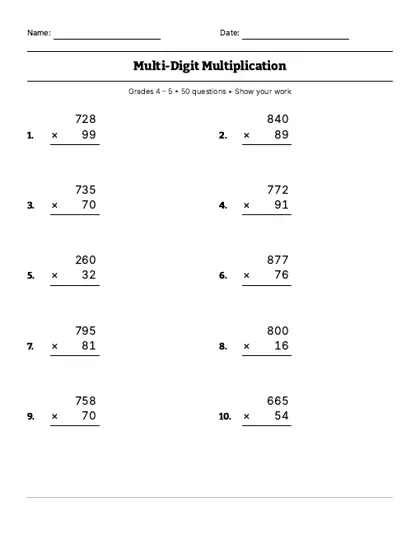
Multi-digit multiplication worksheet: printable PDF with an answer key. · Make a fresh test
Last reviewed
Questions parents ask
What is the standard algorithm for multiplication?
Multiply the top number by each digit of the bottom number, one row per digit, shifting each row one place left (placeholder zeros), then add the rows.
How many rows do you need?
One for each digit in the bottom number. 347 × 26 has two rows; 347 × 126 has three.
How do you multiply when there is a zero in the top number?
Multiply it like any digit: 0 times anything is 0, then add any carry. Don’t skip the column.
How do you check long multiplication?
Estimate by rounding, or swap the numbers and multiply again.
What grade learns multi-digit multiplication?
Grade 5 is expected to use the standard algorithm fluently (5.NBT.B.5).