
How to calculate percent change
Percent change compares a change with the starting amount. Find the change, divide by the start, then multiply by 100.
The big idea: compare the change with the start
When a price goes from $40 to $50, it has gone up by $10. Percent change asks how big that $10 is compared with where you started, $40. The answer, 25%, means the price grew by a quarter.
Percent change lets you compare changes of different sizes fairly. A $10 rise on a $40 game is big (25%). The same $10 on a $400 bike is small (2.5%).
See it: pictures to draw with your child
Copy these onto paper or a whiteboard. A quick sketch makes the idea concrete before any written method.
The method in three steps
- Find the change: new amount − starting amount. $50 − $40 = $10.
- Divide by the starting amount: 10 ÷ 40 = 0.25.
- Multiply by 100: 25%. The price went up, so it is a 25% increase.
For a decrease, the steps are the same. From $50 to $40 is a change of $10, and 10 ÷ 50 = 20%. So it is a 20% decrease.
Why you always divide by the starting amount
The same $10 gives a 25% increase from $40 but a 20% decrease from $50. The difference is the starting amount. Percent change always measures against where you began.
This is the number-one mistake in percent change. Before dividing, ask “what was the amount before the change?” and circle it.
Percent change calculator
Type the starting amount and the new amount. The calculator shows the change, the division and whether it is an increase or a decrease.
Percent change examples
| From | To | Change | Percent change |
|---|---|---|---|
| $40 | $50 | +$10 | 10 ÷ 40 = 25% increase |
| 80 | 60 | −20 | 20 ÷ 80 = 25% decrease |
| 200 | 230 | +30 | 30 ÷ 200 = 15% increase |
| 1,500 | 1,200 | −300 | 300 ÷ 1,500 = 20% decrease |
| 20 cm | 50 cm | +30 cm | 30 ÷ 20 = 150% increase |
The last row shows that an increase can be more than 100%. A decrease can never be more than 100%, because you cannot lose more than everything.
Going the other way: the multiplier
If you know the percent change and want the new amount, use a multiplier. A 25% increase means the new amount is 125% of the old, so multiply by 1.25: $40 × 1.25 = $50.
A 20% decrease leaves 80%, so multiply by 0.8: $50 × 0.8 = $40. The percent increase and decrease lesson practices this.
Percent change in real life
News reports, shop prices and science all use percent change. Prices rise by a few percent a year, populations grow and phones lose value.
Ask your child to find a percent change in real life each week. Last month’s and this month’s price of something you buy often is a perfect start.
Quiz: percent change
Find the percent increase or decrease, or the new amount. Type numbers only.
Where this fits: percentages step by step
- What is a percent
- Percent to fraction
- Fraction to percent
- Percent to decimal
- Decimal to percent
- Comparing fractions, decimals and percents
- Benchmark percents
- Percent mental math
- Over 100% and under 1%
- Percent of a number
- Finding the percent
- Finding the whole
- Percent change (this page)
- Percent increase and decrease
- Discounts and sale price
- Sales tax
- Tips
- Simple interest
- Markup, commission and percent error
- Percent word problems
What to say to your child
A short script for teaching it the first time. Pause after each line and let your child do the next step.
- “A game was $20 and now costs $25. How much did it go up?” ($5.)
- “What was the starting price?” ($20.)
- “So 5 out of 20 is what percent?” (25%.)
- “Is that an increase or a decrease?” (An increase.)
- “If it went back from $25 to $20, what percent is that?” (5 ÷ 25 = 20%, a decrease.)
More worked examples
Example 1: from 60 to 75
Change 15. 15 ÷ 60 = 25% increase.
Example 2: from 120 to 90
Change 30. 30 ÷ 120 = 25% decrease.
Example 3: from 250 to 300
Change 50. 50 ÷ 250 = 20% increase.
Example 4: from 8 to 2
Change 6. 6 ÷ 8 = 75% decrease.
Practice questions (answers below)
Ask these out loud or write them down. Check each answer, and ask “how did you get that?” for one or two.
- From 50 to 60
- From 80 to 60
- From 40 to 50
- From 200 to 150
- From 25 to 30
- From 10 to 15
- From 100 to 1
- From 400 to 440
- From 30 to 60
- Stretch: from 20 to 50
Show the answers
- 20% increase
- 25% decrease
- 25% increase
- 25% decrease
- 20% increase
- 50% increase
- 99% decrease
- 10% increase
- 100% increase
- 150% increase
Common mistakes
How to teach it at home
Price watch
Track a price over a few weeks and find each percent change.
Growth chart
Find your child’s height change as a percent.
News hunt
Find a percent change in a news story and check it.
By grade
- Grade 7 (7.RP.A.3): percent increase and decrease in multi-step problems.
- Grade 6: finding the percent, the base for this skill.
- In India, percent change comes in class 8 maths.
- Next: percent increase and decrease.
More for each grade: Grade 7 math and the CBSE class 7 maths guide.
Worksheets and practice
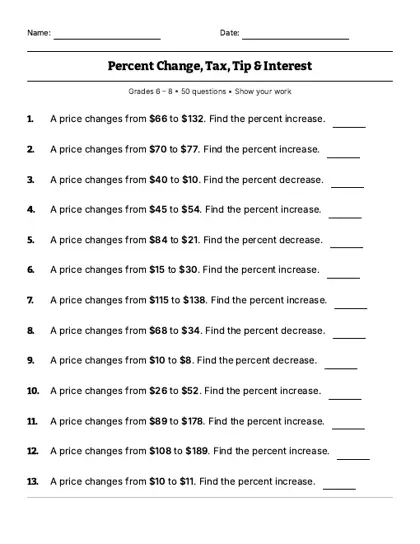
Percent change worksheet: printable PDF with an answer key. · Make a fresh test
Percent practice · percent calculator · fraction, decimal and percent converter · percentage quiz · percent levels · percent games · percentages for kids
Last reviewed
Questions parents ask
How do you calculate percent change?
Find the change, divide by the starting amount, then multiply by 100. From $40 to $50 is 10 ÷ 40 = 25%.
Do you divide by the old or the new number?
The old, starting number. The change is always measured against where you started.
How do you know if it is an increase or a decrease?
If the new amount is bigger, it is an increase. If it is smaller, it is a decrease.
Can a percent increase be more than 100%?
Yes. Going from 20 to 50 is a 150% increase. A decrease can never be more than 100%.
What grade learns percent change?
Grade 7 under Common Core 7.RP.A.3. In India, class 8.