
How to find the whole from a percent
When you know a part and its percent, work back to 100%. If 15 is 30%, then 5 is 10%, and the whole is 50.
The idea: work back to 100%
Most percent questions give the whole and ask for a part. This one is the other way round. You know a part, and you know what percent it is. The job is to find the whole, which is always 100%.
For example, “15 is 30% of what number?” Here 15 is the part and 30% is its percent. The answer is the whole: the number that 15 is 30% of.
A good first step is to ask “is the whole bigger or smaller than the part?” Since 30% is less than 100%, the whole must be bigger than 15. That check catches most mistakes.
See it: pictures to draw with your child
Copy these onto paper or a whiteboard. A quick sketch makes the idea concrete before any written method.
Method 1: find 1%, then 100%
- Divide the part by the percent to find 1%. 15 ÷ 30 = 0.5, so 1% is 0.5.
- Multiply by 100 to find 100%. 0.5 × 100 = 50.
- Check: 30% of 50 is 15. Correct.
This method always works, even with awkward percents like 37%. It is the method behind the formula whole = part ÷ percent × 100.
Method 2: find a friendly percent first
When the percent is a multiple of 10 or 25, a friendlier step is quicker. If 30% is 15, then 10% is a third of that: 5. Ten lots of 10% make 100%, so the whole is 50.
For example, 8 is 25% of what? 25% is a quarter, so four quarters make the whole: 8 × 4 = 32. Children who know the benchmark percents can do many of these in their head.
Find the whole
Type the part and its percent. The calculator shows each step, so you can check your own work.
Method 3: write an equation
Older children can write the question as an equation. “15 is 30% of what?” becomes 15 = 0.3 × w. Divide both sides by 0.3: w = 15 ÷ 0.3 = 50.
This is the method grade 7 uses for harder problems, such as finding an original price after a discount. The percent of a number page shows the same equation the other way round.
Which kind of percent question is it?
There are three kinds of percent question, and they use the same three numbers: the part, the whole and the percent. The question tells you which one is missing.
- “What is 30% of 50?” The part is missing. See percent of a number.
- “15 is what percent of 50?” The percent is missing. See finding the percent.
- “15 is 30% of what?” The whole is missing. That is this page.
The words “of what” or “of what number” are the clue that the whole is missing.
Finding the whole in real life
This skill answers everyday questions. A child saved $12, which is 40% of the price of a game. What does the game cost? 10% is $3, so 100% is $30.
It also works backwards from sales. A jacket costs $60 after 25% off, so $60 is 75% of the original price. 25% is $20, so the original price was $80.
Quiz: find the whole
Find the whole from a part and its percent. Type the number only.
Where this fits: percentages step by step
- What is a percent
- Percent to fraction
- Fraction to percent
- Percent to decimal
- Decimal to percent
- Comparing fractions, decimals and percents
- Benchmark percents
- Percent mental math
- Over 100% and under 1%
- Percent of a number
- Finding the percent
- Finding the whole (this page)
- Percent change
- Percent increase and decrease
- Discounts and sale price
- Sales tax
- Tips
- Simple interest
- Markup, commission and percent error
- Percent word problems
What to say to your child
A short script for teaching it the first time. Pause after each line and let your child do the next step.
- “I spent 6 dollars, and that was 20% of my money. How much did I have?”
- “What is 10% then?” (3 dollars.)
- “How many tens make 100%?” (10.) “So 10 × 3 is …” (30 dollars.)
- “Check: is 20% of 30 equal to 6?” (Yes.)
- “Is the whole bigger or smaller than the part?” (Bigger.)
More worked examples
Example 1: a friendly percent
12 is 50% of what? 50% is half, so the whole is double: 24.
Example 2: using 10%
18 is 60% of what? 10% is 18 ÷ 6 = 3, so 100% is 30.
Example 3: using 1%
21 is 35% of what? 1% is 21 ÷ 35 = 0.6, so 100% is 60.
Example 4: a price
$9 is 15% of a bill. 5% is $3, so 100% is $60.
Practice questions (answers below)
Ask these out loud or write them down. Check each answer, and ask “how did you get that?” for one or two.
- 10 is 50% of what?
- 6 is 25% of what?
- 4 is 10% of what?
- 9 is 30% of what?
- 14 is 20% of what?
- 12 is 75% of what?
- 3 is 1% of what?
- 45 is 90% of what?
- $8 is 40% of a price. What is the price?
- Stretch: 18 is 120% of what?
Show the answers
- 20
- 24
- 40
- 30
- 70
- 16
- 300
- 50
- $20
- 15
Common mistakes
How to teach it at home
Pocket money puzzles
“I spent $4. That was 20% of my money. How much did I have?”
Battery maths
“The battery is 50% and has 3 hours left. How long when full?”
Reverse sales
Look at sale prices and work out the original price together.
By grade
- Grade 6 (6.RP.A.3c): find the whole, given a part and the percent.
- Grade 7 (7.RP.A.3): multi-step problems, like original prices before a discount.
- In India, this comes in class 7 and class 8 maths.
- Next: percent change.
More for each grade: Grade 6 math and the CBSE class 6 maths guide.
Worksheets and practice
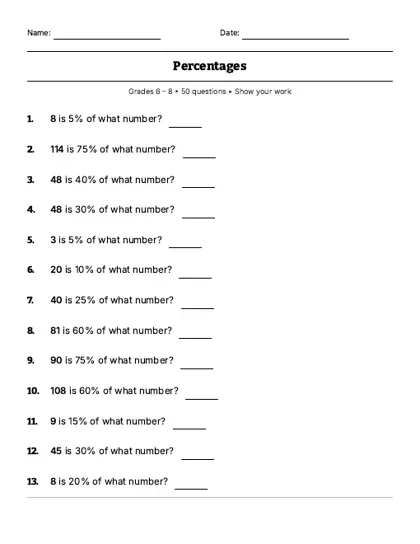
Finding the whole worksheet: printable PDF with an answer key. · Make a fresh test
Percent practice · percent calculator · fraction, decimal and percent converter · percentage quiz · percent levels · percent games · percentages for kids
Last reviewed
Questions parents ask
How do you find the whole from a percent?
Divide the part by the percent to get 1%, then multiply by 100. If 15 is 30%, 1% is 0.5 and the whole is 50.
What is the formula for finding the whole?
Whole = part ÷ percent × 100. Or, with a decimal, whole = part ÷ 0.3 for 30%.
How do you know a question is asking for the whole?
Look for “of what” or “of what number”, like “15 is 30% of what?”
Is the whole always bigger than the part?
Yes, when the percent is less than 100%. If the percent is over 100%, the whole is smaller.
What grade learns finding the whole?
Grade 6 under Common Core 6.RP.A.3c. In India, class 7.