
Percent increase and decrease
To increase an amount by a percent, add that percent of it. To decrease, take it away. A multiplier does both in one step.
The two-step method
- Find the percent of the amount.
- Add it for an increase, or subtract it for a decrease.
For example, increase 80 by 15%. 15% of 80 is 12, so the new amount is 80 + 12 = 92. To decrease 80 by 15%, subtract instead: 80 − 12 = 68.
See it: pictures to draw with your child
Copy these onto paper or a whiteboard. A quick sketch makes the idea concrete before any written method.
The multiplier method
A quicker way uses one multiplication. An increase of 15% leaves you with 100% + 15% = 115% of the amount. As a decimal that is 1.15, so multiply by 1.15. For example, 80 × 1.15 = 92.
A decrease of 15% leaves 100% − 15% = 85%. Multiply by 0.85: 80 × 0.85 = 68. The multiplier is the key idea for grade 7 and beyond.
Common multipliers
| Change | New amount is | Multiplier |
|---|---|---|
| Increase by 10% | 110% | × 1.1 |
| Increase by 25% | 125% | × 1.25 |
| Increase by 50% | 150% | × 1.5 |
| Increase by 100% | 200% | × 2 |
| Decrease by 10% | 90% | × 0.9 |
| Decrease by 25% | 75% | × 0.75 |
| Decrease by 50% | 50% | × 0.5 |
Percent change calculator
Type a starting amount and a new amount to see the percent increase or decrease, step by step.
Why up 10% then down 10% is not the same
Increase 100 by 10% to get 110. Now decrease 110 by 10%: 10% of 110 is 11, so you get 99, not 100. The second change is a percent of a bigger number.
With multipliers it is clear: 100 × 1.1 × 0.9 = 99. This surprises many adults, and it is a great talking point with older children.
Going the other way: finding the percent change
Sometimes you know the old and new amounts and need the percent. Find the change, then divide by the starting amount. From 80 to 92 is a change of 12, and 12 ÷ 80 = 0.15 = 15%.
The percent change page covers this in full. Remember to always divide by the starting amount, never the new one.
Percent increase and decrease in real life
Prices, pay and populations all change by percents. A $2.00 bus fare that rises by 5% becomes $2.10. A town of 8,000 people that grows by 3% gains 240 people.
Decreases are everywhere too. A phone that loses 20% of its value each year is worth 80% of last year’s price. After two years, a $500 phone is worth $500 × 0.8 × 0.8 = $320.
Ask your child to spot these in the news or at the shops. Each one is a chance to choose between the two-step method and the multiplier.
Quiz: increase and decrease
Find the new amount, or the percent change. Type numbers only.
Where this fits: percentages step by step
- What is a percent
- Percent to fraction
- Fraction to percent
- Percent to decimal
- Decimal to percent
- Comparing fractions, decimals and percents
- Benchmark percents
- Percent mental math
- Over 100% and under 1%
- Percent of a number
- Finding the percent
- Finding the whole
- Percent change
- Percent increase and decrease (this page)
- Discounts and sale price
- Sales tax
- Tips
- Simple interest
- Markup, commission and percent error
- Percent word problems
What to say to your child
A short script for teaching it the first time. Pause after each line and let your child do the next step.
- “A $40 game goes up by 10%. What is 10% of 40?” ($4.)
- “So the new price is …” ($44.)
- “What percent of the old price is that?” (110%.)
- “So we could just multiply by …” (1.1.)
- “What would we multiply by for a 10% decrease?” (0.9.)
More worked examples
Example 1: increase 60 by 20%
20% of 60 is 12. 60 + 12 = 72. Or 60 × 1.2 = 72.
Example 2: decrease 250 by 30%
30% of 250 is 75. 250 − 75 = 175. Or 250 × 0.7 = 175.
Example 3: a population
A town of 5,000 grows by 4%. 5,000 × 1.04 = 5,200.
Example 4: a price drop
A $90 bike drops 1/3 in price, about 33%. 90 × 2/3 = $60.
Practice questions (answers below)
Ask these out loud or write them down. Check each answer, and ask “how did you get that?” for one or two.
- Increase 50 by 10%
- Increase 200 by 25%
- Decrease 80 by 25%
- Decrease 40 by 5%
- Multiplier for a 30% increase
- Multiplier for a 20% decrease
- 120 × 1.5
- From 50 to 60: percent increase?
- From 80 to 60: percent decrease?
- Stretch: 100 up 20% then down 20%
Show the answers
- 55
- 250
- 60
- 38
- 1.3
- 0.8
- 180
- 20%
- 25%
- 96
Common mistakes
How to teach it at home
Price watch
Track a price over a few weeks and work out each percent change.
Growth chart
Find your child’s height increase as a percent.
Multiplier match
Match cards: “up 25%” and “× 1.25”.
By grade
- Grade 7 (7.RP.A.3): percent increase and decrease in multi-step problems.
- Grade 8 and up: repeated changes and growth.
- In India, this comes in class 8 maths.
- Next: discounts and sale price.
More for each grade: Grade 7 math and the CBSE class 7 maths guide.
Worksheets and practice
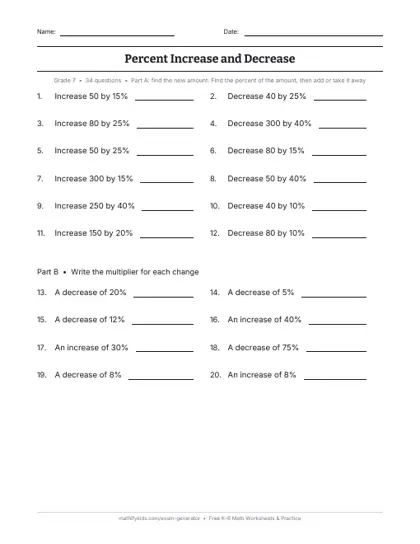
Percent increase and decrease worksheet: printable PDF with an answer key. · Make a fresh test
Percent practice · percent calculator · fraction, decimal and percent converter · percentage quiz · percent levels · percent games · percentages for kids
Last reviewed
Questions parents ask
How do you increase a number by a percent?
Find the percent of the number and add it on. Or multiply by 1 plus the percent as a decimal: × 1.15 for 15%.
How do you decrease a number by a percent?
Find the percent and subtract it. Or multiply by 1 minus the percent: × 0.85 for 15%.
What is a multiplier?
The single number you multiply by to make a percent change, like 1.2 for +20% or 0.75 for −25%.
Why doesn’t up 10% then down 10% get back to the start?
The second 10% is taken from a bigger amount. 100 × 1.1 × 0.9 = 99.
What grade learns percent increase and decrease?
Grade 7 under Common Core 7.RP.A.3. In India, class 8.