
Simple interest
Simple interest is money earned, or paid, as a percent of the starting amount each year. Interest = principal × rate × time.
The idea: a percent each year
When you save money in a bank, the bank pays you interest for keeping it there. When you borrow money, you pay interest to the lender. Either way, interest is a percent of the money.
With simple interest, the percent is always taken from the starting amount, called the principal. So $200 at 5% earns $10 every year, year after year.
See it: pictures to draw with your child
Copy these onto paper or a whiteboard. A quick sketch makes the idea concrete before any written method.
The formula: I = P × r × t
- I is the interest earned or paid.
- P is the principal, the starting amount.
- r is the yearly rate as a decimal: 5% = 0.05.
- t is the time in years.
For example, $200 at 5% for 3 years: I = 200 × 0.05 × 3 = $30. The total in the account is then $200 + $30 = $230.
Watching it grow year by year
| Year | Interest that year | Total interest | Money in the account |
|---|---|---|---|
| 0 | – | $0 | $200 |
| 1 | $10 | $10 | $210 |
| 2 | $10 | $20 | $220 |
| 3 | $10 | $30 | $230 |
The interest is the same every year, because it is always 5% of the original $200. That steady pattern is what makes it “simple”.
Find one year’s interest
Type the rate and the principal. Multiply the answer by the number of years for the total interest.
Finding the rate or the time
The formula can be turned around. If $500 earns $60 in 3 years, the interest each year is $20. As a percent of $500, that is 20 ÷ 500 = 4%.
To find the time, divide the total interest by one year’s interest. $400 at 5% earns $20 a year, so earning $80 takes 80 ÷ 20 = 4 years.
Simple interest and compound interest
Most real savings accounts pay compound interest. Each year’s interest is added to the account, and next year’s interest is worked out on the bigger amount. So the money grows a little faster every year.
For example, $200 at 5% compound becomes $210, then $220.50, then $231.53. Simple interest is the first step to understanding this. Grade 7 focuses on simple interest only.
Interest on loans
Borrowing works the other way. A $1,000 loan at 6% simple interest for 2 years costs $120 in interest, so $1,120 must be paid back.
This is a great conversation for older children. A high rate makes borrowing expensive, and comparing rates is how families choose loans and savings accounts.
Quiz: simple interest
Find the interest, the total, the rate or the time. Type numbers only.
Where this fits: percentages step by step
- What is a percent
- Percent to fraction
- Fraction to percent
- Percent to decimal
- Decimal to percent
- Comparing fractions, decimals and percents
- Benchmark percents
- Percent mental math
- Over 100% and under 1%
- Percent of a number
- Finding the percent
- Finding the whole
- Percent change
- Percent increase and decrease
- Discounts and sale price
- Sales tax
- Tips
- Simple interest (this page)
- Markup, commission and percent error
- Percent word problems
What to say to your child
A short script for teaching it the first time. Pause after each line and let your child do the next step.
- “You save $100 and the bank pays 10% a year. How much interest in one year?” ($10.)
- “And in 3 years?” ($30.)
- “How much is in the account then?” ($130.)
- “What if the rate was 5%?” ($5 a year, $15 in 3 years.)
- “Is it better to save at 5% or 10%?” (10%.)
More worked examples
Example 1: savings
$500 at 4% for 2 years: I = 500 × 0.04 × 2 = $40. Total $540.
Example 2: a loan
$1,200 at 5% for 3 years: I = $180. Pay back $1,380.
Example 3: finding the rate
$300 earns $45 in 3 years: $15 a year. 15 ÷ 300 = 5%.
Example 4: finding the time
$800 at 2% earns $16 a year. $64 takes 4 years.
Practice questions (answers below)
Ask these out loud or write them down. Check each answer, and ask “how did you get that?” for one or two.
- $100 at 5% for 1 year
- $100 at 5% for 4 years
- $400 at 3% for 2 years
- $1,000 at 2% for 5 years
- Total after $200 at 10% for 2 years
- $500 earns $50 in 2 years. Rate?
- $600 at 5% earns $90. Years?
- Write 6% as a decimal
- Interest on a $2,000 loan at 4% for 1 year
- Stretch: $250 at 8% for 6 months
Show the answers
- $5
- $20
- $24
- $100
- $240
- 5%
- 3
- 0.06
- $80
- $10
Common mistakes
How to teach it at home
Piggy bank bank
Pay your child 10% a month on savings kept in a jar.
Rate hunt
Look up savings rates online and compare them.
Loan talk
Talk through what a family loan costs in interest.
By grade
- Grade 7 (7.RP.A.3): simple interest is named in the standard.
- High school: compound interest and exponential growth.
- In India, simple interest comes in class 7 and compound interest in class 8.
- Next: markup, commission and percent error.
More for each grade: Grade 7 math and the CBSE class 7 maths guide.
Worksheets and practice
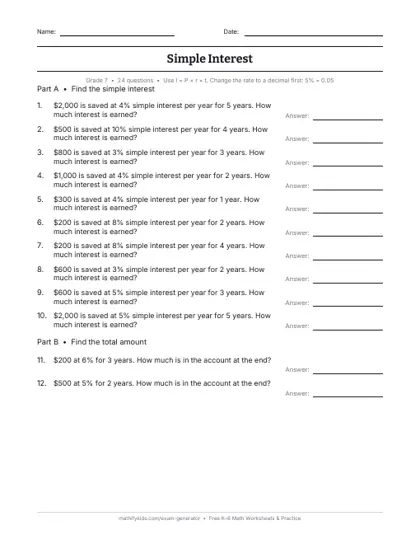
Simple interest worksheet: printable PDF with an answer key. · Make a fresh test
Tax, tip and interest worksheet · Percent practice · percent calculator · fraction, decimal and percent converter · percentage quiz · percent levels · percent games · percentages for kids
Last reviewed
Questions parents ask
What is simple interest?
Interest worked out as a percent of the starting amount each year. The same amount is earned every year.
What is the simple interest formula?
I = P × r × t: principal × rate (as a decimal) × time in years.
How do you find the total amount?
Add the interest to the principal. $200 + $30 = $230.
What is the difference between simple and compound interest?
Simple interest uses only the starting amount. Compound interest also earns interest on past interest.
What grade learns simple interest?
Grade 7 under Common Core 7.RP.A.3. In India, class 7.