
How to find perimeter
Perimeter is the distance around a shape. Add the lengths of all the sides. For a rectangle there is a shortcut: 2 × (length + width). A 6 by 4 rectangle has a perimeter of 20. This page covers perimeter of any polygon, missing sides, the rectangle builder, and why shapes with the same perimeter can have different areas.
Perimeter: the big idea
Imagine walking all the way round the edge of a shape, or putting a fence around a garden. The total distance is the perimeter. It is a length, so it is measured in plain units: cm, m, in, ft.
How to find perimeter, step by step
- Find every side length. Mark each side as you count it so none is missed.
- Add them all.
- Write the unit (cm, m, in…).
Rectangle shortcut: opposite sides are equal, so P = 2 × (length + width). Square: P = 4 × side.
Perimeter and area together
Try 6 × 4 and 8 × 2. Same perimeter (20), different area.
Finding a missing side
A rectangle has a perimeter of 30 cm and a length of 9 cm. Two lengths make 18, so the two widths make 12, and each width is 6 cm (3.MD.D.8). For L-shapes, use the opposite sides: the missing horizontal pieces add up to the long horizontal side.
Same perimeter, different area
A 6 × 4 rectangle and an 8 × 2 rectangle both have a perimeter of 20, but their areas are 24 and 16. The closer a rectangle is to a square, the more area it holds for the same fence. This is a favorite grade 3 problem.
Common mistakes
How to teach it at home
Walk the edge
Pace out the perimeter of a room or the garden.
String shapes
Use a 24-inch string to make different rectangles. Which holds the most?
Picture frames
Measure a photo and work out how much frame it needs.
By grade
- Grade 3 (3.MD.D.8): perimeter of polygons, missing sides, and rectangles with the same perimeter and different areas.
- See also area.
Worksheets and practice
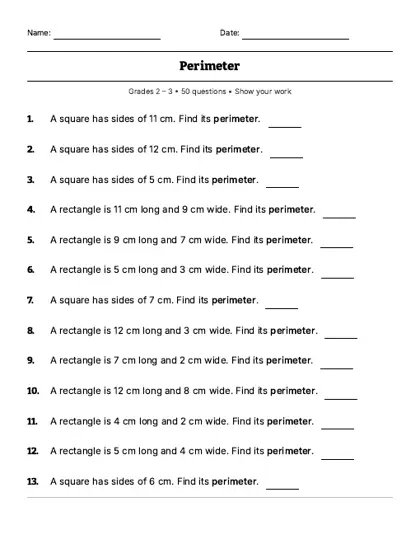
Perimeter worksheet: printable PDF with an answer key. · Make a fresh test
Last reviewed
Questions parents ask
How do you find perimeter?
Add the lengths of all the sides. For a rectangle, 2 × (length + width).
What is the perimeter of a square?
4 × the side length. A square with 5 cm sides has a perimeter of 20 cm.
What is the difference between perimeter and area?
Perimeter is the distance around a shape; area is the space inside it.
How do you find a missing side from the perimeter?
Subtract the known sides from the perimeter. For a rectangle, halve the perimeter and subtract the length to get the width.
What grade learns perimeter?
Grade 3 (3.MD.D.8).