
Adding fractions with unlike denominators
To add fractions with different denominators, make the denominators the same, then add the numerators. 1/2 + 1/3 = 3/6 + 2/6 = 5/6. Never add the denominators. This page shows why with fraction bars, explains how to find a common denominator, works examples including mixed numbers, and has a tool that shows the steps for any two fractions.
Start here: adding fractions with the same denominator
When the pieces are the same size, just count them. 2/8 + 3/8 = 5/8: two eighths and three eighths make five eighths. The denominator names the piece, like “eighths”, so it stays the same.
The big idea: you can only add pieces of the same size
Halves and thirds are different-sized pieces, so 1/2 + 1/3 can’t be counted directly. Cut both into sixths and they become the same size: 1/2 = 3/6 and 1/3 = 2/6. Now there are 5 sixths.
How to add fractions with unlike denominators, step by step
- Find a common denominator: a number both denominators divide into. The least common multiple keeps numbers small.
- Rewrite each fraction as an equivalent fraction with that denominator, multiplying top and bottom by the same number.
- Add the numerators. Keep the denominator.
- Simplify, and change an improper fraction to a mixed number if needed.
Fraction adder: see every step
Type two fractions and choose + or −. The bars show both fractions cut into the same size pieces.
Worked examples: adding fractions
Example 1: 1/4 + 2/4
Same denominator: 3/4.
Example 2: 1/2 + 1/3
Common denominator 6: 3/6 + 2/6 = 5/6.
Example 3: 2/3 + 1/4
Common denominator 12: 8/12 + 3/12 = 11/12.
Example 4: 3/4 + 1/6
LCM of 4 and 6 is 12 (not 24): 9/12 + 2/12 = 11/12.
Example 5: 5/6 + 3/4
12ths: 10/12 + 9/12 = 19/12 = 1 7/12.
Example 6: 1/2 + 3/10
10 is already a multiple of 2: 5/10 + 3/10 = 8/10 = 4/5 after simplifying.
Adding mixed numbers
Add the whole numbers and the fractions separately, then combine. 2 3/4 + 1 1/2: wholes 2 + 1 = 3; fractions 3/4 + 2/4 = 5/4 = 1 1/4; total 4 1/4. If the fractions make more than 1, the extra whole joins the whole numbers.
Common mistakes when adding fractions
How to teach adding fractions at home
Measuring cups
Pour 1/2 cup and then 1/4 cup into the same container and read the total (3/4 cup). Children see the answer before they calculate it.
Fraction strips
Cut paper strips into halves, thirds, quarters, sixths and twelfths. Lay pieces end to end to add them, and find which strip they match.
Pizza or chocolate
“You ate 1/4 and I ate 3/8. How much is gone?” Cut the pieces to make them match.
Adding fractions by grade
- Grade 4 (4.NF.B.3): add and subtract fractions and mixed numbers with like denominators.
- Grade 5 (5.NF.A.1, 5.NF.A.2): unlike denominators, including word problems.
Before this, children need equivalent fractions and the least common multiple. Afterwards: simplifying fractions and multiplying mixed numbers.
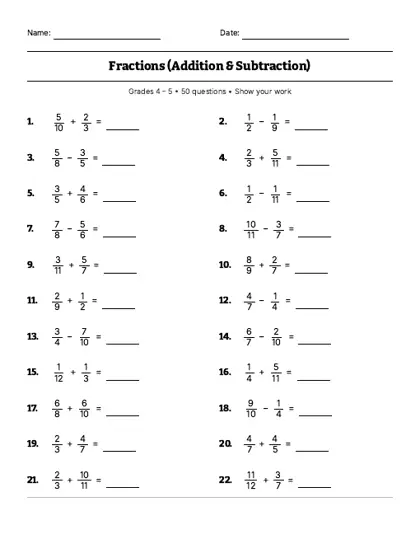
Adding fractions worksheets
Last reviewed
Questions parents ask
How do you add fractions with unlike denominators?
Rewrite both fractions with a common denominator, then add the numerators and keep the denominator. 1/2 + 1/3 = 3/6 + 2/6 = 5/6. Simplify at the end if you can.
Why can’t you just add the tops and bottoms?
Because the denominator is the size of the pieces, not a count. 1/2 + 1/3 is not 2/5, because 2/5 is less than 1/2 on its own. You can only add pieces of the same size.
How do you find a common denominator?
Find a number both denominators divide into. The smallest one is the least common multiple: for 4 and 6 it is 12. Multiplying the two denominators (24) also works, but gives bigger numbers to simplify.
How do you add mixed numbers?
Add the whole numbers, then add the fractions. If the fractions make more than 1, carry it into the whole number. 2 3/4 + 1 1/2 = 3 + 3/4 + 2/4 = 3 + 5/4 = 4 1/4.
How do you subtract fractions?
The same way: get a common denominator, then subtract the numerators. 3/4 − 1/6 = 9/12 − 2/12 = 7/12.
What grade learns adding fractions?
Grade 4 adds and subtracts fractions with the same denominator, including mixed numbers (4.NF.B.3). Grade 5 adds and subtracts fractions with different denominators (5.NF.A.1).