
Factors and multiples: what is the difference?
Factors divide into a number exactly; multiples are what you get when you multiply it. The factors of 12 are 1, 2, 3, 4, 6 and 12; the multiples of 12 are 12, 24, 36 and so on forever. This page shows how to find every factor in pairs, uses factor rainbows, and has a factor finder for any number.
The difference between factors and multiples
| Factors of 12 | Multiples of 12 | |
|---|---|---|
| Meaning | Numbers that go into 12 | Numbers 12 goes into |
| List | 1, 2, 3, 4, 6, 12 | 12, 24, 36, 48, … |
| How many | A short, complete list | Endless |
| Size | 12 or smaller | 12 or bigger |
Memory aid: factors fit in, multiples multiply out.
How to find all the factors of a number
- Start with 1 × the number.
- Try 2, 3, 4… in order. When one divides exactly, write the pair: 2 × 12, 3 × 8, 4 × 6 for 24.
- Stop when the pairs meet: after 4 × 6, the next would be 6 × 4, which you already have.
Factor finder
Any number up to 10,000: factor pairs, all factors, prime or composite, and the first multiples.
How to find multiples
Skip count, or multiply by 1, 2, 3, 4…: the multiples of 7 are 7, 14, 21, 28, 35… Every number is a multiple of itself, and a multiple of each of its factors.
Common mistakes
How to teach it at home
Rectangle builder
With 24 tiles, how many different rectangles can you make? Each is a factor pair.
Fizz buzz
Clap on multiples of 3, stamp on multiples of 5.
Party bags
24 sweets into equal bags: what bag sizes work?
By grade
- Grade 4 (4.OA.B.4): find all factor pairs for numbers 1–100, recognize multiples, and decide whether a number is prime or composite.
- Next: GCF and LCM in grade 6.
Worksheets and practice
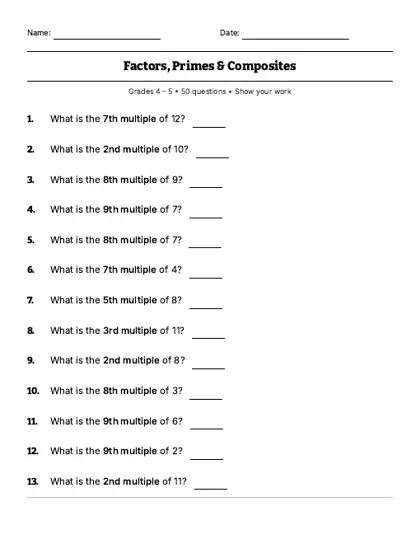
Factors and multiples worksheet: printable PDF with an answer key. · Make a fresh test
Last reviewed
Questions parents ask
What is the difference between a factor and a multiple?
A factor divides into a number exactly; a multiple is the result of multiplying a number. 3 is a factor of 12, and 12 is a multiple of 3.
How do you find all the factors of a number?
Test 1, 2, 3 and so on, writing each factor pair, and stop when the pairs meet in the middle.
Is a number a factor of itself?
Yes. Every number has 1 and itself as factors.
How many multiples does a number have?
Infinitely many: you can keep multiplying forever.
What grade learns factors and multiples?
Grade 4 (4.OA.B.4), with numbers up to 100.