
Skip counting by 2s, 5s and 10s
Skip counting means counting forward by the same number each time: 2, 4, 6, 8… or 5, 10, 15, 20… It makes counting large groups faster and is the first step to the times tables. This page shows the pattern for each number on an interactive hundred chart, plus games and the link to multiplication.
Skip counting on a hundred chart
Choose a number to see its pattern light up.
Patterns to notice
- By 10s: one straight column; the tens digit goes up by 1 each time.
- By 5s: two columns, ending in 5 and 0.
- By 2s: every other number; all the even numbers.
- By 3s: a diagonal pattern.
- By 100s: 100, 200, 300… (grade 2).
Why skip counting matters
Counting coins (5s and 10s), telling time (5s round the clock), counting pairs (2s) and, most of all, multiplication: counting by 4s five times gives 20, which is 5 × 4. See multiplication facts.
Skip counting from any number
Grade 2 counts by 10s and 100s from any number, not just from 0: 37, 47, 57… or 250, 350, 450… This builds place value: only the tens (or hundreds) digit changes.
Common mistakes
How to teach it at home
Count by 2s on walks
Count steps or pairs of shoes in 2s.
Coins
Count nickels by 5s and dimes by 10s.
Skip counting songs
Clap and sing along; the rhythm helps.
Hopscotch
Jump on every second or fifth square.
By grade
- Grade 1: count by 10s from any number (1.NBT.C.5).
- Grade 2 (2.NBT.A.2): skip count by 5s, 10s and 100s within 1,000.
- Grade 3: skip counting supports the times tables.
Worksheets and practice
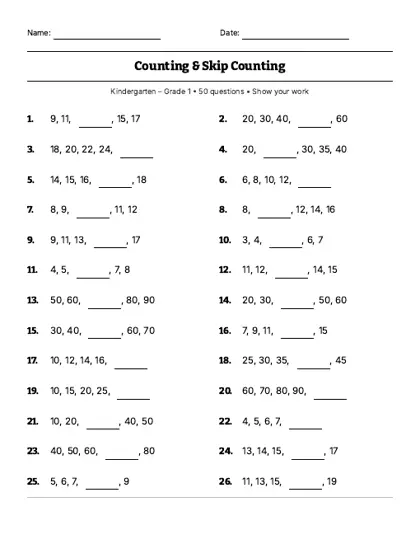
Skip counting worksheet: printable PDF with an answer key. · Make a fresh test
Last reviewed
Questions parents ask
What is skip counting?
Counting forward by the same number each time, like 5, 10, 15, 20.
How do I teach skip counting?
Use a hundred chart to see the pattern, real groups like pairs and coins, and songs with a beat.
Why is skip counting important?
It speeds up counting groups and leads directly into multiplication.
What grade learns skip counting?
Grades 1 and 2: by 10s, then by 5s, 10s and 100s within 1,000 in grade 2 (2.NBT.A.2).
What comes after skip counting?
Multiplication: skip counting by 4 five times is 5 × 4 = 20.