
How to find volume
Volume is the amount of space inside a solid, measured in cubic units. For a box (a rectangular prism), multiply length × width × height. This page shows why that works with cube pictures, has a box builder to explore, works through examples including composite shapes, and covers the mistakes children make.
Volume: the big idea
Volume counts how many unit cubes fit inside a shape. A unit cube is 1 unit long, 1 unit wide and 1 unit high. Fill a box with them, count them, and that is the volume.
Counting one by one is slow, so we count in layers. The bottom layer of the box below has 4 × 3 = 12 cubes. There are 2 layers, so 12 × 2 = 24 cubes.
How to find the volume of a rectangular prism, step by step
- Find the length, width and height. Make sure they use the same unit.
- Multiply length × width to get the area of the base (cubes in one layer).
- Multiply by the height (the number of layers).
- Write the units cubed: cm³, in³, m³.
The order doesn’t matter: 4 × 3 × 2, 2 × 4 × 3 and 3 × 2 × 4 all make 24. Many textbooks write it as V = l × w × h or V = B × h, where B is the area of the base.
Box builder: see the volume change
Drag the sliders to change the length, width and height. The drawing and the calculation update together.
Worked examples: volume of rectangular prisms
Example 1: a shoebox
30 cm long, 20 cm wide, 10 cm high. V = 30 × 20 × 10 = 6,000 cm³. That is 6 liters, since 1,000 cm³ = 1 liter.
Example 2: a cube
Each edge is 5 in. V = 5 × 5 × 5 = 125 in³.
Example 3: finding a missing side
A box has a volume of 60 cm³, a length of 5 cm and a width of 4 cm. One layer holds 5 × 4 = 20 cubes, so the height is 60 ÷ 20 = 3 cm.
Example 4: an L-shaped solid
Split it into two boxes, find each volume and add them. A 6 × 2 × 2 box (24 cm³) next to a 2 × 2 × 3 box (12 cm³) makes 36 cm³ (5.MD.C.5c).
Example 5: fractional edges (grade 6)
A box 2½ cm × 2 cm × 4 cm: V = 2.5 × 2 × 4 = 20 cm³. The same rule works with fractions and decimals.
Units of volume
- Cubic centimeters (cm³): small objects. A sugar cube is about 1 cm³.
- Cubic inches (in³) and cubic feet (ft³): US measurements for boxes, rooms and fridges.
- Cubic meters (m³): rooms, swimming pools, shipping containers.
- Liters and milliliters: liquids. 1 mL = 1 cm³ and 1 L = 1,000 cm³.
Common mistakes with volume
How to teach volume at home
Fill a box with cubes
Sugar cubes, dice or building blocks in a small box: count one layer, then the layers. Then check with l × w × h.
Compare cereal boxes
Measure two different-shaped boxes and predict which holds more. Calculate, then pour rice from one to the other to check.
Water and the kitchen jug
Fill a box-shaped container with water and pour it into a measuring jug. A 10 × 10 × 10 cm container holds exactly 1 liter.
Build with Lego
Build a solid rectangle 4 studs by 2 studs by 3 bricks high and count the bricks. Then build the same volume a different shape.
Volume by grade
- Grade 5 (5.MD.C.3 to 5.MD.C.5): volume as counting unit cubes, V = l × w × h, and adding volumes of two boxes.
- Grade 6 (6.G.A.2): volume with fractional edge lengths.
- Grade 7 (7.G.B.6): volume of prisms with any polygon base.
- Grade 8 (8.G.C.9): volume of cylinders, cones and spheres.
Before volume, children should be confident with area, because the base of every prism is an area.
Volume worksheets and practice
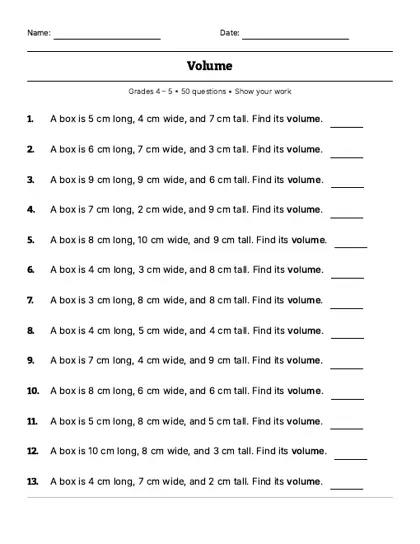
Volume of rectangular prisms worksheet: 50 problems with an answer key.
Make a fresh volume test with the free test maker.
Grade 8: volume of cylinders · cones and spheres · surface area
Related: 3D shapes chart · geometry
Last reviewed
Questions parents ask
How do you find the volume of a box?
Multiply length × width × height. A box 6 cm long, 4 cm wide and 3 cm high has a volume of 6 × 4 × 3 = 72 cubic centimeters.
What units is volume measured in?
Cubic units, written with a small 3: cm³, m³, in³, ft³. Each cubic unit is a cube 1 unit long on every edge. Liquids are often measured in liters and milliliters: 1 mL is the same as 1 cm³.
What is the difference between area and volume?
Area measures a flat surface in square units (cm²). Volume measures the space inside a solid in cubic units (cm³). Area counts squares; volume counts cubes.
Why is volume length × width × height?
Length × width tells you how many cubes fit in one layer on the bottom. Height tells you how many layers there are. Layers × cubes per layer gives all the cubes.
How do you find the volume of a cube?
Multiply the edge length by itself three times. A cube with 5 cm edges has a volume of 5 × 5 × 5 = 125 cm³. That is why 5³ is called “5 cubed”.
What grade learns volume?
Grade 5 (5.MD.C.3 to 5.MD.C.5) learns volume of rectangular prisms by counting cubes and with V = l × w × h. Grade 6 uses fractional edges, and grade 8 finds the volume of cylinders, cones and spheres.