
Multi-digit subtraction with the standard algorithm
Multi-digit subtraction works column by column from the right, regrouping (borrowing) whenever a top digit is smaller than the one below. The hard part is zeros: in 5,003 − 1,278, the borrow has to travel across two zeros. This page shows the standard algorithm, a tool that steps through any problem up to 9,999, and the classic mistakes.
The standard algorithm, step by step
- Estimate: 6,352 − 2,817 is about 6,000 − 3,000 = 3,000.
- Line up the places. Bigger number on top.
- Start with the ones. If the top digit is smaller, borrow 1 from the next place to the left, which gives 10 more.
- Move left column by column, using the new digits after any borrowing.
- Check by adding the answer to the number you took away.
Step through any subtraction up to 9,999
Try 5003 − 1278 to see borrowing across zeros.
Worked examples
Red numbers show what each digit becomes after borrowing.
Example 1: Regroup in two places
6,352 − 2,817 = 3,535. Check: 3,535 + 2,817 = 6,352.
Example 2: Across two zeros
5,003 − 1,278 = 3,725. Check: 3,725 + 1,278 = 5,003.
Example 3: Across three zeros
8,000 − 3,456 = 4,544. Check: 4,544 + 3,456 = 8,000.
Subtracting across zeros
When the next place is 0, keep going left until you reach a non-zero digit, borrow from it, and every 0 on the way becomes 9. A shortcut: read the digits before the ones as one number and take 1 away. 5,003 has 500 tens; take one away and it becomes 499 tens and 13 ones: 4 | 9 | 9 | 13.
Common mistakes
How to teach it at home
Count down a budget
Start with $5,000 for a pretend holiday and subtract costs.
Years apart
How many years between 1969 and 2026? (57)
Odometer maths
Subtract two car odometer readings to find a trip’s distance.
By grade
- Grade 3 (3.NBT.A.2): subtract within 1,000. See 3-digit subtraction.
- Grade 4 (4.NBT.B.4): subtract multi-digit whole numbers with the standard algorithm.
Worksheets and practice
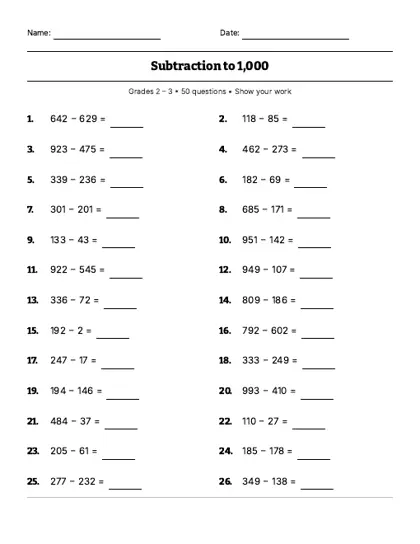
3-digit subtraction worksheet: printable PDF with an answer key. · Make a fresh test
Last reviewed
Questions parents ask
How do you subtract across zeros?
Borrow from the first non-zero digit to the left. Every zero you pass becomes 9, and the place you need gets 10 more. 5,003 becomes 4 | 9 | 9 | 13.
What is the standard algorithm for subtraction?
The column method: subtract from right to left, borrowing from the next place whenever a top digit is smaller than the bottom one.
How do you check multi-digit subtraction?
Add the answer to the number you subtracted. You should get the top number.
Why is subtracting across zeros so hard?
Because the borrow has to pass through several places. Thinking of 5,003 as 500 tens and 3 ones makes it one step.
What grade learns multi-digit subtraction?
Grade 4, with the standard algorithm (4.NBT.B.4).