
Composite numbers
A composite number has more than two factors. 12 is composite because 1, 2, 3, 4, 6 and 12 all divide it.
What is a composite number?
A composite number is a whole number with more than two factors. 6 has the factors 1, 2, 3 and 6, so it is composite.
A prime number has exactly two factors, 1 and itself. The number 1 has only one factor, so 1 is neither prime nor composite.
| Prime | Composite | |
|---|---|---|
| Number of factors | Exactly 2 | More than 2 |
| Examples | 2, 3, 5, 7, 11, 13 | 4, 6, 8, 9, 10, 12 |
| Rectangles of counters | Only one long line | More than one rectangle |
The rectangle test
Take a number of counters and try to make rectangles. Each rectangle is a multiplication array, and its sides are a factor pair.
Squares count as rectangles too. 9 makes a 3 by 3 square, so 9 is composite even though it is odd.
List of composite numbers to 100
There are 74 composite numbers from 1 to 100. The first 30 are:
4, 6, 8, 9, 10, 12, 14, 15, 16, 18, 20, 21, 22, 24, 25, 26, 27, 28, 30, 32, 33, 34, 35, 36, 38, 39, 40, 42, 44, 45
Every even number above 2 is composite, because 2 is a factor. The odd composite numbers below 100 are the tricky ones: 9, 15, 21, 25, 27, 33, 35, 39, 45, 49, 51, 55, 57, 63, 65, 69, 75, 77, 81, 85, 87, 91, 93, 95 and 99.
See the prime and composite numbers chart for all 100 in one picture.
How to tell if a number is composite
- Even and bigger than 2? It is composite.
- Ends in 0 or 5 and bigger than 5? It is composite.
- Digits add to a multiple of 3? Then 3 is a factor, so it is composite (unless it is 3).
- Still not sure? Try dividing by 7. Below 100 you never need to test past 7.
If none of these divide it, the number is prime. The divisibility rules lesson explains each rule.
Odd, even and square composite numbers
Even composite numbers are easy to spot: 4, 6, 8, 10 and every even number after them. Each one has 2 as a factor.
Odd composite numbers need a closer look. The smallest is 9 = 3 × 3, then 15 = 3 × 5 and 21 = 3 × 7. Many of them are multiples of 3, so the digit-sum test catches them.
Square numbers such as 4, 9, 16, 25 and 36 are always composite, apart from 1. Each one has a factor pair that repeats a number, like 5 × 5 = 25. That gives them an odd number of factors: 25 has 1, 5 and 25.
Children who know their times tables spot composite numbers fastest. Any product like 6 × 7, where both numbers are bigger than 1, is composite.
Every composite number is made of primes
Every composite number can be split into prime factors. For example, 12 = 2 × 2 × 3 and 35 = 5 × 7. A factor tree shows this.
That is why composite means “put together”: the number is built from smaller primes. Learn more in prime factorization.
Prime or composite quiz
Decide if each number is prime, composite or neither. Wrong answers show the factors.
What to say to your child
A short script for teaching it the first time. Pause after each line and let your child do the next step.
- “Here are 12 counters. Can you put them in a rectangle?” (3 rows of 4.)
- “Can you make a different rectangle?” (2 by 6, or 1 by 12.)
- “12 makes more than one rectangle, so 12 is composite.”
- “Now try 7 counters. Any rectangle except one long line?” (No.)
- “7 makes only one line, so 7 is prime.”
More worked examples
Example 1: Is 21 prime or composite?
2 + 1 = 3, so 21 is divisible by 3: 21 = 3 × 7. It has four factors (1, 3, 7, 21), so it is composite.
Example 2: Is 29 prime or composite?
Test the primes up to 5, because 6 × 6 = 36 is more than 29. 29 is not divisible by 2, 3 or 5, so it is prime.
Example 3: Is 91 prime or composite?
91 = 7 × 13, so it is composite. It is one of the trickiest numbers below 100.
Example 4: Is 1 prime or composite?
Neither. 1 has only one factor, and composite numbers need more than two.
Practice questions (answers below)
Ask these out loud or write them down. Check each answer, and ask “how did you get that?” for one or two.
- Is 15 prime or composite?
- Is 17 prime or composite?
- Is 27 prime or composite?
- Is 39 prime or composite?
- Is 41 prime or composite?
- Name the smallest composite number.
- Is 57 prime or composite?
- Name the only even prime number.
Show the answers
- Composite: 3 × 5
- Prime
- Composite: 3 × 9
- Composite: 3 × 13
- Prime
- 4
- Composite: 3 × 19 (5 + 7 = 12)
- 2: every other even number is composite
Common mistakes
How to teach it at home
Rectangle hunt
Use coins or buttons. Can your child make more than one rectangle with 15? With 13?
Number plate game
Spot two-digit numbers on cars and call out prime or composite.
Composite count
Count from 1 to 30 and clap on every composite number.
By grade
- Grade 4 (4.OA.B.4): decide whether a whole number from 1 to 100 is prime or composite.
- Grade 5–6: use prime factors of composite numbers for fractions, the GCF and the LCM.
- India: NCERT class 6 covers prime and composite numbers in chapter 5, Prime Time.
More for each grade: Grade 4 math and the CBSE class 4 maths guide.
Worksheets and practice
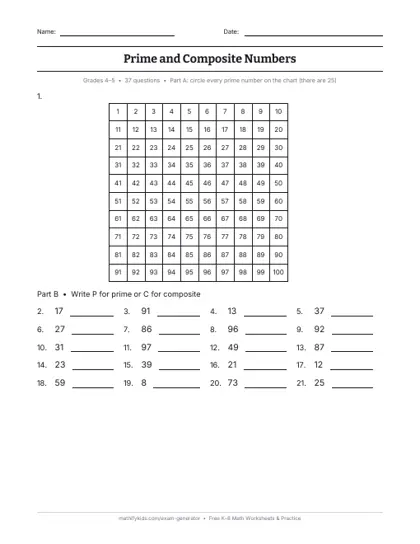
Prime and composite numbers worksheet: printable PDF with an answer key. · Make a fresh test
Practice prime or composite online · Prime numbers and the sieve · Array Builder game
Last reviewed
Questions parents ask
What is a composite number?
A whole number with more than two factors. 4, 6, 8, 9 and 10 are composite: 9 has the factors 1, 3 and 9.
Is 1 a composite number?
No. 1 has only one factor, so it is neither prime nor composite.
What is the smallest composite number?
4. Its factors are 1, 2 and 4, so it has more than two.
How many composite numbers are there from 1 to 100?
74. There are 25 primes, and the number 1 is neither, so the other 74 are composite.
Is 9 a composite number?
Yes. 9 = 3 × 3, so its factors are 1, 3 and 9. Odd numbers can be composite.