
Multiplication arrays
An array is objects in equal rows and columns, like eggs in a carton. Arrays make multiplication easy to see: 3 rows of 5 is 3 × 5 = 15.
What is an array?
An array is a set of objects in rows (going across) and columns (going down), with the same number in every row. To write the multiplication, count the rows, count how many are in one row, and multiply.
Rows × number in each row = total. An array with 4 rows of 6 is 4 × 6 = 24.
Arrays are better than loose groups because they line up neatly: you can check at a glance that every row is the same, and you can count the total by skip counting down the rows (6, 12, 18, 24).
See it: pictures to draw with your child
Copy these onto paper or a whiteboard. A quick sketch makes the idea concrete before any written method.
Array explorer
Build any array and see its multiplication.
Turn the array: the turn-around rule
Turn an array of 3 rows of 5 on its side and it becomes 5 rows of 3. Nothing was added or taken away, so the total is still 15. That is why 3 × 5 = 5 × 3. Mathematicians call it the commutative property; children can call it the turn-around rule.
This halves the number of facts to learn. Once your child knows 3 × 8, they also know 8 × 3. See multiplication properties for the other rules.
Quiz: read the array
Count the rows, count one row, and find the total.
Arrays in real life
- Egg carton: 2 rows of 6 = 12 eggs.
- Muffin tray: 3 rows of 4 = 12 muffins.
- Chocolate bar: 4 rows of 6 = 24 pieces.
- Windows on a building: 5 floors of 8 windows = 40 windows.
- Classroom chairs: 6 rows of 5 = 30 chairs.
Hunt for arrays at home and ask your child to say the multiplication before counting. To build arrays on screen, play the array builder game.
How many arrays can you make with 12?
Give your child 12 counters and ask for every rectangle they can make. They will find 1 row of 12, 2 rows of 6, 3 rows of 4, and the same ones turned around.
Those are the factor pairs of 12: 1 × 12, 2 × 6 and 3 × 4. Try 7 counters next. Only one array works, 1 row of 7, because 7 is a prime number. This game leads straight into factors and multiples in grade 4.
For a challenge, try 24 counters. There are four arrays: 1 × 24, 2 × 12, 3 × 8 and 4 × 6. Ask your child how they know they have found them all.
Arrays show division too
An array of 4 rows of 6 also shows 24 ÷ 4 = 6 (share 24 into 4 rows) and 24 ÷ 6 = 4 (how many rows of 6 in 24). One array gives a whole fact family: 4 × 6, 6 × 4, 24 ÷ 4 and 24 ÷ 6. See division facts.
From arrays to area
Replace the dots with squares and an array becomes a rectangle. A rectangle 4 squares by 6 squares has an area of 24 square units. That is how arrays lead to area in grade 3 and to multiplying bigger numbers in grade 4.
Where this fits: the first steps in multiplication
What to say to your child
A short script for teaching it the first time. Pause after each line and let your child do the next step.
- “Let’s put these 12 coins in rows. Make rows of 4.”
- “How many rows did you make?” (3.) “How many in each row?” (4.)
- “So 3 rows of 4 is 3 × 4. How many coins?” (12.)
- “Turn the paper sideways. Now how many rows, and how many in each?” (4 rows of 3.)
- “Did the number of coins change?” (No.) “So 3 × 4 = 4 × 3.”
More worked examples
Example 1: 4 rows of 5
4 × 5 = 20. Skip count down the rows: 5, 10, 15, 20.
Example 2: A muffin tray
3 rows of 4 muffins: 3 × 4 = 12 muffins.
Example 3: Turn it
An array of 2 rows of 7 is 2 × 7 = 14. Turned, it is 7 rows of 2: 7 × 2 = 14.
Practice questions (answers below)
Ask these out loud or write them down. Check each answer, and ask “how did you get that?” for one or two.
- 2 rows of 5
- 3 rows of 6
- 5 rows of 4
- 4 rows of 7
- An array is 6 rows of 3. Turned around, it is __ rows of __.
- Stickers: 4 rows of 8. How many stickers?
- Write two multiplications for an array of 3 rows of 9.
- Write a division fact for 5 rows of 4.
Show the answers
- 10
- 18
- 20
- 28
- 3 rows of 6
- 32
- 3 × 9 = 27 and 9 × 3 = 27
- 20 ÷ 5 = 4 (or 20 ÷ 4 = 5)
Common mistakes
How to teach it at home
Coin arrays
Arrange coins or buttons in rows and say the multiplication.
Muffin tray maths
Fill a muffin tray or ice cube tray and count by rows.
Graph paper
Colour rectangles on squared paper and write the multiplication inside.
By grade
- Grade 2 (2.OA.C.4): arrays up to 5 rows and 5 columns, written as repeated addition.
- Grade 3 (3.OA.A.1, 3.OA.A.3): arrays to solve multiplication and division problems.
- Grade 4: arrays become area models for multi-digit multiplication.
More for each grade: Grade 2 math and the CBSE class 2 maths guide; Grade 3 math and the CBSE class 3 maths guide.
Worksheets and practice
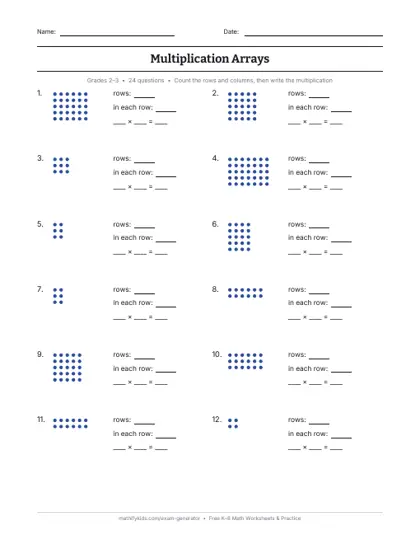
Multiplication arrays worksheet: printable PDF with an answer key. · Make a fresh test
Multiplication practice · times tables · multiplication chart
Last reviewed
Questions parents ask
What is an array in multiplication?
An array is objects arranged in equal rows and columns. The number of rows times the number in each row gives the total. 3 rows of 5 is 3 × 5 = 15.
How do you write a multiplication for an array?
Count the rows, count how many are in one row, and write rows × number in each row = total, such as 4 × 6 = 24.
Are rows across or down?
Rows go across (left to right). Columns go down (top to bottom).
Why are arrays useful?
Arrays show that multiplication is equal groups, prove the turn-around rule (3 × 5 = 5 × 3), show division in the same picture, and lead to area.
What are examples of arrays in real life?
Egg cartons, muffin trays, chocolate bars, windows on a building and rows of chairs.