
What is multiplication?
Multiplication is a quick way to count equal groups. Instead of adding 4 + 4 + 4, we say “3 groups of 4” and write 3 × 4 = 12.
Multiplication means equal groups
This page explains the meaning with pictures, the words children need, an equal groups maker to play with and a short quiz.
When things come in equal groups, multiplication tells you how many there are altogether. 3 bags with 5 apples in each bag is 3 groups of 5. Counting them one by one gives 15. Multiplication gives the same answer faster: 3 × 5 = 15.
The sign × is read as “times”. 3 × 5 can be read as “3 times 5”, “3 groups of 5” or “3 multiplied by 5”. All three mean the same thing.
The words to know
| Word | Meaning | In 3 × 5 = 15 |
|---|---|---|
| Factor | A number being multiplied | 3 and 5 |
| Product | The answer to a multiplication | 15 |
| Times (×) | The multiplication sign | × |
| Equal groups | Groups with the same number in each | 3 groups of 5 |
See it: pictures to draw with your child
Copy these onto paper or a whiteboard. A quick sketch makes the idea concrete before any written method.
Equal groups maker
Change the number of groups and how many are in each. Watch the addition and the multiplication change together.
The groups must be equal
Multiplication only works when every group has the same number. A plate with 4 cookies, a plate with 2 and a plate with 5 are not equal groups, so you add them: 4 + 2 + 5 = 11. Three plates with 4 cookies each are equal groups, so you can multiply: 3 × 4 = 12.
A good first question for any picture is: “Are the groups the same size?” If yes, count the groups, count one group, and multiply.
Four ways to show multiplication
Children understand multiplication best when they see the same fact in different pictures:
- Equal groups: 3 plates with 4 cookies each.
- Repeated addition: 4 + 4 + 4 = 12. See multiplication as repeated addition.
- Arrays: 3 rows of 4 dots. See multiplication arrays.
- Skip counting on a number line: 3 jumps of 4 land on 12. See skip counting.
Quiz: write the multiplication
Count the groups, count one group, then find the total.
Multiplication in real life
- 4 packs of juice with 6 boxes in each pack: 4 × 6 = 24 boxes.
- 5 children each with 2 shoes: 5 × 2 = 10 shoes.
- 3 weeks of 7 days: 3 × 7 = 21 days.
- A chocolate bar with 4 rows of 6 squares: 4 × 6 = 24 squares.
Ask your child to find equal groups at home: egg boxes, socks, wheels on cars, legs on chairs. Each one is a multiplication fact waiting to be said out loud.
Multiplication as “times as many”
In grade 4, multiplication gets a second meaning: comparing. “Sam has 3 stickers. Ava has 4 times as many.” Ava has 4 groups of Sam’s 3, so 4 × 3 = 12 stickers.
A bar picture helps. Draw Sam’s bar, then draw Ava’s bar as 4 copies of it. The words “times as many” and “times as long” always mean multiply.
Watch for the trap: “4 more than” means add (3 + 4 = 7), but “4 times as many” means multiply (4 × 3 = 12). See multiplication word problems for more.
Where this fits: the first steps in multiplication
- What is multiplication (this page)
- Repeated addition
- Arrays
- Multiplication properties
- Multiplying by 0 and 1
- Multiplication strategies
- The times tables
- Practice the facts
What to say to your child
A short script for teaching it the first time. Pause after each line and let your child do the next step.
- “Here are 3 plates. Put 4 grapes on each plate.”
- “Are all the plates the same?” (Yes, 4 on each.)
- “How many grapes altogether? You can count or add 4 + 4 + 4.” (12.)
- “There is a quicker way to say it: 3 groups of 4 is 3 times 4, and we write 3 × 4 = 12.”
- “Now put 5 grapes on each plate. What is 3 × 5?” (15.)
More worked examples
Example 1: 2 groups of 6
Two bags with 6 marbles each: 6 + 6 = 12, so 2 × 6 = 12.
Example 2: 5 groups of 3
Five tricycles with 3 wheels each: 3 + 3 + 3 + 3 + 3 = 15, so 5 × 3 = 15.
Example 3: Not equal groups
Bags with 3, 5 and 4 sweets are not equal, so add: 3 + 5 + 4 = 12. There is no multiplication fact for this picture.
Practice questions (answers below)
Ask these out loud or write them down. Check each answer, and ask “how did you get that?” for one or two.
- 4 groups of 2
- 3 groups of 5
- 2 × 7
- 6 groups of 3
- What is the product in 5 × 4 = 20?
- What are the factors in 6 × 2 = 12?
- 5 cars, 4 wheels each. How many wheels?
- Write 7 + 7 + 7 as a multiplication.
Show the answers
- 8
- 15
- 14
- 18
- 20
- 6 and 2
- 5 × 4 = 20 wheels
- 3 × 7 = 21
Common mistakes
How to teach it at home
Snack-time groups
Share crackers onto plates in equal groups and say the multiplication.
Find the groups
On a walk, spot equal groups: legs on dogs, wheels on bikes, windows in rows.
Draw it
Give a fact like 2 × 5 and ask your child to draw it as groups.
By grade
- Grade 2 (2.OA.C.4): equal groups and arrays up to 5 × 5, written as repeated addition.
- Grade 3 (3.OA.A.1): understand 5 × 7 as 5 groups of 7, and use the × sign.
- Next: arrays and times tables.
More for each grade: Grade 2 math and the CBSE class 2 maths guide; Grade 3 math and the CBSE class 3 maths guide.
Worksheets and practice
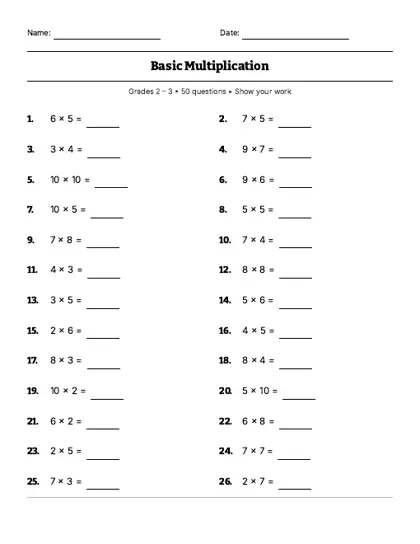
Multiplication facts worksheet: printable PDF with an answer key. · Make a fresh test
Multiplication practice · times tables · multiplication chart
Last reviewed
Questions parents ask
What is multiplication in simple words?
Multiplication is adding equal groups quickly. 3 × 4 means 3 groups of 4, which is 4 + 4 + 4 = 12.
What is the meaning of the × sign?
The × sign means “times” or “groups of”. 6 × 2 is read “6 times 2” and means 6 groups of 2.
What are factors and the product?
The numbers you multiply are factors. The answer is the product. In 4 × 5 = 20, 4 and 5 are factors and 20 is the product.
How do you explain multiplication to a child?
Use real objects in equal groups, such as 3 plates with 4 grapes each. Count them, then show that 4 + 4 + 4 and 3 × 4 give the same answer.
What grade do kids learn multiplication?
Children meet equal groups and arrays in grade 2 and learn multiplication and the times tables in grade 3.