
Properties of multiplication
The properties of multiplication are five rules that are always true. They make the times tables smaller to learn and big multiplications easy to break up.
The five properties at a glance
| Property | Kid-friendly name | Rule | Example |
|---|---|---|---|
| Commutative | Turn-around rule | Order does not matter | 4 × 7 = 7 × 4 |
| Associative | Grouping rule | With three factors, multiply any pair first | (2 × 5) × 7 = 2 × (5 × 7) |
| Distributive | Splitting rule | Split a factor, multiply each part, add | 6 × 7 = 6 × 5 + 6 × 2 |
| Identity | Times 1 rule | Any number × 1 stays the same | 9 × 1 = 9 |
| Zero | Times 0 rule | Any number × 0 is 0 | 9 × 0 = 0 |
See it: pictures to draw with your child
Copy these onto paper or a whiteboard. A quick sketch makes the idea concrete before any written method.
Commutative property: the turn-around rule
You can swap the factors and the product stays the same: 3 × 8 = 8 × 3 = 24. Turn an array on its side and you see why: the same dots, counted a different way.
Why it matters: there are 100 facts from 1 × 1 to 10 × 10, but because of this rule only about 55 are different. Once your child knows 4 × 9, they know 9 × 4.
Associative property: the grouping rule
With three numbers, you can multiply any two first: (2 × 5) × 7 = 2 × (5 × 7). Both are 70. Pick the pair that is easiest: 2 × 5 = 10, then 10 × 7 = 70.
It also explains tricks: 4 × 6 = (2 × 2) × 6 = 2 × (2 × 6), which is “double, then double again”, the trick for the 4 times table.
Distributive property: the splitting rule
You can split one factor into parts, multiply each part, and add the answers: 6 × 7 = 6 × 5 + 6 × 2 = 30 + 12 = 42. This is the most useful property of all. It turns hard facts into easy ones and is how children multiply big numbers: 23 × 4 = 20 × 4 + 3 × 4 = 80 + 12 = 92.
Try it with the array splitter: a red line cuts the array into two easier arrays.
In grades 6 and 7 the same rule works with letters: 3(x + 4) = 3x + 12. See the distributive property with variables.
Array splitter
Change the rows and columns, then move the split. The two parts always add up to the whole.
Identity property (× 1) and zero property (× 0)
Times 1: one group of 8 is just 8, so 8 × 1 = 8. Times 0: 8 groups of nothing is nothing, so 8 × 0 = 0. These two are easy to mix up with addition (8 + 0 = 8), so they have their own lesson: multiplying by 0 and 1.
Using the properties together
Real calculations often use two or three properties at once. Here are three to try with your child:
- 25 × 7 × 4: turn it around to 25 × 4 × 7, then group: (25 × 4) × 7 = 100 × 7 = 700.
- 8 × 27: split 27 into 20 and 7: 8 × 20 + 8 × 7 = 160 + 56 = 216.
- 5 × 13 × 2 × 0: one factor is 0, so the answer is 0 without any other work.
Asking “which rule makes this easier?” before calculating is a habit that pays off all the way to algebra.
Quiz: name the property
Choose the rule each equation shows, then check.
Where this fits: the first steps in multiplication
- What is multiplication
- Repeated addition
- Arrays
- Multiplication properties (this page)
- Multiplying by 0 and 1
- Multiplication strategies
- The times tables
- Practice the facts
What to say to your child
A short script for teaching it the first time. Pause after each line and let your child do the next step.
- “Is 3 × 6 the same as 6 × 3? Build both with blocks and check.” (Yes, 18.)
- “That is the turn-around rule. Now: 7 × 6 is hard. 5 × 6 is easy. What is it?” (30.)
- “And 2 × 6?” (12.) “7 is 5 and 2, so 7 × 6 is 30 + 12.” (42.)
- “What about 2 × 9 × 5? Which two would you do first?” (2 × 5 = 10, then 10 × 9 = 90.)
- “And 9 × 0?” (0: nine groups of nothing.)
More worked examples
Example 1: 8 × 6 by splitting
8 × 6 = 8 × 5 + 8 × 1 = 40 + 8 = 48.
Example 2: Grouping to make 10
5 × 3 × 2 = 3 × (5 × 2) = 3 × 10 = 30.
Example 3: Splitting a big number
14 × 6 = 10 × 6 + 4 × 6 = 60 + 24 = 84.
Practice questions (answers below)
Ask these out loud or write them down. Check each answer, and ask “how did you get that?” for one or two.
- Which property: 5 × 9 = 9 × 5?
- Which property: 7 × 1 = 7?
- Fill in: 6 × 8 = 6 × 5 + 6 × __
- Work out 4 × 2 × 5 the easy way.
- Which property: (3 × 2) × 4 = 3 × (2 × 4)?
- Use splitting: 9 × 7
- 12 × 0
- Use splitting: 13 × 4
Show the answers
- Commutative (turn-around)
- Identity (× 1)
- 3
- 4 × 10 = 40
- Associative (grouping)
- 9 × 5 + 9 × 2 = 45 + 18 = 63
- 0
- 10 × 4 + 3 × 4 = 40 + 12 = 52
Common mistakes
How to teach it at home
Lego arrays
Build a 4 × 6 rectangle of bricks and split it into 4 × 5 and 4 × 1.
Spot the easy pair
Give three numbers like 2, 7, 5 and ask which pair to multiply first.
Turn-around race
Say a fact; your child says its turn-around and the product.
By grade
- Grade 3 (3.OA.B.5): apply the commutative, associative and distributive properties as strategies.
- Grade 4: use the distributive property to multiply multi-digit numbers.
- Grade 6: write the properties with letters, for example a × b = b × a, and expand brackets like 3(x + 4) = 3x + 12 (see the distributive property with variables).
More for each grade: Grade 3 math and the CBSE class 3 maths guide; Grade 4 math and the CBSE class 4 maths guide.
Worksheets and practice
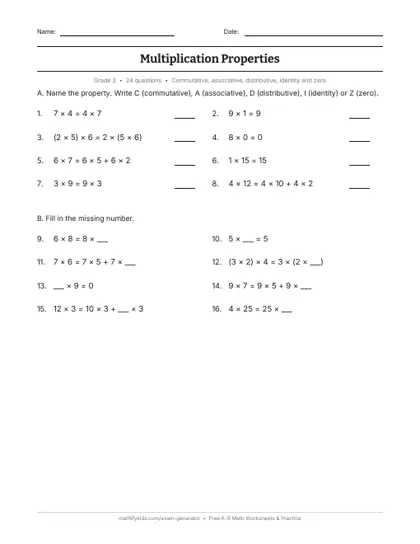
Multiplication properties worksheet: printable PDF with an answer key. · Make a fresh test
Multiplication practice · times tables · multiplication chart
Last reviewed
Questions parents ask
What are the properties of multiplication?
Commutative (order does not matter), associative (grouping does not matter), distributive (split a factor and add), identity (× 1 stays the same) and zero (× 0 is 0).
What is the commutative property of multiplication?
Swapping the factors does not change the product: 4 × 7 = 7 × 4 = 28.
What is the distributive property in simple words?
You can split a number into parts, multiply each part, and add: 6 × 7 = 6 × 5 + 6 × 2 = 42.
What is the associative property of multiplication?
When multiplying three numbers, you can multiply any two first: (2 × 5) × 7 = 2 × (5 × 7) = 70.
Why do kids learn multiplication properties?
They cut the number of facts to memorise, turn hard facts into easy ones, and are the basis of multi-digit multiplication and algebra.